In today’s digital world, acronyms dominate online conversations. If you’ve ever received a text saying “wdym” and felt confused, you’re not alone. This guide explains everything you need to know about WDYM, from its basic meaning to proper usage across different platforms.
What Is the Meaning of “wdym” in Text?
WDYM stands for “What Do You Mean?” It’s an acronym used in texting and online messaging when someone needs clarification about a statement they didn’t fully understand. This digital shortcut emerged in the late 2000s alongside SMS texting and instant messaging apps, helping people communicate faster on small keyboards.
Why People Use “wdym” Instead of Writing the Full Sentence?
Several practical reasons explain WDYM’s popularity:
Speed and Efficiency: Typing four letters beats typing 16 characters, especially during rapid conversations or on mobile devices.
Casual Tone: Abbreviations create an informal, friendly atmosphere that matches texting’s conversational style.
Digital Culture: For Gen Z and millennials, using internet slang is their natural communication style—it’s how they connect with peers online.
Multitasking: Quick abbreviations help you keep up with multiple conversations without losing momentum.
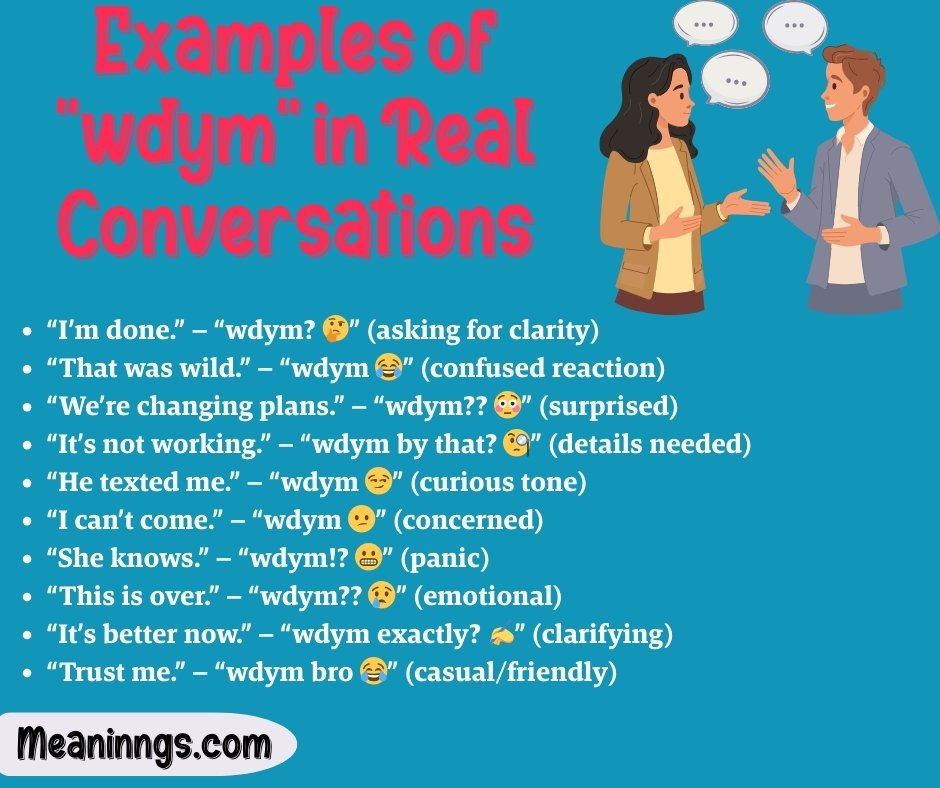
Examples of “wdym” in Real Conversations
Friendly Conversation
Person 1: “I might skip the party tonight.”
Person 2: “wdym? You were so excited yesterday!”
Surprised Tone
Friend 1: “I just adopted three cats.”
Friend 2: “WDYM three cats?! What happened to getting just one?”
Confused Tone
Classmate 1: “Remember to bring that thing tomorrow.”
Classmate 2: “wdym ‘that thing’? Can you be more specific?”
Clarifying a Statement
You: “I’m done with this.”
Friend: “wdym?”
You: “I meant I’m logging off early tonight!”
Playful/Ironic Tone
Friend 1: “I think pineapple belongs on pizza.”
Friend 2: “wdym??? Are you serious right now? 😂”
Different Emotional Tones Behind “wdym”
| Tone | How It Looks | What It Signals |
| Neutral/Curious | wdym? | Simple clarification request |
| Surprised | WDYM?! | Shock or disbelief |
| Annoyed | wdym. | Frustration (notice the period) |
| Playful | wdym lol | Lighthearted confusion |
| Upset | WDYM BY THAT | Defensive response |
Capitalization, punctuation, and emojis completely change how WDYM is interpreted.
Is “wdym” a Slang Term or Just an Abbreviation?
WDYM is technically an initialism—an abbreviation using the first letter of each word. However, it functions as internet slang because it belongs to informal online communication rather than professional contexts.
Is “wdym” Rude? (Important Social Insight)
Not necessarily, but context matters. WDYM itself is neutral—simply asking for clarification. However, it can seem rude depending on the situation:
Consider these examples:
Not Rude:
Friend: “Let’s reschedule our plans.”
You: “wdym? What day works better?”
Potentially Rude:
Manager: “We need better results from your team.”
You: “wdym”
How to Keep WDYM Polite:
- Add softening words: “Sorry, wdym?”
- Include emojis: “wdym? 🤔”
- Avoid using it in serious or professional conversations
- Write out the full phrase when in doubt
Where “wdym” Is Most Commonly Used
WDYM appears across various platforms:
- WhatsApp & Text Messaging: Everyday conversations with friends and family
- Instagram: DMs and Story replies
- Snapchat: Fast-paced, disappearing messages
- TikTok: Comment sections seeking context
- Discord: Gaming communities and casual servers
- Twitter/X: Reply threads questioning unclear tweets
Variations of “wdym” You Might See
WYM: “What You Mean?”—drops “do” for quicker typing
BC WDYM: “Because what do you mean?”—used after surprising statements
WDYMBT: “What Do You Mean By That?”—questions specific words
WDYM vs wdym vs WDYM: Capitalization shows different emotion levels
Related Slang Terms (LSI) Often Used With “wdym”
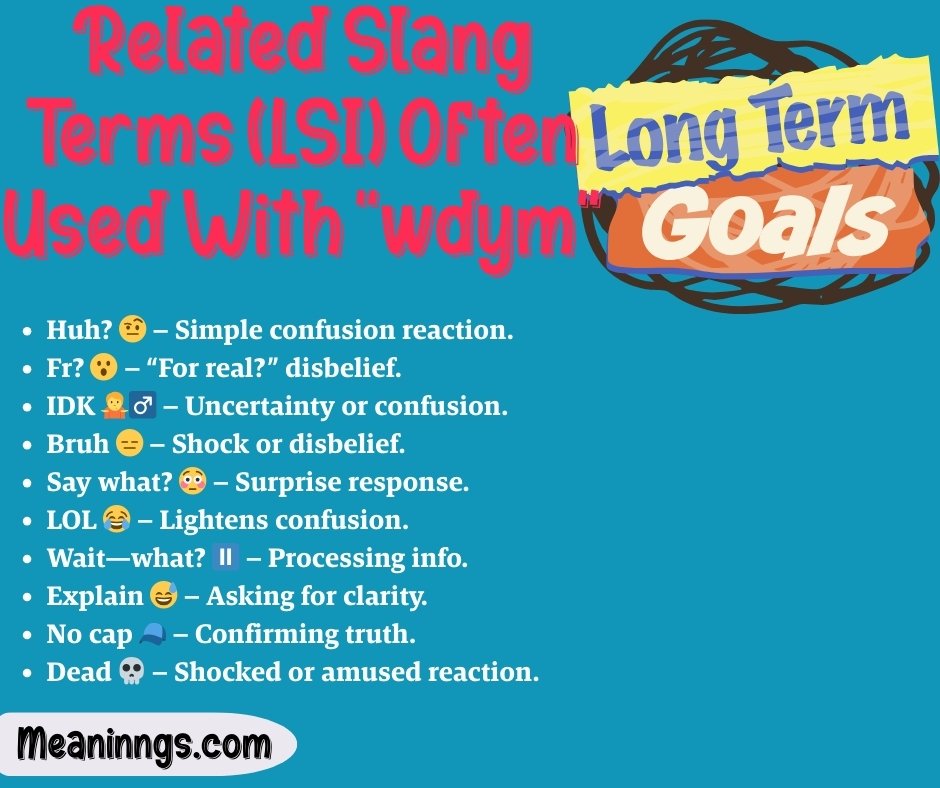
IDK (I Don’t Know): “wdym you’re leaving? idk what’s happening!”
TBH (To Be Honest): “wdym? tbh I thought you were joking”
NVM (Never Mind): “wdym? oh nvm I get it now”
WYD (What You Doing): Asks about activities, not clarification
WDYT (What Do You Think): Asks for opinions
IKWYM (I Know What You Mean): Shows understanding
How to Use “wdym” Properly in Your Own Texts?
Use it when something needs clarity
If a message is vague or confusing, WDYM signals you need more information.
Use it to react to a surprising statement
Express surprise while asking for elaboration: “WDYM?!”
Use it to express disbelief
Politely challenge statements that seem incorrect.
Use it to re-check someone’s message
Give the sender a chance to rephrase or correct typos.
Avoid using it in formal situations
Never use WDYM in:
- Professional emails
- Academic papers
- Job applications
- Communication with authority figures
- Serious personal conversations
Differences Between “wdym” and Similar Phrases
| Phrase | Meaning | When to Use |
| WDYM | What Do You Mean? | Any casual situation |
| WYM | What You Mean? | Very informal chats |
| WDYT | What Do You Think? | Seeking opinions |
| WYD | What You Doing? | Checking in |
Cultural Influence: Why “wdym” Became So Popular
Pop Culture: Justin Bieber’s 2015 song “What Do You Mean?” brought mainstream attention.
Mobile-First Communication: Smartphone keyboards made abbreviations necessary.
Social Media Evolution: Platforms like Twitter and Snapchat created environments where WDYM thrived.
Generational Styles: Gen Z and millennials grew up with texting as their native language.
Generational Differences in Understanding “wdym”
Gen Z (1997-2012): Native users who integrate WDYM naturally
Millennials (1981-1996): Early adopters, comfortable with usage
Gen X (1965-1980): Mixed familiarity
Baby Boomers (1946-1964): Generally less familiar
Adjust your communication based on your audience—write out “What do you mean?” for older recipients.
Advanced Breakdown: Linguistic Meaning of “wdym”
1. It’s a ‘compressed interrogative’
WDYM condenses a complete question into four letters while maintaining full meaning.
2. It relies heavily on context
WDYM is reactive—meaningless alone but powerful when responding to specific statements.
3. It reflects the ‘economy principle’ in language
Languages evolve toward efficiency. WDYM reduces 16 characters to 4—a 75% reduction.
4. It carries pragmatic meaning
WDYM signals confusion, requests elaboration, expresses surprise, or challenges statements depending on context.
Common Misinterpretations of “wdym”
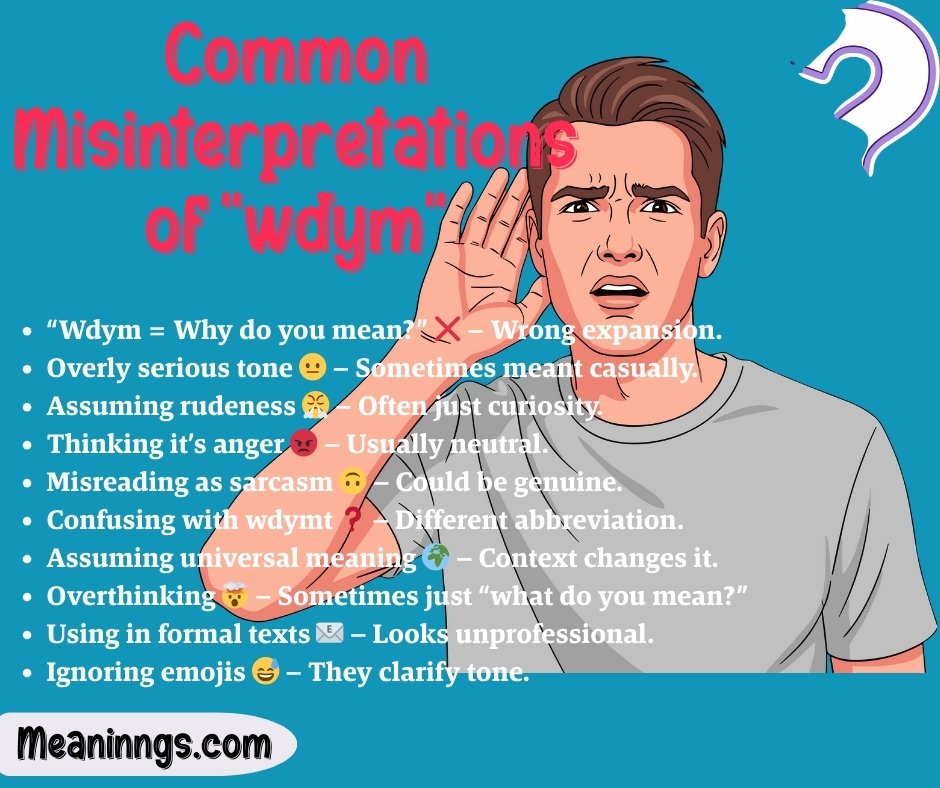
- Mistaking for a typo: Unfamiliar users think it’s a keyboard error
- Confusing with WDYT: Leads to mismatched responses
- Missing emotional tone: Text lacks inflection, so intent gets lost
- Age-related confusion: Older recipients may not understand at all
Add context when needed: “Sorry, wdym by that?”
How To Reply When Someone Says “wdym”?
If they’re confused
Clarify your statement: “I meant we should meet at 5 PM, not 5 AM!”
If they’re asking for clarification
Provide details: “What I meant was we need to finish by Friday.”
If they seem surprised
Explain the unexpected: “Yeah, I really am moving to Japan!”
If they seem upset
Address concerns: “I’m sorry if that came across wrong. Let me explain…”
If you want to keep it short
Quick expansion: “Autocorrect fail, I said beach not bench”
Is “wdym” Appropriate in Formal Writing?
Absolutely not. WDYM has no place in formal contexts:
- Academic essays
- Business proposals
- Professional emails
- Cover letters
- Legal documents
Use complete phrases instead:
- “Could you please clarify?”
- “Would you mind explaining that further?”
- “I don’t quite understand your point.”
FAQ’s
What does “wdym” mean?
WDYM stands for “What Do You Mean?” used to ask for clarification.
Is “wdym” rude?
Not inherently, but context matters—it can seem rude in formal or serious situations.
Should I use “wdym” in formal writing?
No, it’s strictly for informal digital communication.
What’s the difference between “wym” and “wdym”?
Both mean the same; WYM is just quicker and slightly more casual.
How do I reply to “wdym”?
Clarify your previous statement with more details or context.
Conclusion
WDYM has become essential in digital communication, helping millions clarify confusion and maintain conversational flow. Whether texting friends or commenting on social media, this versatile acronym keeps conversations efficient and natural.
Remember to consider your audience, adjust tone with punctuation and emojis, and always use formal language professionally. As internet slang evolves in 2026, staying informed about common acronyms like WDYM keeps you connected and effective in digital interactions.

Muhammad Shoaib is a language-focused content writer and researcher at Meaninngs.com, where he explains the meaning of words, phrases, and text in a clear and reader-friendly way. His work focuses on simplifying language, uncovering context, and helping readers understand text with confidence and clarity.