Ever received a text that says “OTW” and found yourself confused about what it means? You’re not alone. This three-letter abbreviation has become one of the most common shortcuts in digital communication, appearing everywhere from casual texts to social media posts. Understanding what OTW means and how to use it correctly can improve your texting game and help you communicate more efficiently in today’s fast-paced digital world.
What Does OTW Mean?
OTW stands for “On The Way.” It’s a casual shorthand used to inform someone that you’re currently traveling to a location or heading toward them. When you text someone “OTW,” you’re essentially saying, “I’ve already left and I’m coming to meet you” or “I’m en route to our destination.”
This simple abbreviation saves time and keeps conversations flowing naturally. Instead of typing out the full phrase every time, three quick letters convey the same message with perfect clarity.
The abbreviation works across all messaging platforms, including text messages, WhatsApp, Instagram DMs, Snapchat, and even professional communication tools like Slack in more casual work environments.
Why OTW Became So Popular in Texting
The rise of OTW can be traced back to the early 2000s when SMS texting became mainstream. During this era, mobile phones had character limits (typically 160 characters per message), and typing on small keypads was slow and cumbersome. People naturally started shortening common phrases to save time and effort.
Several factors contributed to OTW’s popularity:
Speed and Efficiency: Three letters communicate a complete thought instantly. When you’re driving, walking, or multitasking, OTW is far easier to type than a full sentence.
Universal Understanding: Unlike some obscure slang terms, OTW has become widely recognized across age groups and regions, making it a reliable communication tool.
Casual Tone: The abbreviation keeps conversations light and friendly, matching the informal nature of modern digital communication.
Platform Versatility: OTW works equally well in text messages, social media comments, gaming chats, and instant messaging apps.
As smartphones became more sophisticated and messaging apps like WhatsApp and iMessage gained popularity, abbreviations like OTW became even more embedded in our daily communication habits.
Common Situations Where “OTW” Is Used
1. Meeting Someone
This is perhaps the most common use case for OTW. When you’re meeting friends, family, or colleagues at a specific location, texting “OTW” lets them know you’ve left and are actively traveling toward them.
Example: “Just left the house, OTW to the coffee shop!”
2. Running Late
When you’re behind schedule, OTW serves as a quick update that reassures the other person you’re making progress toward meeting them.
Example: “Sorry, traffic is crazy but I’m OTW. Should be there in 10 minutes.”
3. Pickups and Drop-offs
Parents picking up kids from school, friends coordinating rides, or carpooling situations frequently use OTW to provide real-time location updates.
Example: “OTW to pick you up from the airport. Text me when you land!”
4. Food or Package Delivery
Delivery drivers, food couriers, and even friends dropping off items use OTW to notify recipients that their order or package is en route.
Example: “Your food is OTW. Driver should arrive in 15 mins.”
5. Gaming
In multiplayer online games, players use OTW to signal they’re moving toward a specific location or coming to help teammates during missions or battles.
Example: “Base under attack! OTW to defend.”
6. Work Chats
In casual work environments, colleagues use OTW in internal messaging apps to update team members about their arrival to meetings or the office.
Example: “OTW to the conference room, starting in 5.”
7. Travel Updates
When traveling longer distances, people use OTW to inform others they’ve begun their journey, whether it’s a road trip, flight connection, or train ride.
Example: “Just boarded the train, OTW back home!”
Is OTW Formal or Informal?
OTW is decidedly informal. It falls into the category of casual texting slang and should primarily be used in relaxed, friendly conversations with people you know well.
When to Use OTW:
- Texting friends and family
- Casual conversations with peers
- Social media comments and captions
- Gaming communities
- Informal workplace chats (in relaxed company cultures)
When to Avoid OTW:
- Formal emails to clients or superiors
- Business correspondence
- Academic writing
- Professional presentations
- First-time communications with someone you don’t know well
In professional or formal settings, it’s better to write out the full phrase: “I’m on my way to the meeting” or “I’m heading to your office now.” This shows respect, professionalism, and ensures clarity with recipients who might not be familiar with texting abbreviations.
OTW Meaning in Text vs OTW Meaning on Social Media
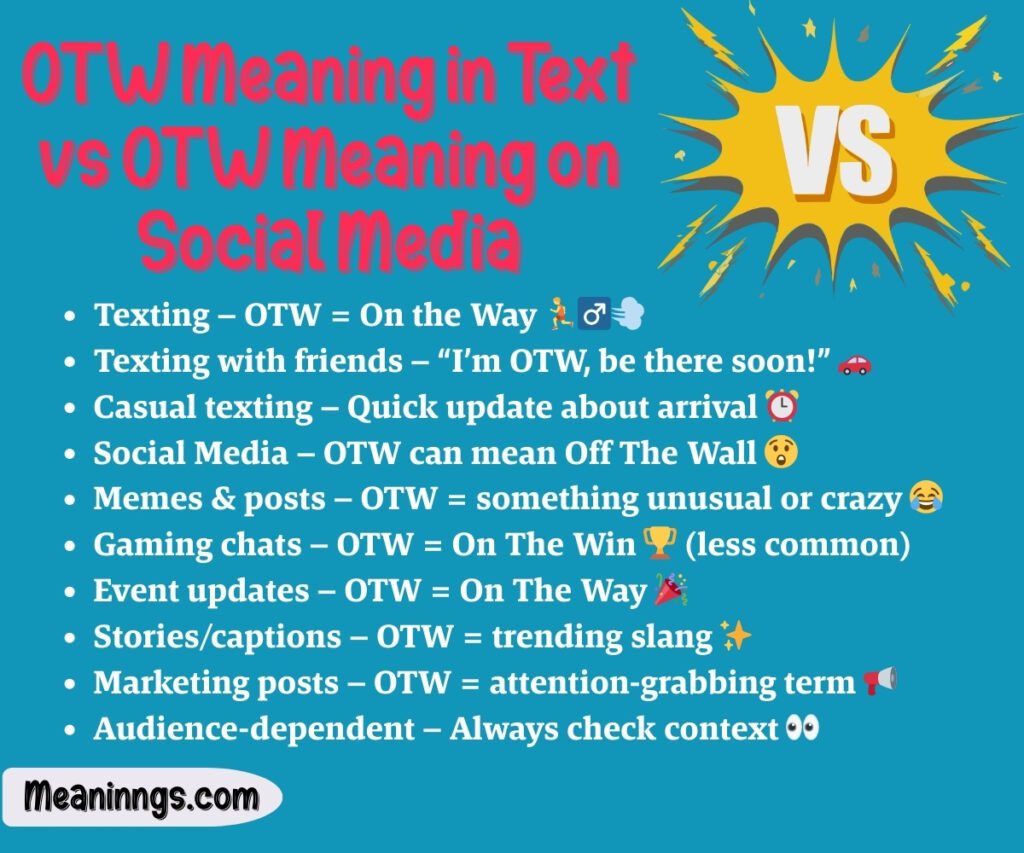
While OTW primarily means “On The Way” across all platforms, its usage and context can vary slightly between private texts and public social media.
In Text Messages:
- Direct, functional communication
- Usually one-to-one updates
- Immediate, time-sensitive information
- Often followed by estimated arrival times
On Social Media:
- More casual and expressive
- Often used in captions to show excitement
- Can be paired with emojis and location tags
- Sometimes used humorously or sarcastically
Social Media Examples:
- Instagram caption: “OTW to the beach! 🌊☀️”
- TikTok comment: “OTW to watch this for the 100th time 😂”
- Twitter post: “OTW to make the biggest mistake of my life (going to the gym)”
On platforms like Instagram and TikTok, OTW has evolved beyond its literal meaning to express anticipation, excitement, or even sarcastic commentary on situations.
Emotional Tone Behind OTW
The emotional tone of OTW can vary significantly based on context, punctuation, and accompanying elements:
Neutral/Informative: “OTW” – Simple, straightforward update
Excited: “OTW!!” or “OTW! Can’t wait to see you!” – Enthusiasm and anticipation
Apologetic: “So sorry, OTW now…” – Running late, expressing regret
Urgent: “OTW NOW” or “OTW ASAP” – Time-sensitive, hurried
Casual: “otw” (lowercase) – Relaxed, very informal tone
Adding emojis can also change the emotional flavor: 🚗 (literally traveling), 😊 (happy), 😅 (rushed or apologetic), or 🏃 (hurrying).
Extended Meanings of OTW (Less Common)
While “On The Way” is the dominant meaning, OTW can occasionally have alternative interpretations:
Off To Work: Some people use OTW to mean they’re heading to their job. However, this meaning is far less common and can cause confusion. If using OTW this way, provide context: “OTW to work, talk later.”
Off The Wall: In certain contexts, particularly pop culture references, OTW can mean something is crazy, unusual, or unbelievable. This usage is rare in everyday texting.
Over The Weekend: Very occasionally used as shorthand for weekend plans, though this is not standard.
In Gaming (FIFA): OTW can refer to special player cards that are “Ones To Watch,” expected to improve in value.
In 98% of everyday usage, OTW means “On The Way.” Context usually makes the intended meaning clear, but when in doubt, the location-based interpretation is safest.
How to Use OTW Correctly (With Examples)
Example 1: Meeting a Friend
Scenario: Your friend asks where you are.
Their message: “Hey, are you close?”
Your reply: “OTW! Just left my place, should be there in 15 mins.”
Example 2: After Running Late
Scenario: You’re delayed but making progress.
Your message: “Sorry for the wait! Got stuck at work but I’m OTW now.”
Example 3: Delivery
Scenario: You’re bringing food to a friend’s house.
Your message: “Pizza acquired ✅ OTW to your place!”
Example 4: Work Update
Scenario: Informal update to team members.
Your message: “OTW to the office, grabbing coffee first. Anyone want anything?”
Example 5: Relationship Context
Scenario: Texting your partner after a long day.
Your message: “Finally done with meetings! OTW home, can’t wait to see you 💕”
How NOT to Use OTW
Avoid in Formal Contexts: ❌ “Dear Mr. Johnson, I’m OTW to your office for our 3pm meeting.” ✅ “Dear Mr. Johnson, I’m on my way to your office and expect to arrive by 3pm.”
Don’t Use Without Context in Ambiguous Situations: ❌ “OTW” (when the recipient doesn’t know where you’re going) ✅ “OTW to the restaurant we talked about!”
Avoid Overuse: ❌ Sending “OTW” multiple times in the same conversation ✅ Send once with an update if timing changes significantly
Don’t Assume Everyone Understands: ❌ Using OTW with older relatives or international contacts unfamiliar with English slang ✅ Write out “On my way” for clarity
Variations & Synonyms of OTW
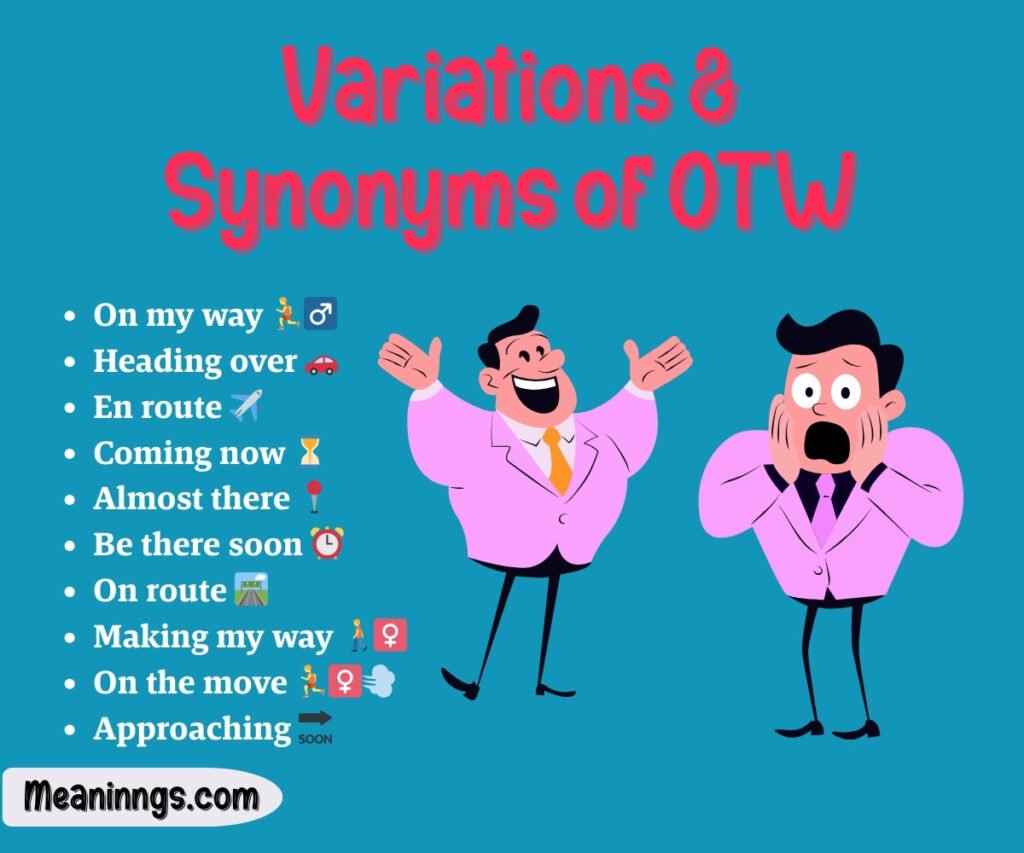
Several alternatives convey similar meanings with slightly different tones:
| Abbreviation | Meaning | Tone |
| OMW | On My Way | Personal, friendly |
| ETA | Estimated Time of Arrival | Professional, specific |
| BRB | Be Right Back | Casual, temporary absence |
| BTS | Be There Soon | Friendly, reassuring |
| Coming | – | Simple, direct |
| En route | – | Formal, professional |
| Heading there | – | Natural, conversational |
Full Phrase Alternatives:
- “I’m on my way”
- “Almost there”
- “Just left, see you soon”
- “In transit”
- “Rolling out now”
OTW vs OMW — What’s the Difference?
This is one of the most frequently asked questions about texting abbreviations. Both acronyms mean essentially the same thing, but there are subtle differences:
OTW (On The Way):
- Can refer to yourself or others
- Slightly more neutral
- Can describe objects: “Your package is OTW”
- More versatile in describing anything in transit
OMW (On My Way):
- More personal and specific to the speaker
- Emphasizes individual movement
- Always refers to the person texting
- Slightly more common in everyday use
Examples Showing the Difference:
OTW: “The delivery driver is OTW to your house.” (about someone else)
OMW: “I’m OMW to your house.” (about yourself)
OTW: “Your order is OTW.” (about an object)
OMW: “I’m OMW with your order.” (personal involvement)
In practice, most people use these interchangeably when talking about themselves. The distinction is minimal, and both are widely understood. Choose whichever feels more natural to you.
Cultural & Linguistic Insight
OTW has transcended language barriers and become globally recognized, particularly in English-speaking countries and among younger generations worldwide.
Regional Variations:
- United States & Canada: OTW is widely used and immediately understood across all age groups familiar with texting.
- United Kingdom: Common, though some prefer OMW for personal usage.
- Australia: Popular in casual communication, particularly among millennials and Gen Z.
- Asia: Increasingly common in regions with strong English influence or among bilingual populations.
- Non-English Countries: Often adopted directly without translation due to global digital culture.
Generational Differences:
- Gen Z and Millennials: Use OTW fluently and frequently
- Gen X: Generally familiar, use occasionally
- Baby Boomers: May not understand without context
The global spread of messaging apps and social media has made abbreviations like OTW part of a universal digital language that crosses cultural boundaries.
Why Understanding OTW Improves Communication
Knowing modern texting abbreviations like OTW enhances your digital literacy and makes communication more effective:
Saves Time: Quick updates keep conversations flowing without lengthy typing.
Reduces Misunderstandings: Clear, recognized abbreviations prevent confusion about your status or location.
Shows Cultural Awareness: Using appropriate slang demonstrates you’re comfortable with modern communication styles.
Improves Coordination: Real-time updates help others plan around your arrival.
Builds Rapport: Speaking the same digital “language” as your peers creates connection and understanding.
In professional contexts where informal communication is accepted, using OTW appropriately shows you can adapt to different communication styles while maintaining efficiency.
Sample Sentences Using “OTW”
Casual Friendship:
- “OTW to grab those concert tickets! So pumped!”
- “Running late but OTW, save me a seat?”
Family Communication:
- “OTW home from work, need anything from the store?”
- “Kids are ready, OTW to school drop-off”
Dating/Relationships:
- “Just finished getting ready, OTW to pick you up 😊”
- “OTW back from the gym, want to grab dinner?”
Professional (Casual):
- “OTW to the meeting room, starting in 2”
- “Grabbing lunch, OTW back in 20”
Group Coordination:
- “OTW to the party! Who else is there already?”
- “Just parked, OTW up to the apartment now”
Advanced Usage: OTW in Professional Settings
While OTW is primarily informal, it can appear in certain professional contexts:
Acceptable Professional Use:
- Internal team chats in casual company cultures
- Quick updates on Slack or Microsoft Teams
- Informal coordination among peers
- Startups and creative industries with relaxed communication norms
Best Practices:
- Always consider your company culture first
- Use full phrases when communicating with clients or senior leadership
- Add context and estimated arrival times
- Follow up with more detailed communication if needed
Professional Alternatives:
- “I’m en route to the office”
- “Currently heading to the meeting”
- “In transit, ETA 3:15pm”
- “On my way, should arrive shortly”
The Psychology Behind OTW
Why do abbreviations like OTW resonate so strongly with users?
Efficiency Mindset: Modern life moves fast. OTW allows people to communicate movement without breaking stride.
Social Reassurance: Receiving “OTW” provides psychological comfort that someone is actively coming, reducing anxiety about delays or no-shows.
Digital Intimacy: Using shared slang creates in-group belonging and strengthens social bonds.
Reduced Effort: In an age of constant communication, shortcuts prevent message fatigue while maintaining connection.
Immediate Gratification: Quick updates satisfy the modern expectation for instant information.
These psychological factors explain why OTW has remained popular even as other slang terms fade away.
Common Mistakes People Make With OTW
Mistake #1: Using OTW Before Actually Leaving Don’t say “OTW” if you’re still getting ready. This creates false expectations about your arrival time.
Mistake #2: Sending OTW Without Destination Context If the recipient doesn’t know where you’re headed, OTW alone causes confusion.
Mistake #3: Overusing in Formal Settings Sending OTW to your boss, professor, or client can appear unprofessional.
Mistake #4: No Follow-Up When Plans Change If you get delayed after sending OTW, update the person. Silence after OTW is frustrating.
Mistake #5: Using Lowercase “otw” in Professional Contexts While lowercase is fine among friends, it looks too casual in work settings.
How to Reply When Someone Says OTW?
Your response to OTW depends on the context and your relationship with the sender:
Acknowledgment:
- “Ok!”
- “Thanks for letting me know”
- “👍”
Appreciation:
- “Great, see you soon!”
- “Perfect timing!”
- “Thanks! Drive safe!”
Additional Information:
- “No rush, take your time”
- “I’ll be ready when you get here”
- “Meet you at the entrance”
Humorous/Friendly:
- “Finally! 😂”
- “Can’t wait!”
- “Hurry up! 🏃”
Professional:
- “Sounds good, see you shortly”
- “Thanks for the update”
- “I’ll be in the conference room”
The key is matching the tone of the original message while providing any necessary additional information.
OTW in Pop Culture & Social Media Trends
OTW has found its way into pop culture and online trends:
Music Reference: “OTW” is the title of a 2018 song by Khalid, featuring 6LACK and Ty Dolla $ign, which further popularized the abbreviation.
TikTok Trends: Users create humorous videos with captions like “POV: You said OTW 20 minutes ago but you’re still in bed.”
Meme Culture: OTW appears in relatable memes about running late, procrastination, or exaggerating how close you are to arriving.
Instagram Captions: Influencers and regular users alike use OTW to build anticipation for events, trips, or meetups.
Twitter Humor: Tweets often play with OTW in sarcastic or exaggerated ways: “Me: OTW to make bad decisions” or “Sleep: OTW to ruin my morning plans.”
These cultural references keep OTW relevant and continuously introduce it to new users.
FAQ’s
1. What is the real OTW meaning in text?
OTW means “On The Way” – it tells someone you’re traveling to a location or heading toward them.
2. Is OTW and OMW the same?
Yes, they’re nearly identical. OMW emphasizes you personally are coming, while OTW can refer to anyone or anything in transit.
3. Can I use OTW in professional messages?
Only in casual work environments. For formal communication, write out “I’m on my way” or “heading there now.”
4. Does OTW mean I already left?
Typically yes. OTW implies you’ve started traveling, not that you’re still preparing to leave.
5. What’s the best reply to OTW?
Simple acknowledgments work best: “See you soon!”, “Thanks!”, “Drive safe!”, or just “👍”.
Conclusion
Understanding OTW and using it appropriately can significantly improve your digital communication skills. This simple three-letter abbreviation has become an essential part of modern texting language, helping millions of people coordinate meetings, update friends and family, and keep conversations efficient.
Remember that OTW works best in casual, informal settings with people who understand texting slang. When communicating professionally or with those unfamiliar with abbreviations, opt for complete phrases to ensure clarity and maintain appropriate tone.

Muhammad Shoaib is a language-focused content writer and researcher at Meaninngs.com, where he explains the meaning of words, phrases, and text in a clear and reader-friendly way. His work focuses on simplifying language, uncovering context, and helping readers understand text with confidence and clarity.
Pingback: LFG Meaning in Text and Social Media: Full Explanation 2026