
If you’ve been scrolling through TikTok, checking your Instagram DMs, or catching up on Twitter threads lately, you’ve probably stumbled across “MFS” and wondered what it actually means. You’re definitely not alone. This three-letter acronym has taken over social media, appearing in everything from memes to casual group chats. Understanding what MFS stands for can help you navigate modern digital conversations with confidence and avoid awkward misunderstandings.
In this comprehensive guide, we’ll break down the MFS meaning in text, explore its various uses, and help you understand when it’s appropriate to use this popular slang term in 2026.
What Does MFS Mean in Text?
The primary meaning of MFS in text is “motherf*ckers.” While this might sound harsh at first, the way people actually use it online is far more nuanced than you might think.
In modern digital communication, MFS has evolved beyond its literal definition. It’s become a casual way to refer to “people,” “guys,” or “folks” in informal conversations. The tone can range from playful teasing to genuine frustration, depending entirely on context.
For example, when someone texts “mfs really think they can skip the line,” they’re not necessarily being aggressive. They’re simply making a casual observation about people’s behavior in a way that resonates with internet culture.
Quick Definition
MFS = Motherf*ckers (but commonly used to mean “people” or “those guys” in a casual, often humorous context)
The Emotional Power Behind MFS in Texting
What makes MFS so popular in digital communication isn’t just its brevity—it’s the emotional punch it delivers. This abbreviation carries an intensity that simple words like “people” or “folks” can’t match.
Users leverage MFS to add emphasis, humor, or relatability to their messages. The term has become a linguistic tool that expresses:
- Exasperation: “Mfs really forgot my birthday again 😭”
- Amusement: “Mfs when they realize it’s Monday tomorrow 💀”
- Camaraderie: “These mfs always have my back”
- Sarcasm: “Mfs acting like they invented the internet”
The emotional versatility of MFS is precisely why it’s become such a staple in Gen Z and millennial communication styles.
Common Interpretations of MFS Meaning in Text
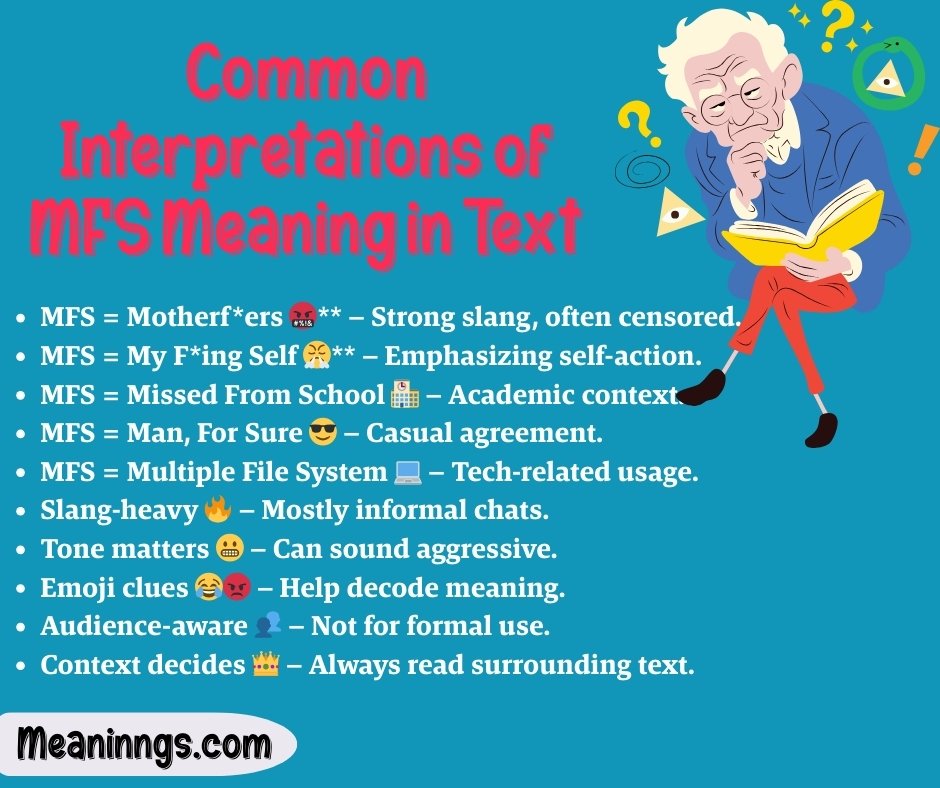
While MFS primarily stands for one phrase, the way it’s interpreted varies based on context, tone, and relationship dynamics. Let’s explore the different ways people use and understand MFS in their daily texting.
MFS as an Expression of Surprise
When something unexpected happens, MFS often pops up in texts as a way to express disbelief or shock. The surprise can be positive or negative.
Example: “MFS actually showed up on time for once 😂”
In this context, the sender is genuinely surprised but in a lighthearted, teasing way.
MFS Used Humorously
Perhaps the most common use of MFS in 2026 is for comedic effect. It’s become integral to meme culture and humorous observations about everyday life.
Example: “Mfs be like ‘I’m different’ and then do exactly what everyone else does 💀”
This usage capitalizes on the term’s bluntness to deliver punchlines that resonate with online audiences.
MFS Showing Frustration or Anger
Sometimes MFS does express genuine annoyance or frustration, though even then it’s often softened by emojis or casual language.
Example: “These mfs at work keep asking me the same questions 😤”
The frustration is real, but the informal slang keeps the tone from becoming too serious or aggressive.
MFS as Admiration or Awe
Surprisingly, MFS can also convey positive emotions like admiration or respect, especially when someone does something impressive.
Example: “These mfs really pulled off that performance 🔥”
Context and accompanying emojis help signal that this is praise rather than criticism.
Is MFS Always Offensive? Let’s Clear the Confusion
Here’s the million-dollar question: Is MFS inherently offensive? The answer is nuanced.
Technically, yes—MFS abbreviates profanity, which many consider inappropriate in formal settings. However, in practice, its offensiveness depends heavily on:
Context Matters Most
Among close friends who regularly use casual slang, MFS is rarely considered offensive. It’s simply part of the digital vernacular. However, using it with:
- Elders or authority figures: Likely inappropriate
- Professional colleagues: Definitely unprofessional
- Strangers: Could be misinterpreted
- Close friends: Generally acceptable
The Role of Tone
Online, tone is conveyed through emojis, context, and relationship dynamics. MFS paired with laughing emojis (😂💀😭) signals humor rather than hostility. Without these visual cues, the term can seem more aggressive than intended.
Cultural and Generational Differences
Younger users (teens through late twenties) tend to view MFS as mild slang rather than serious profanity. Older generations may find it more offensive. This generational gap in perception is crucial to understanding when MFS is appropriate.
MFS Meaning in Text vs Social Media
The way MFS appears in private texts versus public social media posts reveals interesting patterns about modern communication.
In Private Messages
In WhatsApp, iMessage, or direct messages, MFS tends to be more personal and context-specific. Friends use it as shorthand for shared frustrations or inside jokes.
Example: “Mfs in our group chat never respond when we’re trying to make plans 😒”
On Social Media Platforms
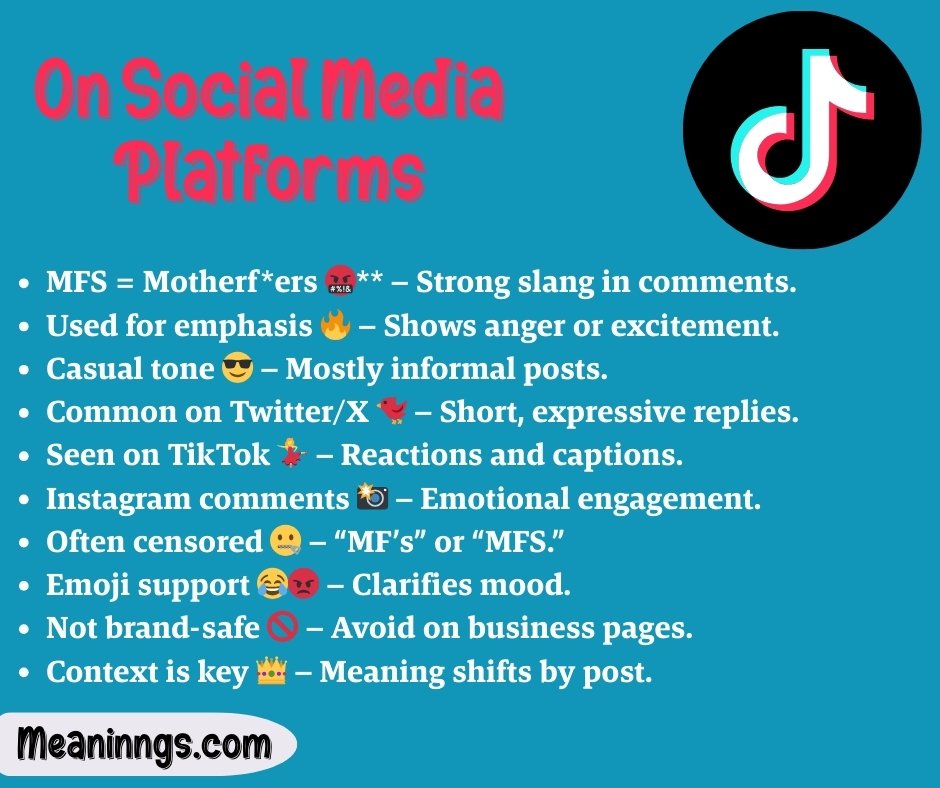
On Twitter, TikTok, and Instagram, MFS often appears in:
- Meme captions: “Mfs when the WiFi goes out for 2 seconds” (followed by a dramatic reaction image)
- Viral trends: “Mfs be like” templates
- Commentary: Sarcastic observations about common behaviors
According to social media analytics, MFS appears in over 220,000 tweets daily as of 2026, often paired with emojis like 😂, 💀, or 😭 that signal humorous intent rather than aggression.
How MFS Evolved in Digital Language
The journey of MFS from taboo phrase to mainstream slang tells us a lot about how language evolves online.
Early Internet Era
In the early 2000s, internet forums and instant messaging platforms like AIM and MSN Messenger popularized abbreviations as a way to communicate faster. Strong language was often abbreviated to bypass content filters or simply to save time.
Rise of Social Media
As platforms like Twitter with character limits gained popularity, abbreviations became essential. MFS emerged as a convenient shorthand that packed emotional punch into just three letters.
Meme Culture Explosion
By the mid-2010s, MFS had become firmly embedded in meme culture. The “MFS when…” format became a viral template for highlighting ironic or exaggerated behaviors.
2026 and Beyond
Today, MFS has achieved mainstream recognition among younger demographics. It’s evolved from purely profane to a versatile linguistic tool that can express everything from frustration to affection, depending on context.
Different Ways MFS Appears in Text
MFS isn’t always typed the same way. These variations can affect tone and meaning:
- mfs: Lowercase, casual, most common
- MFS: All caps, emphasizing emotion or volume
- mfs💀: With skull emoji, indicating something is hilariously relatable
- these mfs: More specific, referring to particular people
- mf’s: Alternative spelling, though less common
Examples of MFS in Real Conversations
Seeing MFS in action helps clarify its various uses. Here are authentic examples from different contexts:
Friend Group Chat:
- Person A: “mfs really woke me up at 7am on a Saturday 😭”
- Person B: “that’s wild 😂 who does that”
Twitter/X Thread: “Mfs be like ‘I’m on a diet’ and then order three desserts 💀”
Instagram Caption: “These mfs when they see their crush 😂” (attached to a funny video)
Gaming Discord: “Mfs out here camping in corners the whole game 🙄”
TikTok Comment: “Mfs really think they can dance to anything 😭😭”
MFS Meaning in Text Compared to Similar Slang
To better understand MFS, let’s compare it to similar internet slang terms.
| Term | Stands For | Primary Use | Tone |
| MFS | Motherf*ckers | Referring to people (plural) | Variable: humorous, frustrated, sarcastic |
| MF | Motherf*cker | Referring to one person | Usually more direct/harsh |
| FFS | For F*ck’s Sake | Expressing frustration | Annoyed, exasperated |
| SMH | Shaking My Head | Showing disappointment | Disapproving, resigned |
| LMAO | Laughing My Ass Off | Finding something hilarious | Purely humorous |
| Bruh | Brother/Bro | Expressing disbelief | Casual, resigned |
Key Difference: Unlike FFS or SMH which have singular emotional registers, MFS is remarkably versatile. It can be playful, frustrated, admiring, or sarcastic—all depending on context.
When Should You Use MFS in Texting?
Knowing when to use MFS is just as important as understanding what it means. Here’s a practical guide:
✅ Appropriate Contexts
- Casual conversations with close friends who share your communication style
- Memes and humorous content where the tone is clearly playful
- Private group chats where everyone understands the slang
- Social media posts targeting younger, informal audiences
- When expressing relatable frustrations in a lighthearted way
❌ Inappropriate Contexts
- Professional emails or work communications of any kind
- Messages to teachers, professors, or supervisors
- Conversations with elders or family members who may find it disrespectful
- Formal social media accounts (business pages, professional profiles)
- When communicating with strangers who might misinterpret your tone
- Public comments where diverse audiences might see them
Alternative Options
When MFS seems too strong, consider these alternatives:
- “People”: Neutral and universally appropriate
- “Folks”: Friendly and casual without profanity
- “These guys”: Informal but inoffensive
- “They”: Simple and context-appropriate
Cultural Context and Linguistic Insight
Understanding MFS requires appreciating its cultural roots and linguistic significance.
Origins in AAVE
MFS and similar terms have strong connections to African American Vernacular English (AAVE), where expressive language and creative abbreviations have long been integral to communication. As these terms crossed into mainstream internet culture, they sometimes lost connection to their origins.
Global Digital Culture
While MFS originated in English-speaking communities, its use has spread globally through social media. However, cultural differences affect how it’s received. What’s casual slang in one culture might be seriously offensive in another.
Linguistic Evolution
The transformation of MFS from pure profanity to multi-functional slang demonstrates how digital communication accelerates language evolution. Terms can shift meaning, tone, and appropriateness within just a few years.
Why Understanding MFS Meaning in Text Matters?
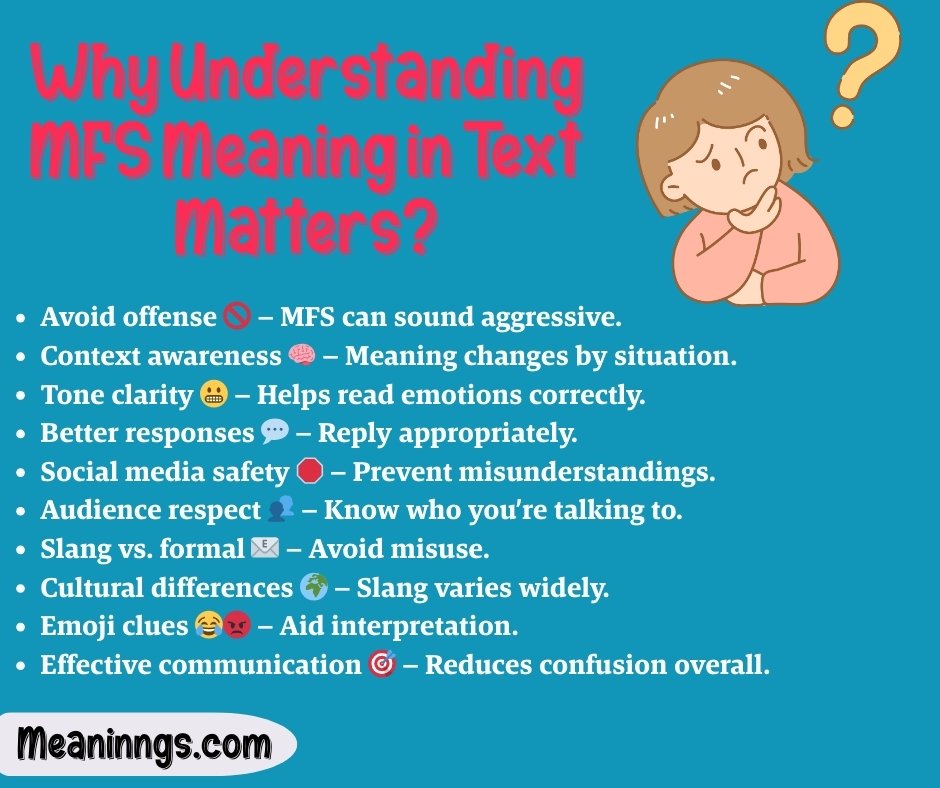
You might wonder why it’s worth understanding slang like MFS. Here’s why it matters in 2026:
Effective Communication
Misunderstanding slang can lead to awkward situations or misinterpreted intentions. Knowing what MFS means helps you respond appropriately.
Cultural Fluency
Language evolves constantly, especially online. Understanding current slang keeps you culturally fluent and able to engage with diverse communities.
Avoiding Offense
Using MFS inappropriately can offend people or damage your reputation. Knowing when not to use it is as important as knowing what it means.
Generational Connection
For parents, teachers, or anyone working with younger people, understanding their communication style builds stronger connections and trust.
MFS and Emotional Intelligence in Texting
Using slang like MFS effectively requires emotional intelligence—the ability to read context, understand your audience, and adjust your communication accordingly.
Reading the Room (Digitally)
Before using MFS, consider:
- Who will see this message?
- What’s our relationship like?
- What tone am I trying to convey?
- Could this be misunderstood?
Tone Indicators
Smart communicators pair MFS with context clues:
- Emojis: 😂💀😭 signal humor; 😤😒 indicate genuine frustration
- Punctuation: Excessive exclamation marks or all caps affect perception
- Follow-up messages: Clarifying tone if there’s any doubt
Adapting Communication Style
Emotional intelligence means switching between communication styles based on context. You might use MFS freely with friends but switch to formal language in professional settings—and that’s perfectly appropriate.
Frequently Asked Questions
What does MFS stand for in texting?
MFS stands for “motherf*ckers,” though it’s commonly used to casually refer to people or groups in informal digital communication.
Is MFS always offensive?
Not necessarily. While it originates from profanity, context and relationship determine offensiveness. Among friends using casual slang, it’s typically not offensive, but in formal or unfamiliar contexts, it can be inappropriate.
Can I use MFS in professional settings?
No, MFS should never be used in professional communication, emails, or workplace conversations as it’s considered unprofessional regardless of context.
What’s the difference between MFS and MF?
MFS is plural (referring to multiple people) while MF is singular (referring to one person). MFS also tends to be slightly less harsh in casual usage.
Where did MFS originate?
MFS evolved from internet and texting culture in the early 2000s, gaining popularity on platforms like Twitter and TikTok as a way to abbreviate strong language for faster communication.
What emojis are commonly used with MFS?
The most common emojis paired with MFS are 😂 (laughing), 💀 (skull/dying of laughter), 😭 (crying/laughing), and 😤 (frustrated), which help convey the intended tone.
Is MFS popular on TikTok?
Yes, MFS is extremely popular on TikTok, appearing in captions, comments, and viral trends, particularly in the “MFS when…” meme format.
Are there alternatives to using MFS?
Yes, safer alternatives include “people,” “folks,” “these guys,” “they,” “bruh,” or “squad,” depending on the context and desired tone.
Conclusion
Understanding MFS meaning in text is essential for navigating digital communication in 2026. While this three-letter acronym technically stands for “motherf*ckers,” its actual usage spans a wide spectrum—from playful humor to genuine frustration, from casual observations to affectionate teasing.
The key takeaway? Context is everything. MFS isn’t inherently good or bad—its appropriateness depends entirely on who you’re talking to, what platform you’re using, and what tone you’re trying to convey. Among close friends in casual settings, it’s just another part of modern slang. In professional environments or with unfamiliar audiences, it’s best avoided entirely.

Muhammad Shoaib is a language-focused content writer and researcher at Meaninngs.com, where he explains the meaning of words, phrases, and text in a clear and reader-friendly way. His work focuses on simplifying language, uncovering context, and helping readers understand text with confidence and clarity.
Pingback: WSP Meaning in Text: Full Definition, Examples, and How to Reply
Pingback: IWK Meaning in Text: Slang Definition You Should Know