In today’s fast-paced digital world, text messaging has become our primary mode of communication. Among countless abbreviations flooding our screens, one particular acronym carries genuine emotional weight: IMY.
Whether you’ve received this message from a close friend, romantic partner, or family member, understanding its meaning and proper usage can deepen your digital connections.
What Does IMY Mean in Text?
IMY stands for “I Miss You.” This simple three-letter acronym packs tremendous emotional significance into digital conversations. Unlike casual abbreviations like LOL or BRB, IMY expresses genuine longing, affection, and emotional connection.
When someone sends you IMY, they’re communicating that:
- You’re in their thoughts
- They wish you were physically present
- They value your relationship
- They’re experiencing emotional attachment
The beauty of IMY lies in its versatility—it works equally well between romantic partners, close friends, and family members separated by distance.
Origin of IMY: From Texts to Global Digital Culture
IMY emerged during the late 1990s and early 2000s as part of SMS language evolution. When text messaging first gained popularity, character limits forced users to create shorter versions of common phrases. Early platforms like:
- MSN Messenger
- AOL Instant Messenger (AIM)
- Yahoo Chat
- SMS text messaging
These platforms popularized IMY as efficient shorthand for expressing emotional closeness. The 160-character SMS limit particularly accelerated acronym adoption, making brevity essential for meaningful communication.
As smartphones evolved and messaging apps like WhatsApp, Instagram, and Snapchat dominated social interaction, IMY transcended its original purpose. It became a universally recognized expression of affection across global digital culture, transcending language barriers and age groups.
How IMY Is Used in Conversations
IMY appears in various conversational contexts, each carrying slightly different emotional tones:
Romantic Relationships:
- “IMY so much babe 😢 counting down until Friday”
- “Can’t wait to see you again ❤️ IMY”
Friendships:
- “It’s been forever since we hung out! IMY”
- “Remember our beach trip? IMY 🥺”
Family Connections:
- “Hope your day went well, IMY ❤️”
- “Miss you tons, mom. IMY”
Long-Distance Situations:
- “This apartment feels empty without you. IMY”
- “6 more weeks until vacation… IMY already”
Context significantly impacts how IMY is interpreted. Paired with emojis, it becomes warmer and more personal, helping convey the sender’s emotional state more accurately.
Common Variations of IMY
As digital communication evolved, several IMY variations emerged to express different intensity levels:
| Variation | Full Meaning | Usage Context |
| IMYT | I Miss You Too | Response to someone who said IMY first |
| IMYSM | I Miss You So Much | Expresses stronger, more intense longing |
| IMYM | I Miss You More | Playful, competitive expression of affection |
| IMY2 | I Miss You Too | Shorter version of IMYT for quick replies |
| IMYSFM | I Miss You So F***ing Much | Very intense, typically romantic contexts |
| IMYMTA | I Miss You More Than Anything | Extremely strong emotional expression |
These variations allow users to calibrate their emotional expression precisely, adding nuance to digital conversations that might otherwise feel flat or impersonal.
The Emotional Power of IMY
IMY carries significant psychological weight in modern communication. Research suggests that small affectionate messages like IMY:
- Strengthen social bonds across distances
- Reduce feelings of loneliness and isolation
- Improve mood and emotional well-being
- Maintain connection during physical separation
- Create emotional security in relationships
The acronym works because it bridges the gap between casual digital communication and genuine emotional expression. In an era where people often struggle to articulate feelings, IMY provides an accessible entry point for vulnerability.
For long-distance relationships especially, IMY serves as a crucial connector. Regular messages containing IMY help couples, friends, and families maintain intimacy despite geographical barriers. The frequency and context of these messages often correlate with relationship satisfaction and emotional closeness.
IMY vs ILY: What’s the Difference?
While both acronyms express affection, they occupy different emotional territories:
| Aspect | IMY (I Miss You) | ILY (I Love You) |
| Emotional Intensity | Moderate longing | Deep love and commitment |
| Usage Frequency | More casual, frequent | Reserved for significant moments |
| Relationship Stage | Any stage, including friendships | Typically romantic or very close family |
| Risk Level | Lower emotional risk | Higher vulnerability |
| Appropriate Recipients | Friends, family, partners | Romantic partners, parents, children |
Key Distinction: IMY focuses on absence and longing, while ILY declares commitment and deep affection. IMY is often the precursor to deeper expressions like ILY in developing relationships.
Many people use IMY when they’re not yet ready to say ILY, or when they want to express connection without the weight of romantic commitment. This makes IMY more flexible and widely applicable across different relationship types.
When to Use IMY (and When Not To)
Perfect Times to Use IMY:
✅ After quality time together – “Had such a great weekend! Already IMY”
✅ During physical separation – “First day at my new job… IMY everyone back home”
✅ Responding to nostalgia – “Remember that road trip? IMY those days”
✅ Maintaining long-distance relationships – “Good morning from across the country! IMY”
✅ Expressing genuine emotion – “Saw something that reminded me of you. IMY”
✅ Reconnecting after silence – “Been too long since we talked. IMY”
When to Avoid IMY:
❌ Professional or work contexts – Too casual and emotionally inappropriate
❌ With toxic ex-partners – Can send mixed signals or reopen unhealthy dynamics
❌ When you barely know someone – May come across as overly intense or clingy
❌ Formal communications – Use complete sentences instead: “I look forward to reconnecting”
❌ Repeatedly without response – Can feel overwhelming or pressuring
❌ When you don’t genuinely mean it – Authenticity matters in emotional expression
How IMY Varies by Platform
Different social media platforms influence how IMY is perceived and used:
WhatsApp:
- Most common in direct chats
- Often paired with voice notes or photos
- Used frequently in group family chats
Instagram:
- Appears in DMs responding to stories or posts
- Common in comments on nostalgic photos
- Often includes additional context about shared memories
Snapchat:
- Casual, spontaneous usage
- Frequently accompanied by filters or selfies
- More common among younger users
TikTok:
- Appears in comments supporting creators
- Used to express longing for content creators’ past videos
- Part of wider nostalgia culture on the platform
Facebook Messenger:
- More common among older demographics
- Often used in family communications
- Typically accompanied by more context than on other platforms
Understanding platform culture helps you gauge appropriate IMY usage and interpretation across different digital spaces.
Cultural and Generational Use of IMY
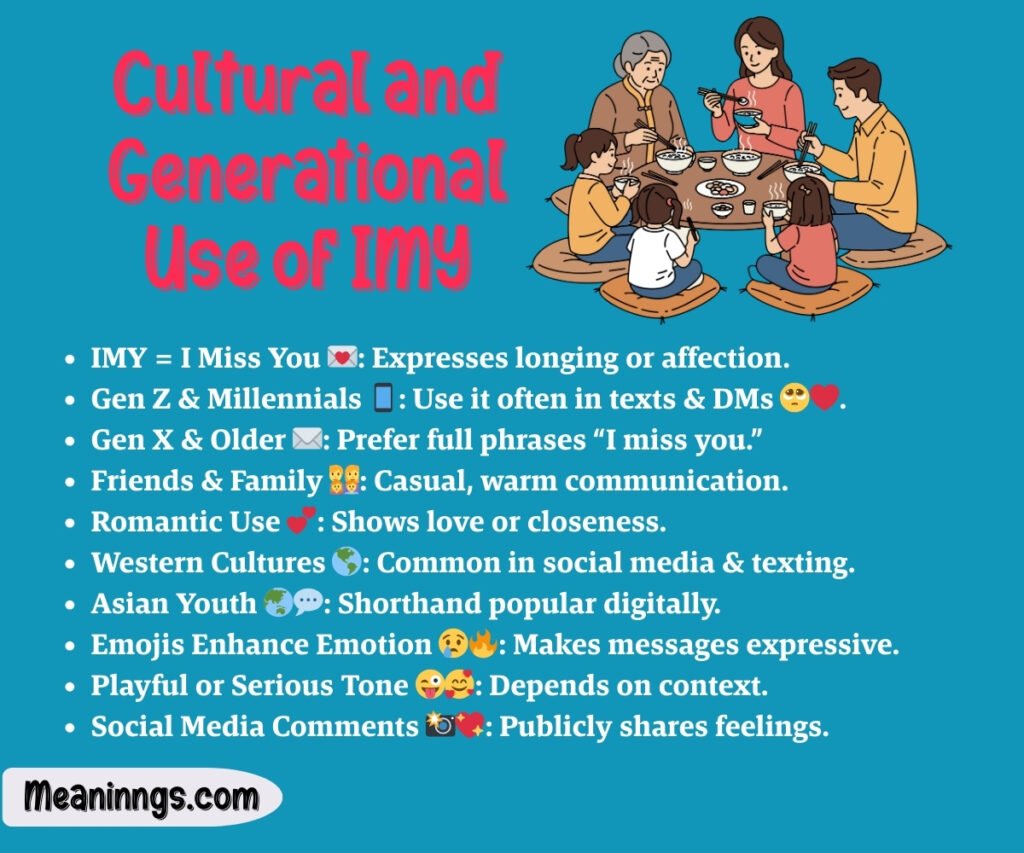
Generational Differences:
Teenagers (Gen Z):
- Use IMY freely among friends
- Incorporate extensive emoji use
- Often employ variations like IMYSM for emphasis
- Comfortable with casual emotional expression
Young Adults (Millennials):
- Balance between romantic and friendship contexts
- More likely to use in long-distance relationships
- Often pair with memes or GIFs
- Comfortable with digital emotional vocabulary
Adults (Gen X and older):
- More reserved usage, typically family-focused
- May spell out “I miss you” instead
- Less frequent emoji pairing
- Often learned through younger family members
Cultural Considerations:
Different cultures approach direct emotional expression differently. In cultures emphasizing indirect communication, IMY might be used less frequently or replaced with more subtle expressions. However, as digital communication becomes increasingly globalized, IMY has achieved relatively universal recognition among online communities.
Non-English speakers often create similar local abbreviations, though IMY’s simplicity has led to cross-cultural adoption in many international digital conversations.
How to Respond When Someone Says IMY
Your response should reflect your genuine feelings and relationship context:
If you feel the same:
- “IMY too ❤️ Let’s plan something soon!”
- “IMYT so much 😊”
- “Miss you more! When can we catch up?”
If you’re friendly but less intense:
- “Aw, you’re sweet! Hope you’re doing well”
- “Miss you too! How have you been?”
- “Same here! Let’s video chat this weekend”
If you’re maintaining boundaries:
- “Thanks for thinking of me. Hope all is well with you”
- “I appreciate you reaching out. Take care!”
- “Thank you. Wishing you the best”
Playful responses:
- “Miss my face already, huh? 😏”
- “Of course you do! I’m amazing 😂”
- “Same energy! When’s our next adventure?”
With emojis and warmth:
- “IMY too 💕 Can’t wait to see you”
- “Aww 🥺 miss our late-night talks”
- “This made my day ❤️ IMYSM”
The key is matching your response to the relationship’s nature and your genuine emotional state. Authenticity resonates far more than forced enthusiasm or excessive emotional distance.
IMY in Pop Culture
IMY has transcended simple texting to become embedded in popular culture:
Music: The most iconic example is Blink-182’s 2004 hit song “I Miss You,” which became a cross-generational anthem. The song’s emotional vulnerability and Tom DeLonge’s distinctive vocal delivery turned it into a cultural phenomenon, achieving over one billion Spotify streams. The track references appear throughout memes and social media, with its gothic aesthetic and heartfelt lyrics resonating with multiple generations.
Social Media Trends:
- TikTok features countless videos using IMY in captions about nostalgia
- Instagram posts frequently use “IMY” for throwback photos
- Twitter threads discuss the emotional impact of receiving IMY messages
- YouTube compilation videos showcase IMY moments in relationships
Television and Film: Contemporary shows depicting digital communication often feature characters texting IMY, reflecting authentic modern relationship dynamics. The acronym appears in teen dramas, romantic comedies, and coming-of-age stories as shorthand for emotional connection.
Memes and Internet Culture: The phrase “IMY” has spawned numerous memes about long-distance relationships, missing pets, favorite foods, and nostalgic experiences, demonstrating its cultural penetration beyond romantic contexts.
Why People Prefer Saying IMY Instead of “I Miss You”
Several psychological and practical factors explain IMY’s popularity:
Efficiency: Three letters convey a complete emotional thought instantly, perfect for fast-paced digital conversations.
Emotional Buffer: The abbreviation provides slight emotional distance, making vulnerability feel less intense for those uncomfortable with direct expression.
Casual Tone: IMY feels lighter and less heavy than spelling out “I miss you,” reducing pressure on both sender and recipient.
Modern Identity: Using IMY signals digital fluency and connection to contemporary communication culture.
Universal Recognition: The acronym crosses language barriers more easily than full phrases, facilitating global communication.
Reduced Overthinking: The brevity prevents excessive rumination about exact wording, encouraging spontaneous emotional expression.
Platform Appropriateness: IMY fits naturally into character-limited platforms and rapid-fire messaging styles.
Despite its brevity, IMY retains emotional authenticity when used genuinely, proving that meaningful connection doesn’t always require lengthy expression.
Emotional Psychology Behind IMY
From a psychological perspective, IMY serves several important functions:
Attachment Maintenance: Regular IMY messages help maintain attachment bonds during separation, reinforcing relationship security and continuity.
Emotional Regulation: Expressing “I miss you” helps people process feelings of longing and separation, providing emotional release and validation.
Connection Signaling: IMY signals to recipients that they matter and are remembered, fulfilling fundamental human needs for belonging and significance.
Vulnerability Expression: The acronym provides a lower-stakes way to be vulnerable, important for people who struggle with direct emotional communication.
Anticipation Building: IMY creates positive anticipation for future interactions, strengthening relationship satisfaction and commitment.
Loneliness Reduction: Both sending and receiving IMY can alleviate loneliness by creating moment-to-moment connection despite physical distance.
Research in digital communication psychology suggests that brief, frequent affectionate messages like IMY may be more effective at maintaining relationship satisfaction than less frequent but longer communications.
IMY in Different Languages
While IMY originated in English, similar abbreviations exist across languages:
Spanish: “TE” (Te extraño – I miss you)
French: “TMM” (Tu me manques – You are missing from me)
German: “IVD” (Ich vermisse dich – I miss you)
Portuguese: “SMD” (Sinto muito a sua falta – I really miss you)
Italian: “MM” (Mi manchi – You are missing to me)
Arabic: Various phonetic abbreviations based on “اشتقت لك”
Chinese: Numeric codes like “530” represent similar sentiments
Japanese: Often use “会いたい” (ai tai) without abbreviation
Interestingly, IMY itself has achieved global recognition, with non-native English speakers frequently using the English acronym in international digital spaces, demonstrating its transcultural adoption.
Examples of Using IMY in Real Messages
Between Partners:
- “Just got home. Place feels so empty. IMY already 💔”
- “Looking at our vacation photos… IMY so much babe”
- “Good morning beautiful ☀️ IMY and ILY”
Between Friends:
- “Saw our favorite coffee shop today. IMY! We need to meet up”
- “Remember when we used to stay up all night talking? IMY those times”
- “IMY bestie! How’s life treating you?”
Family Messages:
- “First week at college done. IMY mom ❤️”
- “Kids asked about you today. They IMY so much!”
- “Happy birthday sis! Wish I could be there. IMY”
Long-Distance:
- “47 days until I’m back home… IMY everyone”
- “Time zones suck. IMY and our normal schedule”
- “Wish you could see this sunset with me. IMY”
Casual Friendship:
- “Haven’t seen you at the gym lately! IMY workout buddy”
- “Your jokes always made Mondays better. IMY at the office”
- “Who else am I supposed to binge-watch with? IMY!”
Each context demonstrates how IMY adapts to relationship dynamics while maintaining its core emotional message.
Frequently Asked Questions
What does IMY mean in text?
IMY means “I Miss You” – a heartfelt way to express that you’re thinking about someone and wish they were present.
Is IMY romantic or friendly?
Both! IMY works for romantic longing or friendly affection depending on relationship context and accompanying words/emojis.
What’s the difference between IMY and IMYT?
IMYT means “I Miss You Too” – it’s a reciprocal response when someone says IMY first.
Can I use IMY in professional settings?
No, IMY is too casual and emotionally personal for work contexts. Use professional alternatives like “Looking forward to reconnecting.”
What does IMYSM mean?
IMYSM means “I Miss You So Much” – a more intense, emotional version expressing stronger longing.
How do you reply to IMY?
Respond authentically based on your feelings: “IMY too ❤️” if reciprocal, or “Thanks for thinking of me!” if friendly but less intense.
Is it okay to text IMY first?
Initiating IMY shows you care and aren’t afraid to express emotions, which most people appreciate.
What’s the difference between IMY and ILY?
IMY expresses longing and missing someone, while ILY declares deep love. IMY is lighter and more versatile across relationship types.
Conclusion
IMY represents far more than three simple letters in modern communication. This powerful acronym bridges digital efficiency with genuine emotional expression, allowing people to maintain meaningful connections across physical distances. Whether used between romantic partners separated by circumstance, friends maintaining bonds despite busy lives, or family members staying connected across generations, IMY serves as a vital tool for contemporary relationship maintenance.
Understanding when and how to use IMY—along with its variations, cultural contexts, and emotional implications—enhances your digital communication skills. As messaging continues dominating human interaction, mastering emotional abbreviations like IMY helps ensure your digital presence reflects your authentic feelings.

Muhammad Shoaib is a language-focused content writer and researcher at Meaninngs.com, where he explains the meaning of words, phrases, and text in a clear and reader-friendly way. His work focuses on simplifying language, uncovering context, and helping readers understand text with confidence and clarity.
Pingback: BRB Meaning in Text: The Complete 2026 Guide to This Popular Online Slang