In today’s fast-paced digital world, abbreviations and slang dominate our text messages, social media conversations, and online chats. One term that frequently appears across platforms like WhatsApp, Instagram, Snapchat, and TikTok is HYD.
f you’ve ever received a message saying “HYD?” and found yourself wondering what it means, you’re not alone. Understanding modern texting slang helps you communicate smoothly, respond naturally, and avoid awkward misunderstandings.
This comprehensive guide breaks down everything you need to know about HYD—from its meaning and origins to practical usage examples and reply strategies. Whether you’re texting friends, chatting on dating apps, or navigating professional messages, this article will help you master HYD and use it confidently.
What Does HYD Mean in Text?
HYD stands for “How You Doing?” It’s a casual, informal way to check in on someone’s well-being or start a conversation. This simple three-letter abbreviation serves as a digital greeting that conveys friendliness without requiring lengthy messages.
The phrase essentially asks:
- How are you feeling?
- What’s going on with you?
- How’s life treating you?
HYD emerged from the broader culture of internet slang where brevity matters. Instead of typing out the full question, people use HYD to save time while maintaining a warm, conversational tone. You’ll see it written in both uppercase (HYD) and lowercase (hyd), though younger users tend to prefer lowercase for a more relaxed vibe.
Why Do People Use HYD?
People gravitate toward HYD for several practical and social reasons:
Speed and Convenience: Typing three letters is significantly faster than typing “How you doing?” or “How are you?” This efficiency matters when you’re juggling multiple conversations or typing on mobile devices.
Casual Friendliness: HYD creates an informal, approachable tone. It feels less formal than “How are you?” and more personal than a simple “Hey.” This makes it perfect for friends, acquaintances, and casual dating conversations.
Universal Recognition: Unlike some niche slang terms, HYD is widely understood across different age groups and online communities. This recognition makes it a safe choice for starting conversations.
Low Pressure: HYD doesn’t demand deep emotional responses. It’s light enough to answer with a simple “Good, you?” or elaborate if you feel like sharing more.
Conversation Starter: When you haven’t talked to someone in a while, HYD serves as an easy icebreaker that opens the door for further interaction without being too intense.
How HYD Developed in Online Slang Culture
The evolution of HYD traces back to the early days of digital communication when character limits and slow typing created a need for shortcuts.
The SMS Era
In the late 1990s and early 2000s, SMS text messaging had strict character limits (usually 160 characters). Users developed abbreviations like “How R U?” and eventually HYD to pack more meaning into fewer characters. Fewer letters meant faster messages and lower costs when texts weren’t unlimited.
Pop Culture Influence
The phrase “How you doin’?” gained massive popularity through television, particularly through Joey Tribbiani’s iconic catchphrase on the sitcom Friends. This pop culture moment helped normalize the casual, conversational phrasing that would later inspire the HYD abbreviation.
Social Media Expansion
As platforms like AOL Instant Messenger, MSN Messenger, and later Facebook, Twitter, Instagram, and Snapchat emerged, HYD spread organically. The abbreviation proved useful across all platforms because it served a fundamental human need—checking in with others.
Modern Usage
Today, HYD remains relevant and widely used among teenagers, young adults, and even some older generations who’ve adapted to digital communication norms. Google Trends data shows periodic spikes in searches for “HYD meaning,” especially when the term spreads through TikTok trends or Twitter conversations.
How to Use HYD in a Sentence (With Examples)
Understanding the context helps you use HYD naturally. Here are practical examples showing different scenarios:
Friendly Check-ins:
- “HYD? Haven’t heard from you in weeks!”
- “Hey! HYD today?”
- “HYD bro? Everything good?”
After Events:
- “HYD after the exam?”
- “HYD? Did you survive Monday?”
- “HYD after that crazy party last night?”
Health Concerns:
- “HYD? Heard you weren’t feeling well.”
- “HYD? Feeling any better?”
- “HYD today? Hope you’re recovering.”
Dating Contexts:
- “HYD beautiful? 😊”
- “HYD tonight? Miss talking to you.”
- “HYD? Wanna grab coffee later?”
Group Chats:
- “Morning everyone! HYD?”
- “HYD guys? Ready for the weekend?”
Professional Casual Settings:
- “HYD team? Let’s kick off the meeting.”
- “HYD after the client presentation?”
Is HYD Formal or Informal?
HYD is decidedly informal. This abbreviation belongs exclusively to casual communication contexts. Understanding when it’s appropriate—and when it’s not—helps you maintain professional boundaries while enjoying relaxed conversations with friends.
Where HYD Works:
- Text messages with friends and family
- Instagram DMs and story replies
- Snapchat conversations
- TikTok comments
- WhatsApp group chats
- Dating app conversations (Tinder, Bumble, Hinge)
- Casual workplace messaging (Slack with close teammates)
Where to Avoid HYD:
- Formal business emails
- Professional correspondence with clients
- Academic communications with professors
- Job applications or cover letters
- Official documents
- First contact with professional connections
Rule of thumb: If you wouldn’t use casual slang in a conversation, don’t use HYD. When in doubt, opt for “How are you?” instead.
HYD and Emojis: How They Work Together
Emojis significantly change the tone and meaning of HYD. The same three letters can convey completely different emotions depending on which emoji accompanies them.
Friendly/Casual:
- “HYD? 😊” — Warm and welcoming
- “HYD? 🙂” — Pleasant check-in
- “HYD today? ☀️” — Bright and positive
Flirty/Romantic:
- “HYD? 😏” — Playful and suggestive
- “HYD beautiful? 😘” — Clearly romantic
- “HYD? 😉” — Teasing and interested
Concerned/Supportive:
- “HYD? 🤗” — Supportive hug
- “HYD? 💙” — Showing care
- “HYD? Hope you’re okay 🥺” — Empathetic
Excited/Energetic:
- “HYD?! 🎉” — High energy
- “HYD? 🔥” — Enthusiastic
- “HYD??? 😄” — Very excited
The emoji adds emotional context that pure text lacks, helping prevent misunderstandings about intent.
Difference Between HYD and HBU / WYD / HRU
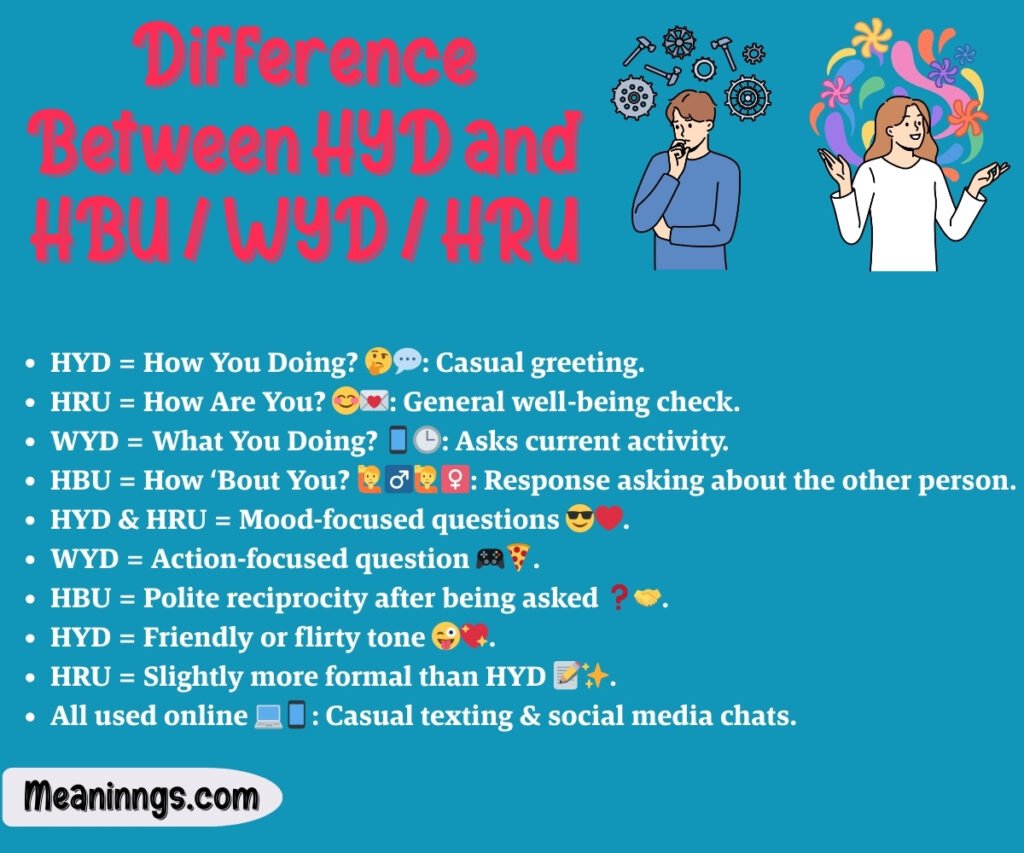
While these abbreviations seem similar, they serve distinct purposes in conversations. Understanding these differences helps you respond appropriately.
| Abbreviation | Full Meaning | Primary Focus | Tone Level |
| HYD | How You Doing? | Overall well-being | Casual, friendly |
| HRU | How Are You? | General state | Slightly more formal |
| WYD | What You Doing? | Current activity | Casual, immediate |
| HBU | How About You? | Return question | Conversational flow |
HYD vs. WYD
- HYD asks about your overall state: “How are you feeling emotionally and physically?”
- WYD asks about your current activity: “What are you doing right now?”
Example:
- “HYD?” → “I’m good, just relaxing.”
- “WYD?” → “Watching Netflix.”
HYD vs. HRU
- HYD feels more casual and friendly
- HRU sounds slightly more proper and polite
Both ask about well-being, but HYD has a warmer, more relaxed vibe while HRU maintains a touch more formality.
HYD vs. HBU
- HYD initiates a conversation
- HBU continues a conversation by returning the question
Example conversation:
- Person A: “HYD?”
- Person B: “Pretty good! HBU?”
When You Should NOT Use HYD
Despite its versatility, certain situations call for more formal or thoughtful communication:
Serious or Sensitive Topics
When someone is dealing with grief, trauma, or major life crises, HYD can seem too casual or dismissive. Use full sentences to show appropriate care: “How are you holding up?” or “I’m thinking about you during this difficult time.”
First Contact with Authority Figures
Don’t use HYD when messaging professors, bosses, or other authority figures unless they’ve explicitly established a casual communication style.
Professional Networking
LinkedIn messages, professional introductions, and business networking require proper language. “How are you?” or “I hope you’re doing well” are more appropriate.
Formal Writing
Any official documentation, reports, or formal correspondence should avoid abbreviations entirely.
When Tone is Unclear
If you’re uncertain about your relationship with someone or how they might receive casual language, err on the side of formality.
International Communication
Not all English speakers worldwide are familiar with American texting slang. With international contacts, clearer language prevents confusion.
Alternative Ways to Ask “How You Doing?”
Variety keeps conversations fresh and allows you to match your tone to different situations:
Very Casual:
- What’s up?
- Sup?
- How’s it going?
- What’s good?
- How ya been?
Slightly More Formal:
- How are you?
- How have you been?
- How are things?
- How’s everything?
Specific Check-ins:
- How’s your day going?
- How was your week?
- How’s work been?
- How are you feeling?
Expressive Variations:
- How’s life treating you?
- What have you been up to?
- How are you holding up?
- What’s new with you?
Using different phrases prevents your messages from sounding repetitive and shows thoughtfulness in communication.
HYD in Different Languages or Cultures
While HYD originated in English-speaking online communities, similar abbreviations exist across languages:
Spanish:
- “QTL?” (Que tal?) — How are you?
- “CME?” (Como estas?) — How are you?
French:
- “CV?” (Ça va?) — How’s it going?
- “CCVB?” (Comment ça va bien?) — How are you doing well?
German:
- “WG?” (Wie geht’s?) — How’s it going?
Portuguese:
- “TDB?” (Tudo bem?) — Everything good?
Cultural Context Matters: In some cultures, direct check-ins about well-being are expected and valued. In others, such questions might seem intrusive if the relationship isn’t close. When communicating across cultures, consider whether abbreviated slang will translate well or if clearer language serves better.
HYD in Romantic Contexts
In dating and romantic relationships, HYD serves multiple purposes and carries different weight depending on timing and frequency.
Early Dating Stages
HYD works as a low-pressure conversation starter on dating apps like Tinder, Bumble, or Hinge. It’s casual enough not to seem too intense but shows interest in the other person.
Example opening:
- “HYD? Your profile caught my eye 😊”
Building Connection
When you’re getting to know someone, regular “HYD?” messages show consistent interest without overwhelming them. The frequency matters—daily HYD messages can signal strong interest or potential clinginess, depending on how the other person responds.
Reading Romantic Signals
Context clues help you understand if HYD carries romantic interest:
Signs of Romantic Interest:
- Frequent HYD messages (several times per week)
- Quick response times
- Paired with flirty emojis (😏, 😘, 😉)
- Followed by deeper conversation
- Sent during late-night hours
Signs of Friendly Interest:
- Occasional check-ins
- Casual response timing
- Standard emojis (😊, 🙂)
- Brief exchanges
Relationship Stage
In established relationships, HYD becomes routine maintenance—a simple way to stay connected throughout the day without lengthy conversations.
HYD and Mental Health Check-ins
In modern digital communication, HYD has evolved beyond casual greetings to serve as an important mental health check-in tool.
Genuine Care
When someone you know is struggling, “HYD?” can open the door for them to share what’s really going on. The informal nature sometimes makes it easier to answer honestly than more formal questions.
Appropriate Follow-up
If someone responds to HYD with concerning information:
- Don’t minimize: Avoid “It could be worse” or “Cheer up!”
- Show empathy: “That sounds really tough” or “I’m sorry you’re dealing with that”
- Offer support: “Want to talk about it?” or “Is there anything I can do?”
- Check in again: Don’t let one exchange be your only follow-up
When HYD Isn’t Enough
For serious mental health concerns, HYD might seem too casual. In these situations, be more direct:
- “I’ve been worried about you. How are you really doing?”
- “I’m here if you want to talk about what’s going on.”
- “You seem like you’re going through something. Want to grab coffee and chat?”
Creating Safe Space
Regular “HYD?” messages from trusted friends can create patterns of checking in that make it easier to spot when someone is struggling.
HYD vs. “How You Doing?” (The Nuanced Difference)
While HYD abbreviates “How You Doing?”, the abbreviated form carries slightly different connotations than spelling it out.
HYD (Abbreviated)
- Very casual and modern
- Implies familiarity with texting culture
- Saves time
- Primarily written communication
- Popular with younger generations
“How You Doing?” (Written Out)
- Still informal but slightly less abbreviated
- Can be used in voice conversations
- May seem more personal or thoughtful
- Works across more age groups
- Can appear in casual emails
“How Are You Doing?” (Full Formal)
- Most proper version
- Appropriate for professional settings
- Used in formal writing
- Standard in introductions
The level of abbreviation you choose signals your relationship with the recipient and the formality of your communication.
How to Reply to HYD (With Natural Example Replies)
Your response to HYD depends on several factors: your mood, relationship with the sender, and context. Here are natural responses for different situations:
Short and Simple
- “Good! You?”
- “Pretty good, thanks!”
- “Doing well! HBU?”
- “Not bad! What about you?”
- “All good here!”
Engaged and Detailed
- “I’m good! Just finished a great workout. HBU?”
- “Doing well, thanks for asking! Been busy with work. How’s your week going?”
- “Pretty good! Just relaxing at home watching movies. What are you up to?”
Honest but Casual
- “Could be better honestly, but hanging in there. You?”
- “Tired but good! Long week. HBU?”
- “Kinda stressed with school but managing. How are you?”
Flirty Responses
- “Better now that you texted 😊”
- “Good… but you could make it better 😏”
- “Doing well! Miss talking to you though”
Professional Casual
- “Doing well, thank you. How can I help you?”
- “I’m good, thanks! What’s up?”
- “Pretty good! What did you need?”
When Struggling
- “Honestly, not great. Mind if I vent a bit?”
- “Been better, but I appreciate you asking”
- “Having a rough day, but I’ll be okay”
Pro tip: Avoid one-word answers like just “Good” or “Fine” unless you want to end the conversation. Including a return question keeps dialogue flowing.
Does HYD Mean the Same on Social Media?
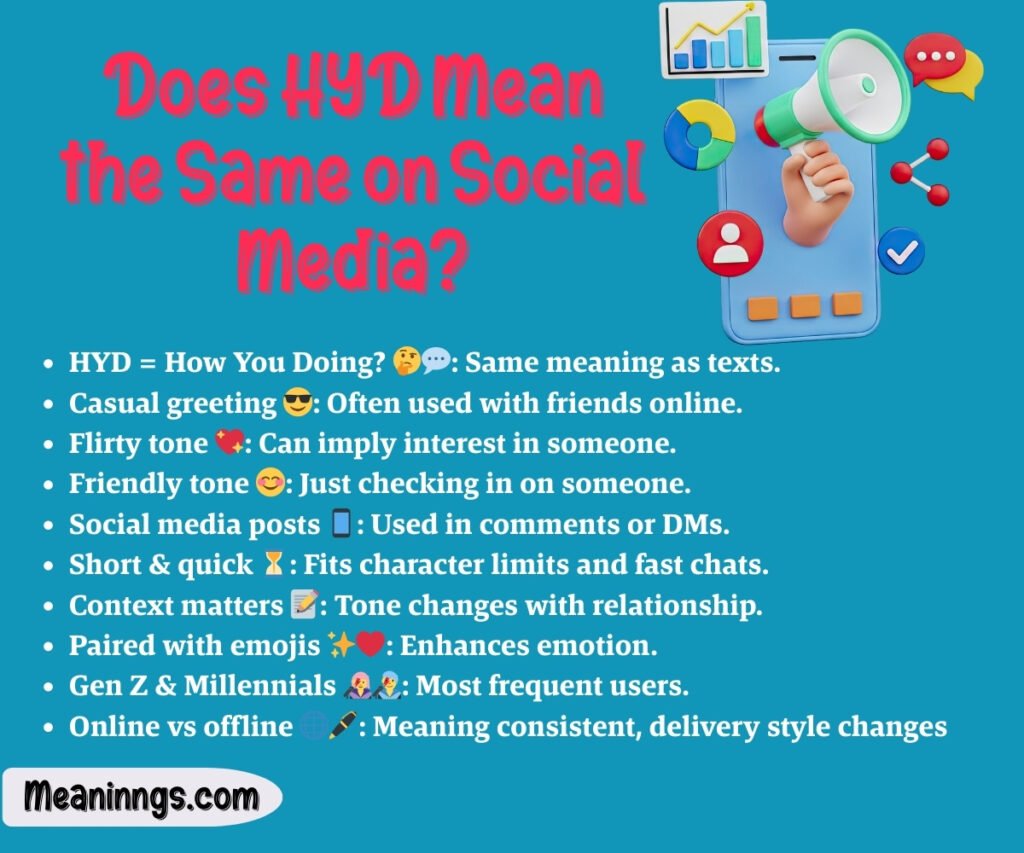
HYD maintains its core meaning across all platforms, but the context and implications shift slightly depending on where you see it.
- DMs: Casual check-ins, often after seeing someone’s story
- Comments: Public show of support or connection
- Story Replies: Direct response to shared content
Example: Someone posts a story about starting a new job. Reply: “HYD with the new gig? 🎉”
Snapchat
- Snaps: Often paired with selfies
- Streaks: Quick daily check-ins
- Chat: More casual than Instagram
Example: Sending a snap with “HYD?” text overlay
TikTok
- Comments: Public check-ins on content
- DMs: Following up after engaging content
- Duets/Stitches: Response videos
Example: Commenting “HYD?” on a creator’s video about their day
- Personal chats: Most common usage
- Group chats: Greeting multiple people
- Status replies: Responding to updates
Example: “HYD everyone? Ready for tonight?”
Twitter/X
- Replies: Public or semi-public check-ins
- DMs: Private conversations
- Less common than other platforms
Facebook Messenger
- Similar to WhatsApp
- Used across age groups
- More likely to see full phrases mixed with abbreviations
Linguistic Insight: Why Abbreviations Like HYD Work
From a linguistic perspective, abbreviations like HYD succeed because they fulfill several communication needs:
Cognitive Efficiency
Human brains process familiar abbreviations almost as quickly as full words. Once you’ve learned what HYD means, your brain doesn’t need to consciously translate it—you just understand.
Social Bonding
Using shared slang creates in-group identity. When you and your friends use HYD, you’re participating in a shared linguistic code that strengthens social bonds.
Adaptation to Technology
Digital communication requires different language skills than face-to-face conversation. Abbreviations evolved to match the constraints and opportunities of texting and typing.
Universal Pattern Recognition
HYD follows common abbreviation patterns:
- First letter of each major word (H-Y-D)
- Phonetic simplification (“you” becomes “y”)
- Maintains recognizable structure
Emotional Expression
Despite being shorter, abbreviations like HYD still carry emotional weight. The brevity doesn’t diminish the care behind checking in—it just makes it faster.
Cultural Evolution
Language constantly evolves, and abbreviations represent natural linguistic change. HYD is part of how English adapts to new communication technologies.
Common Misunderstandings About HYD
Several misconceptions exist about HYD that can lead to confusion:
Misunderstanding #1: HYD Only Means One Thing
While “How You Doing?” is the primary meaning in texting, HYD can represent:
- Hyderabad (airport code: HYD)
- Hydraulics (technical contexts)
- Hydration (fitness contexts)
Always consider context to determine the correct interpretation.
Misunderstanding #2: HYD is Always Flirty
Many people assume HYD signals romantic interest, but it’s primarily just a friendly greeting. Context, emojis, and relationship history determine romantic intent—not HYD itself.
Misunderstanding #3: Only Young People Use HYD
While more common among younger generations, many adults use HYD, especially those comfortable with digital communication. Age doesn’t determine usage as much as comfort with texting culture.
Misunderstanding #4: HYD Requires Deep Responses
HYD is casual and doesn’t demand lengthy emotional sharing. “Good, you?” is a perfectly acceptable response.
Misunderstanding #5: HYD is Dying Out
Despite constant evolution in slang, HYD remains stable because it serves a fundamental communication purpose. Unlike trend-based slang, functional abbreviations tend to stick around.
Misunderstanding #6: HYD is Rude or Lazy
Some people view abbreviations as laziness, but linguistic research shows they’re actually efficient communication tools. HYD isn’t rude—it’s practical.
HYD in Professional Settings: Yes or No?
The professional appropriateness of HYD depends heavily on workplace culture and relationship dynamics.
When HYD Works Professionally:
Established Casual Relationships: If you’ve built rapport with a coworker who texts casually, HYD can maintain that friendly tone.
Company Culture: Tech startups, creative agencies, and companies with young, casual cultures might embrace HYD in Slack messages or team chats.
Internal Communication: Within teams that communicate informally, HYD works in group chats or quick check-ins.
After-Hours Communication: Personal texts with coworkers outside work hours can be more casual.
When to Avoid HYD Professionally:
Client Communication: Never use HYD in external communication with clients, customers, or business partners.
Formal Documentation: Reports, proposals, presentations, and official documents require proper language.
First Impressions: Initial contact with new coworkers, managers, or clients should be more formal.
Uncertain Dynamics: If you’re unsure about appropriateness, err on the side of formality.
Generational Gaps: Older colleagues or executives might not appreciate abbreviated language.
Better Professional Alternatives:
- “How are you?”
- “How’s your week going?”
- “How are things on your end?”
- “Hope you’re doing well”
HYD and Generation Differences
Different age groups interact with HYD in distinct ways:
Gen Z (Born 1997-2012)
- Usage: Very high
- Comfort Level: Native speakers of texting slang
- Style: Lowercase preferred (hyd)
- Platform: Instagram, TikTok, Snapchat
- Perception: Completely normal, unremarkable
Millennials (Born 1981-1996)
- Usage: High to moderate
- Comfort Level: Adapted well to digital slang
- Style: Mix of uppercase and lowercase
- Platform: All platforms
- Perception: Practical and efficient
Gen X (Born 1965-1980)
- Usage: Moderate to low
- Comfort Level: Varies widely
- Style: More likely to spell out phrases
- Platform: Facebook, WhatsApp
- Perception: Sometimes seen as too casual
Boomers (Born 1946-1964)
- Usage: Low
- Comfort Level: Generally unfamiliar
- Style: Prefer full sentences
- Platform: Facebook, email
- Perception: May not understand without explanation
Bridge the Gap: When communicating across generations, gauge the other person’s comfort with abbreviations. Start formal and match their style.
Extended Variations of HYD
Several variations and related phrases expand on HYD:
HBYD — How’s Your Day? More specific focus on the current day’s events.
HBYW — How’s Your Week? Broader timeframe for longer check-ins.
HDYD — How Do You Do? More formal, old-fashioned greeting style.
HYB — How You Been? Focuses on the time since last contact.
HYDD — How You Doing Dude? Adds casual address.
HWYD — How Was Your Day? Past tense for end-of-day check-ins.
These variations serve similar purposes but with slightly different temporal or tonal focuses.
Real-Life Scenarios Where HYD Is Used
Understanding practical contexts helps you recognize when and how to use HYD:
Scenario 1: Reconnecting with Old Friends
“Hey! It’s been months. HYD?” This shows you remember the person and want to reconnect without pressure.
Scenario 2: Dating App First Message
“Hey Sarah! HYD? Your travel photos are amazing 😊” Opens conversation casually while showing interest.
Scenario 3: Post-Illness Check-in
“HYD? Feeling better after the flu?” Shows care while keeping tone light.
Scenario 4: After Missing Plans
“Sorry I missed the hangout yesterday! HYD? Did you guys have fun?” Acknowledges absence while showing continued interest.
Scenario 5: Late Night Text from Crush
“HYD? Can’t sleep so thought I’d see what you’re up to 😏” Casual opener with potential romantic undertones.
Scenario 6: Group Chat Morning Greeting
“Morning team! HYD? Ready to crush this project?” Energizes the group with friendly check-in.
Scenario 7: Following Up on Bad News
“HYD today? I know last week was rough” Shows ongoing support without being overwhelming.
Scenario 8: Instagram Story Reply
[Someone posts about starting college] “HYD with the college life so far??” Engages with their shared content naturally.
Creative Example Sentences Using HYD (Ready for Publication)
Here are polished, natural examples you can adapt:
- “HYD? I saw your post about the new job—congratulations!”
- “Haven’t talked in forever! HYD? We should catch up soon.”
- “HYD after that crazy exam? Hope it went well!”
- “Morning! HYD? Need any coffee before this meeting?”
- “HYD beautiful? Been thinking about you 😊”
- “HYD? Just checking in since you mentioned feeling stressed last week.”
- “HYD? Want to grab lunch sometime this week?”
- “HYD team? Let’s sync up before the client call.”
- “HYD with all the wedding planning? Getting excited?”
- “HYD? Your vacation photos look incredible!”
Frequently Asked Questions
What does HYD mean in a text message?
HYD means “How You Doing?” and is a casual way to greet someone or check on their well-being.
Is HYD flirty or just friendly?
HYD can be both—context, emojis, and sender intent determine whether it’s friendly or flirty.
Can I use HYD in professional emails?
No, HYD is too informal for professional emails. Use “How are you?” instead.
What’s the difference between HYD and WYD?
HYD asks about overall well-being while WYD asks about current activity.
How should I respond to HYD?
Simple responses work well: “Good, thanks! You?” or “Doing well! HBU?”
Is HYD still popular in 2026?
Yes, HYD remains widely used across messaging platforms and social media.
What does HYD mean on Snapchat?
On Snapchat, HYD means the same thing—”How You Doing?”—often used in streaks or casual snaps.
Can HYD mean something besides “How You Doing?”
In technical contexts, HYD can mean hydraulics or refer to Hyderabad airport, but in texting it almost always means “How You Doing?”
Is HYD rude?
No, HYD is friendly and casual, not rude—unless used in inappropriate formal contexts.
Do older people understand HYD?
Some do, but many older adults prefer full phrases and may need clarification.
Conclusion
HYD represents more than just three letters—it’s a window into how modern communication evolves to meet our needs for efficiency, connection, and casual friendliness. Whether you’re texting friends, checking in on loved ones, or navigating dating apps, understanding HYD helps you communicate naturally in today’s digital landscape.

Muhammad Shoaib is a language-focused content writer and researcher at Meaninngs.com, where he explains the meaning of words, phrases, and text in a clear and reader-friendly way. His work focuses on simplifying language, uncovering context, and helping readers understand text with confidence and clarity.
Pingback: LYK Meaning in Text: Everything You Need to Know About This Slang
Pingback: WYTB Meaning in Text Explained: Slang, Usage, and Examples