If you’ve encountered “ASF” in text messages, social media comments, or casual chats, you’re not alone in wondering what it means.
This internet slang has become essential for navigating modern digital communication, especially among younger users. This guide covers everything about ASF—its meaning, usage, common mistakes, and when to avoid it.
What Does ASF Mean in Text?
ASF stands for “as f*”**—a vulgar intensifier used to emphasize extreme emotions, feelings, or descriptions in casual conversations. It functions similarly to words like “very,” “extremely,” or “super,” but with more dramatic flair and emotional punch.
When someone writes “I’m tired ASF,” they’re expressing that they’re extremely tired. The phrase amplifies whatever comes before it, making statements feel more authentic, relatable, and emotionally charged.
While ASF contains profanity in its expanded form, many users don’t employ it with offensive intent. In casual digital spaces, it often reads as humorous, exaggerated, or simply expressive rather than vulgar.
Why People Use ASF in Messaging and Social Media?
ASF has become popular for several key reasons:
- Efficiency: Just three letters deliver maximum emphasis with minimal typing
- Emotional Expression: Helps convey feelings that plain text often misses
- Authenticity: Reflects the raw, genuine communication style preferred by younger generations
- Cultural Connection: Signals awareness of internet culture and trending conversations
- Filter Bypass: Abbreviated form helps avoid automatic content censorship
How to Use ASF Correctly in Text? (With Examples)
ASF functions as an intensifier placed after an adjective or adverb. Here are common usage patterns:
1. Emotional Expressions
- “I’m excited ASF for the concert tonight! 🎵”
- “I’m stressed ASF about this exam tomorrow 😰”
2. Compliments
- “Your outfit is cute ASF 😍”
- “This food tastes good ASF“
3. Complaints or Annoyances
- “This traffic is annoying ASF right now”
- “It’s hot ASF outside today ☀️”
4. Humor and Exaggeration
- “When your alarm goes off and you’re tired ASF 😭”
- “That meme was funny ASF 💀”
5. Descriptions or Opinions
- “That movie was boring ASF“
- “This game is addictive ASF“
Alternative Meanings of ASF (Less Common But Real)
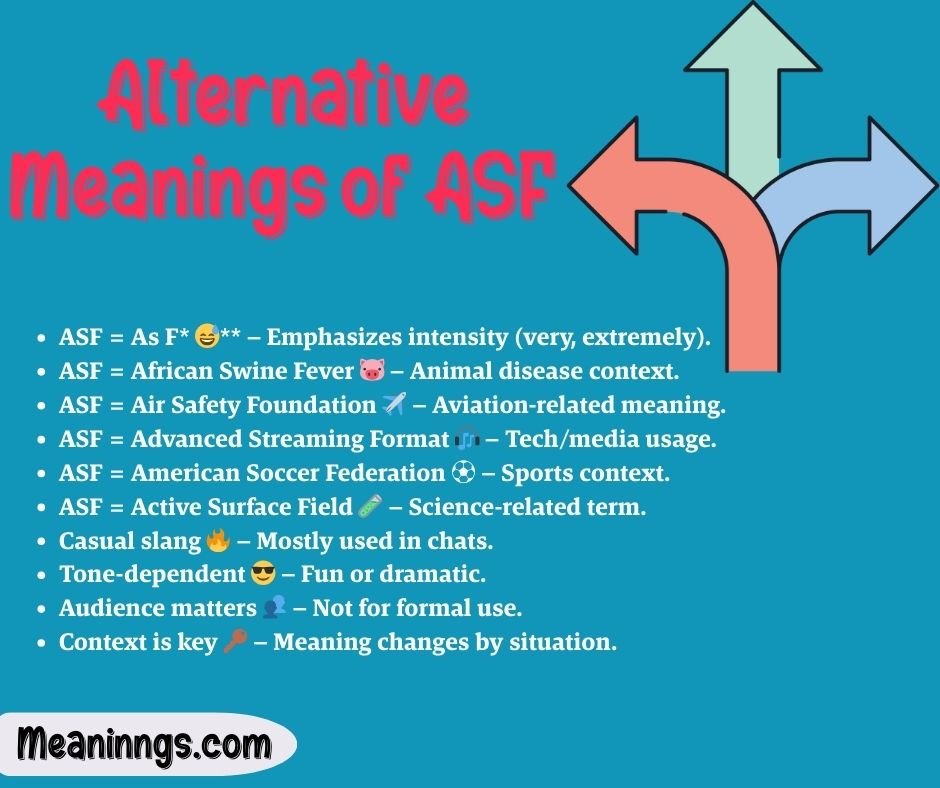
While “as f***” dominates casual texting, ASF has other meanings depending on context:
| Alternative Meaning | Context | Example Usage |
| Age, Sex, From | Dating/chatrooms (similar to ASL) | “ASF? 25, Male, Chicago” |
| And So Forth | Formal writing/lists | “Include supplies: pens, paper, ASF” |
| Advanced Systems Format | Technology/computing | “ASF file format for streaming media” |
| Apache Software Foundation | Tech/open-source | “ASF manages numerous projects” |
| Air Safety Foundation | Aviation | “ASF provides pilot training” |
Context clues help determine which meaning applies: If the message contains adjectives like “tired,” “hot,” or “cute,” it’s almost certainly the slang intensifier. If discussing technology, organizations, or formal subjects, consider the professional abbreviations.
Is ASF Considered a Bad Word?
ASF abbreviates profanity, which makes it vulgar. However, social acceptability varies by context:
Generally Acceptable:
- Casual chats with close friends
- Social media among peers (TikTok, Instagram, Snapchat)
- Informal group conversations
Inappropriate:
- Professional workplace communication
- Academic settings
- Conversations with authority figures
- Formal or public-facing content
Key takeaway: Audience awareness matters most. ASF can damage your professional image if used inappropriately.
Why ASF Became Popular (Cultural Explanation)
1990s-2000s: The phrase “as f***” existed in spoken English as casual slang among friends.
Early 2010s: Texting and social media growth led people to abbreviate profanity. ASF and AF emerged as popular shorthand.
Mid-2010s: Platforms like Vine, Tumblr, and Twitter accelerated ASF’s spread through viral memes and relatable content.
2020s-2026: TikTok and Instagram cemented ASF as mainstream Gen Z slang, symbolizing authentic digital communication where brevity and emotion triumph over formality.
Example Sentences Using ASF (Human-Like, Realistic)
- “Just got to the beach and it’s packed ASF 🏖️”
- “You got the job?! That’s amazing ASF, congratulations! 🎉”
- “This burger is good ASF, you have to try it”
- “It’s cold ASF this morning, bundle up ❄️”
- “That HIIT session was intense ASF but I feel great”
Common Mistakes When Using ASF
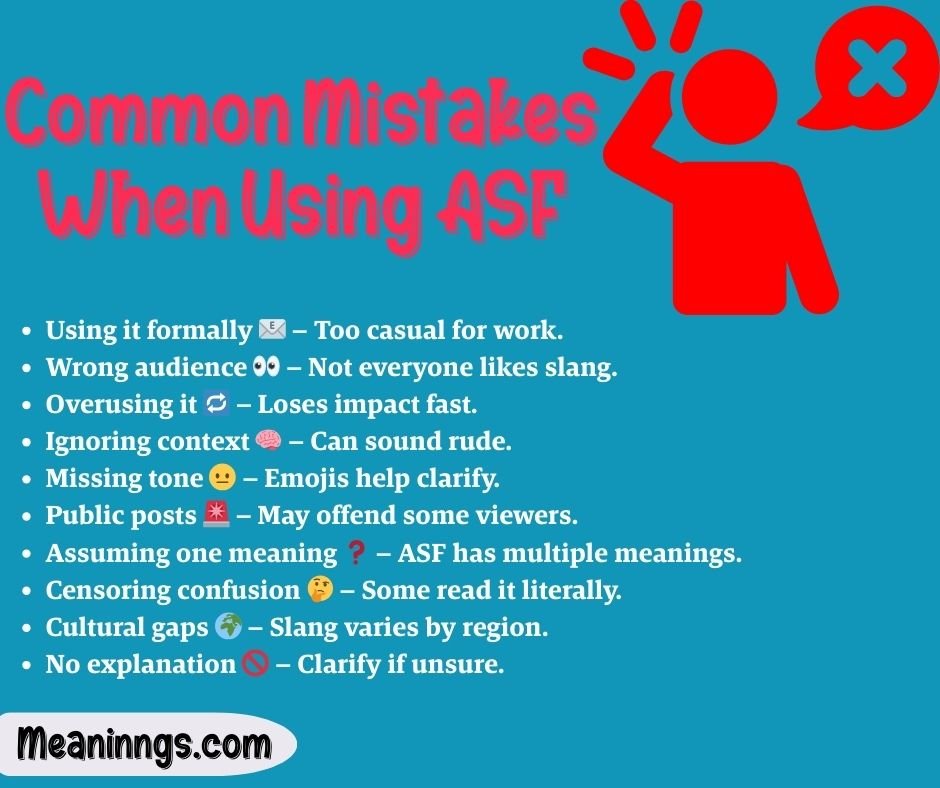
1. Using it in formal situations
❌ Wrong: “Dear Professor, I’m sorry ASF for missing class…” ✅ Right: “Dear Professor, I sincerely apologize for missing class…”
2. Using it with wrong sentence structure
❌ Wrong: “I ASF am tired” ✅ Right: “I’m tired ASF”
3. Overusing it
❌ Wrong: “I’m tired ASF, hungry ASF, and bored ASF.” ✅ Right: “I’m tired ASF right now. This day has been way too long.”
4. Using it with inappropriate audiences
❌ Wrong: Texting grandma “Thanks for the gift, it’s nice ASF!” ✅ Right: “Thanks for the gift, Grandma! I absolutely love it!”
When Should You Avoid Using ASF?
Skip ASF in these situations:
- Professional: Work emails, client communications, job applications
- Academic: Essays, emails to teachers, formal presentations
- Sensitive topics: Serious discussions requiring maturity and respect
- Uncertain audiences: First-time contacts or mixed-age groups
Smart alternative: Use “very,” “extremely,” “really,” “super,” or “incredibly” when in doubt.
How ASF Differs from AF, Asfhh, and Asfff
Understanding these variations helps you navigate slang more fluently:
| Term | Meaning | Usage Difference | Popularity |
| AF | As f*** | Shorter, more common version | Most popular |
| ASF | As f*** | Slightly more dramatic emphasis | Very common |
| Asfhh | As f*** (extended) | Extra letters show extended emotion/laughter | Less common |
| Asfff | As f*** (extended) | Additional emphasis through repetition | Occasional |
Key insight: AF and ASF are interchangeable and mean exactly the same thing. AF appears more frequently overall, while ASF offers a stylistic variation. The extended versions (asfhh, asfff) mimic drawn-out speech or heightened emotion, similar to “yessss” or “omgggg.”
ASF vs. Very, Super, Really — What’s the Difference?
While all these words intensify meaning, they carry different tones and appropriateness:
| Intensifier | Formality Level | Emotional Impact | Best Context |
| ASF | Very informal | Highest (dramatic) | Casual texts, social media |
| Very | Formal to neutral | Moderate | All contexts, including professional |
| Super | Casual to neutral | Moderate-high | Friendly conversations |
| Really | Neutral | Moderate | Everyday speech, most contexts |
| Extremely | Formal to neutral | High (serious) | Professional, academic writing |
| Incredibly | Formal to neutral | High | Formal writing, presentations |
Example transformation:
- Casual: “I’m tired ASF” → Neutral: “I’m really tired” → Formal: “I’m extremely fatigued”
The choice depends on your relationship with the recipient and the communication setting.
Why ASF Works So Well in Modern Texting
ASF’s effectiveness stems from several key factors:
Compensates for Lost Cues: Text lacks tone and body language. ASF helps restore emotional intensity that plain messages miss.
Efficiency: Three letters deliver what previously required multiple words, perfect for fast-paced digital chats.
Social Connection: Using shared slang creates bonding and signals cultural awareness.
Authenticity: ASF sounds raw and genuine rather than carefully edited, resonating with users who value real expression over polish.
Attention Capture: In scrolling feeds, dramatic language stands out and breaks through information overload.
ASF in Social Media: Usage by Platform
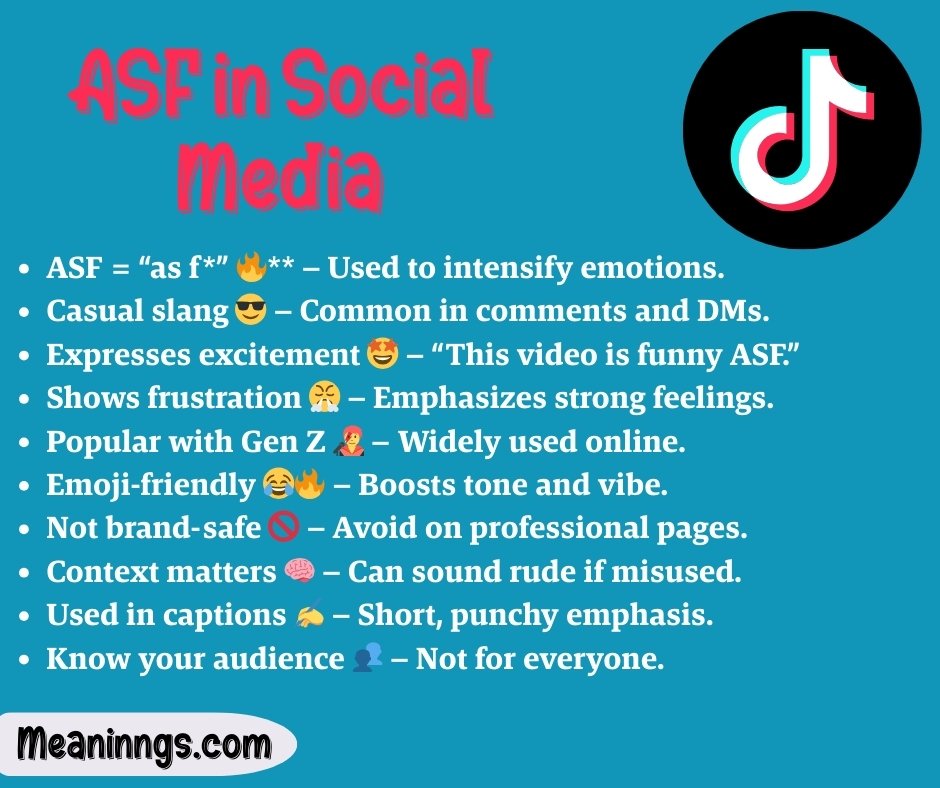
TikTok
ASF appears in captions, comments, and text overlays for relatable moments: “When you wake up tired ASF 😭” or “This trend is addictive ASF.”
Used in captions, stories, and comments to exaggerate qualities: “This view is beautiful ASF 😍” or “That outfit is fire ASF 🔥.”
Snapchat
Perfect for intimate, temporary chats: “I’m bored ASF, wanna hang?” or “This party is lit ASF 🎉.”
Twitter / X
Common in tweets and replies, often with memes: “Coffee hit different today, I’m awake ASF ☕.”
Less frequent due to broader, older user base. Appears mainly in private messages or closed groups.
Is ASF Appropriate for All Ages?
ASF suitability varies by age:
- Teens/Young Adults (13-25): Widely accepted and frequently used
- Adults (26-45): Many understand it; comfort varies by individual
- Older Adults (46+): Often confusing or offensive due to profane origins
- Children (Under 13): Parents should discourage usage and focus on proper language development
Tip: Match language to your conversation partner’s age and comfort level.
A Short Cultural Quote Related to Slang
“Language is the road map of a culture. It tells you where its people come from and where they are going.” — Rita Mae Brown
This quote perfectly captures how ASF and similar slang terms reflect cultural evolution. Digital communication has created new linguistic pathways, showing where younger generations prioritize authenticity, efficiency, and emotional expression over traditional formality.
FAQ’s
What does ASF mean in text?
ASF means “as f***”—an intensifier that emphasizes extreme emotions or descriptions, similar to “very” or “extremely.”
Is ASF a bad word?
ASF abbreviates profanity, making it vulgar in formal contexts, though many use it casually without offensive intent in appropriate settings.
Can you use ASF in school or work?
No, avoid ASF in professional or academic environments—use alternatives like “extremely,” “very,” or “really” instead.
What is the difference between AF and ASF?
Both mean “as f***” and are used interchangeably; AF is slightly more common, while ASF adds stylistic variation.
Does ASF have other meanings?
Yes—ASF can mean “Age, Sex, From” in dating contexts, “And So Forth” in formal lists, or refer to technical terms like “Advanced Systems Format.”
Conclusion
Understanding ASF meaning in text helps you communicate effectively across digital platforms in 2026. This slang intensifier offers a quick, emotional way to amplify feelings and descriptions in casual conversations.
While ASF works well with friends and on social media, avoid it in professional, academic, or formal contexts. Master ASF through audience awareness—knowing when dramatic slang enhances your message versus when cleaner alternatives serve you better.

Muhammad Shoaib is a language-focused content writer and researcher at Meaninngs.com, where he explains the meaning of words, phrases, and text in a clear and reader-friendly way. His work focuses on simplifying language, uncovering context, and helping readers understand text with confidence and clarity.