Ever received a text saying “I miss you sm” and paused for a moment? You’re not alone. In today’s lightning-fast digital world, abbreviations like SM dominate our conversations across Instagram, TikTok, Snapchat, and everyday text messages. Understanding what SM means isn’t just about decoding two letters—it’s about staying connected in modern communication.
Whether you’re texting with friends, scrolling through social media comments, or trying to keep up with Gen Z slang, this complete guide will show you everything you need to know about SM in 2026. From its most common meanings to proper usage examples, you’ll master this versatile abbreviation by the end of this article.
What Does “SM” Mean in Text?
SM most commonly stands for “so much” in texting and online conversations. It’s a quick, casual way to express strong emotions like love, excitement, gratitude, or even frustration. When someone texts “I love you sm” or “Thanks sm,” they’re emphasizing the intensity of their feelings without typing out the full phrase.
However, SM isn’t a one-trick pony. Depending on the context, platform, and conversation topic, SM can have several different fw meanings. The key to understanding it lies in reading the surrounding words and tone of the message.
All Possible Meanings of “SM” in Texting
While “so much” dominates everyday use, here are all the common interpretations of SM you might encounter:
- So Much – The primary meaning in casual texting
- Social Media – Refers to platforms like Instagram, TikTok, or Facebook
- Sadomasochism – Used in adult or BDSM contexts (S&M)
- Small – Less common, usually in specific conversations
- Service Mark – A business or trademark term (℠)
- Sales Manager / Senior Manager – Professional workplace abbreviation
- Santa Monica – Geographic reference
- Super Mario – Gaming conversations
- Samsung – Tech and phone discussions
- Send Me – Request for information or files
Why “SM” Has So Many Meanings
The versatility of SM reflects how digital language evolves. Short abbreviations need to work across multiple contexts to survive in fast-paced online communication. Here’s why SM developed so many meanings:
Speed and efficiency: Texting rewards brevity. Two letters beat typing full phrases, especially on mobile keyboards.
Platform culture: Different communities adopted SM for their specific needs—gamers, business professionals, and social media users all claimed it.
Contextual clarity: Most people naturally understand which meaning applies based on conversation flow. Your brain processes “I saw it on SM” differently than “I miss you sm.”
Evolution of internet slang: As digital communication matured, abbreviations became more nuanced. SM adapted to fill multiple linguistic gaps.
The Most Common Meaning: “So Much”
When you see SM in casual texting, it almost always means “so much.” This usage exploded in popularity during the mid-2010s and continues to dominate in 2026, especially among younger users.
Why it works:
- Conveys emotional intensity quickly
- Fits naturally after expressive statements
- Sounds friendly and casual
- Saves time and characters
The beauty of using “sm” instead of “so much” lies in its ability to maintain authenticity while keeping messages concise. It’s not lazy—it’s efficient digital communication.
How “SM” Replaced “So Much” in Modern Texting?
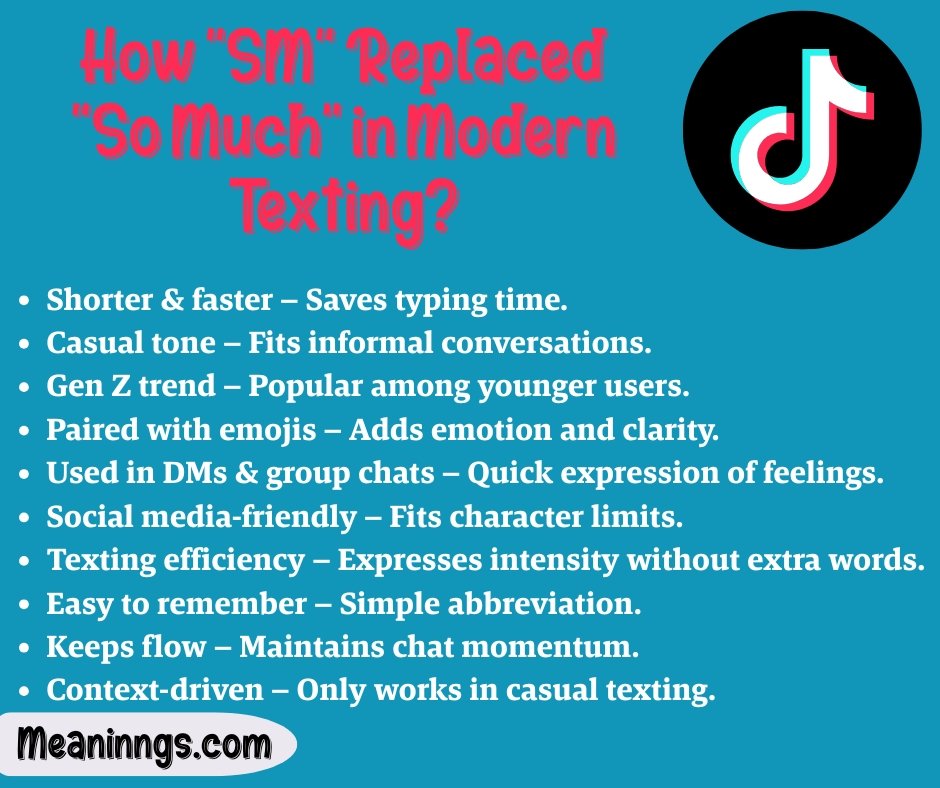
The transformation from “so much” to “sm” didn’t happen overnight. Here’s the evolution:
Early 2000s: Internet users began abbreviating common phrases (LOL, BRB, OMG) in chat rooms and forums.
2010-2015: Smartphones and character limits (especially on Twitter) encouraged shorter expressions. “Sm” emerged as a natural shorthand.
2016-2020: Instagram, Snapchat, and TikTok made casual abbreviations mainstream. Younger users adopted “sm” universally.
2021-2026: Gen Z solidified SM as essential texting vocabulary. It now appears in captions, comments, DMs, and everyday messages across all platforms.
The shift reflects broader changes in digital communication. We’ve moved from formal, complete sentences to quick, emotionally expressive bursts that capture feelings faster.
Examples of “SM” Meaning “So Much”
Here are real-world examples showing how people use SM in conversations:
Expressing love:
- “I love you sm ❤️”
- “Miss you sm, can’t wait to see you”
- “You mean sm to me”
Showing gratitude:
- “Thanks sm for helping me today!”
- “I appreciate you sm”
- “This made my day sm 🥰”
Demonstrating excitement:
- “I’m sm excited for the concert!”
- “This song is sm better than the original”
- “That movie made me cry sm 😭”
Expressing frustration:
- “I hate this sm”
- “This traffic is annoying me sm”
- “The exam was sm harder than I expected”
Notice how SM naturally fits after emotional words and adds emphasis without feeling overdone. It keeps the tone light and conversational.
Less Common Meanings of “SM” You Should Know
While “so much” dominates, these alternative meanings appear in specific contexts. Understanding them prevents confusion and awkward misinterpretations.
SM Meaning: Social Media
In professional or platform-specific discussions, SM frequently refers to social media. You’ll see this usage in:
- Marketing conversations: “Our SM strategy needs updating”
- Business contexts: “The SM team handles Instagram and TikTok”
- General discussions: “I saw it trending on SM”
- Content creation: “Post this on SM later”
Key indicator: When the conversation involves platforms, accounts, posting, or sharing, SM likely means social media.
SM Meaning: Sadomasochism
In adult or BDSM communities, SM (often written as S&M) refers to sadomasochism—consensual practices involving power dynamics. This meaning appears in:
- Dating apps with adult content
- Private messages between consenting adults
- Forums discussing relationships and intimacy
- Specific lifestyle communities
Important: This usage is limited to appropriate adult contexts. It’s not suitable for general, professional, or public conversations. The ampersand (&) in “S&M” distinguishes it from other meanings.
SM Meaning: Small
Occasionally, SM serves as shorthand for “small,” though this usage is rare and typically appears in:
- Shopping conversations: “Do you have this in SM?”
- Size discussions: “I need the SM one, not medium”
- Abbreviated product listings
This meaning is context-specific and less common than others. Most people write “small” fully or use “S” alone.
SM Meaning: Service Mark
In business and legal contexts, SM represents Service Mark (℠)—a symbol indicating trademark claims on services rather than products. You’ll encounter this:
- In business documentation
- On websites and marketing materials
- In legal discussions about intellectual property
- When discussing brand protection
The symbol appears as a superscript: ℠
SM Meaning: Sales Manager / Senior Manager
Professional environments use SM as an abbreviation for managerial positions:
- “The SM approved the budget”
- “Report this to your SM”
- “SM meeting scheduled for Tuesday”
This usage stays within workplace communications and rarely crosses into casual texting.
SM Meaning: Santa Monica / Super Mario / Samsung
Geographic, gaming, and tech conversations occasionally use SM as shorthand:
Santa Monica: “Meeting in SM this weekend” (California location)
Super Mario: “Playing SM all night” (Nintendo games)
Samsung: “My new SM phone is amazing” (electronics)
These meanings are highly context-dependent and rarely confusing when used appropriately.
How to Identify the Meaning of “SM” in Any Conversation
Confused about which SM someone means? Use these three context questions to decode any message:
Ask These 3 Context Questions:
1. What’s the emotional tone? If the message expresses feelings (love, excitement, frustration), SM almost certainly means “so much.”
Example: “That concert was amazing sm” = so much
2. What’s the topic? If discussing platforms, accounts, or posting, think “social media.” If talking about feelings or intensity, think “so much.”
Example: “Check our latest SM post” = social media
3. Who’s the sender? Younger users (Gen Z, Gen Alpha) typically mean “so much.” Business contacts likely mean “social media” or professional terms. Adult dating contexts might reference the intimate meaning.
Example from a teenager: “Love this sm” = so much Example from a marketer: “SM metrics look good” = social media
When in doubt, the surrounding words provide clear clues. Reading the full sentence makes the meaning obvious in 95% of cases.
Why “SM” Became Popular Among Gen Z
Gen Z didn’t just adopt SM—they made it essential. Here’s why this abbreviation resonated with digital natives:
1. It’s Short, Expressive, and Aesthetic
Gen Z values efficiency without sacrificing emotion. “Sm” delivers both—it’s quick to type but still conveys genuine feeling. The lowercase style fits the aesthetic preference for casual, unpretentious communication.
2. It Pairs Well with Emojis
Modern texting combines words with visual elements. “Sm” works perfectly with emojis, creating expressive combinations:
- “Love you sm ❤️”
- “This is sm cute 🥺”
- “Thanks sm 🙏”
The abbreviation doesn’t compete with emojis—it complements them.
3. It Matches Internet Language Culture
Gen Z grew up with abbreviations like LOL, FOMO, and GOAT. Using “sm” feels natural within this linguistic framework. It’s part of a broader digital dialect that prioritizes speed and authenticity over formal correctness.
4. It’s Emotional but Subtle
“So much” can feel dramatic when written out completely. “Sm” softens the intensity while maintaining the sentiment. It lets Gen Z express strong feelings without seeming over-the-top or too serious.
The abbreviation strikes the perfect balance between genuine emotion and casual coolness—a hallmark of Gen Z communication style.
How to Use “SM” Naturally in Texting? (With Examples)
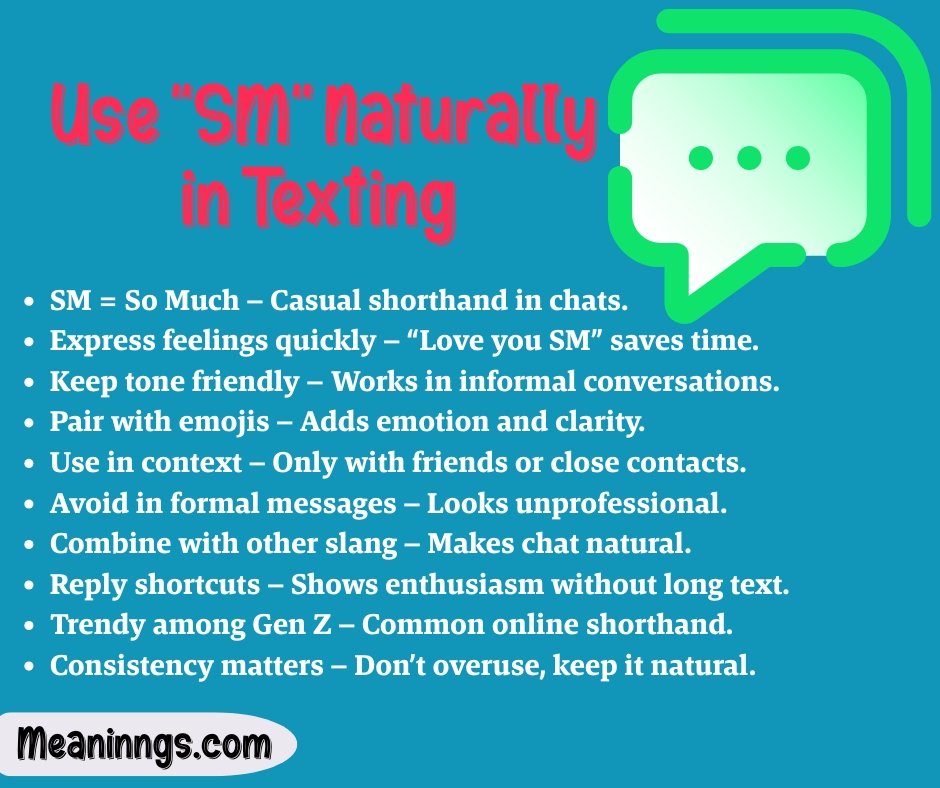
Ready to incorporate SM into your messages? Follow these guidelines for natural, appropriate usage:
Use It with Emotion-Heavy Messages
SM works best when emphasizing feelings or reactions. Add it after statements expressing:
- Love: “I appreciate you sm”
- Excitement: “Can’t wait for this sm!”
- Frustration: “This homework is killing me sm”
- Gratitude: “Thank you sm for everything”
Use It with Reactions
Responding to someone’s message or content? SM adds warmth:
- “This made me smile sm 😊”
- “I relate to this sm”
- “That’s sm true”
- “This helped me sm, thanks!”
Use It for Emphasis
When you want to strengthen a statement without sounding too intense:
- “That movie was sm better than expected”
- “I need coffee sm right now”
- “This game is sm fun”
Avoid It in Formal Writing
SM belongs in casual contexts only. Never use it in:
- Professional emails
- Academic papers
- Job applications
- Formal business communication
- Messages to supervisors or clients (unless they text casually)
Wrong: “Thank you sm for considering my application” Right: “I appreciate you so much for helping me with the project” (casual friend)
Do People Use “SM” in Professional Writing?
Short answer: rarely, and only in specific contexts.
When it’s acceptable:
- Marketing teams discussing social media strategies (SM = social media)
- Casual Slack or team chat conversations
- Internal communications where abbreviations are standard
- Tech or creative industries with relaxed language norms
When to avoid it:
- Client-facing emails
- Official documents
- Presentations
- Meeting notes
- First-time communications with new contacts
If you’re unsure whether SM fits professionally, write out the full phrase. “Social media” or “so much” always works, while “sm” might seem unprofessional or confusing to some readers.
The golden rule: match your audience’s communication style, and when in doubt, choose clarity over brevity.
Regional Variations of “SM” Slang
Interestingly, SM usage stays remarkably consistent across English-speaking regions in 2026. However, some subtle differences exist:
United States: Dominates all meanings, especially “so much” among younger users. Social media interpretation common in professional contexts.
United Kingdom: Similar usage patterns, though slightly less prevalent than American teens. “So much” remains primary meaning.
Australia: Widely adopted among youth, often paired with regional slang in messages.
Canada: Mirrors American usage almost identically.
International English speakers: Understanding SM has become global due to social media’s worldwide reach. Non-native speakers frequently encounter and use it on platforms like Instagram and TikTok.
The abbreviation transcends geographic boundaries because digital culture creates shared language spaces. A teenager in London and one in Los Angeles use SM the same way.
Signs That Someone Is Using “SM” Affectionately

How can you tell if someone’s SM carries genuine emotion? Look for these indicators:
Context clues:
- Appears in personal, one-on-one conversations
- Follows statements about you specifically
- Accompanies compliments or appreciation
Visual elements:
- Paired with heart emojis (❤️, 💕, 🥰)
- Includes affectionate punctuation (!!!, <3)
- Written in lowercase for casual warmth
Message patterns:
- Part of longer heartfelt messages
- Reciprocates your emotional statements
- Used consistently in your conversations
Examples of affectionate SM:
- “You’re such a good friend sm ❤️”
- “Miss talking to you sm”
- “That meant sm to me, thank you”
When someone uses SM affectionately, they’re showing genuine care while keeping their tone comfortably casual—a perfect balance in modern digital relationships.
Common Misunderstandings About “SM”
Despite its popularity, SM causes confusion. Here are the most frequent misinterpretations and how to avoid them:
Mistake 1: Confusing SM with S&M Remember: SM (two letters) differs from S&M (with ampersand). The former usually means “so much” or “social media.” The latter specifically references adult content.
Mistake 2: Using it with the wrong audience Your grandmother might not understand “Thanks sm” the way your friends do. Adjust your language to your audience’s familiarity with texting slang.
Mistake 3: Misreading professional contexts If a coworker mentions “SM strategy,” they’re discussing social media—not expressing emotion. Professional settings typically use SM as a business abbreviation.
Mistake 4: Overusing it Like any abbreviation, SM loses impact with overuse. Sprinkle it naturally rather than adding it to every message. Quality over quantity keeps your communication authentic.
Mistake 5: Assuming everyone knows it While popular among younger users, not everyone recognizes SM immediately. If someone seems confused, simply spell it out—no explanation needed beyond using the full phrase.
When NOT to Use “SM”
Knowing when to avoid SM matters as much as knowing when to use it. Skip this abbreviation in these situations:
Formal communications:
- Job interviews (including text-based ones)
- College application essays
- Professional networking messages
- Letters of recommendation
First impressions:
- Initial messages to new acquaintances
- Dating app openers (unless their profile shows similar language)
- Business introductions
Unclear contexts:
- When the meaning could be ambiguous
- In group chats with diverse age ranges
- When clarity trumps casualness
Serious conversations:
- Discussing sensitive topics
- Delivering important news
- Addressing conflicts
Cross-generational communication:
- Texting parents or grandparents (unless they text similarly)
- Professional contacts significantly older than you
- Anyone who might find abbreviations confusing
When in doubt, write it out. “So much” takes two seconds longer but ensures everyone understands your message perfectly.
Comparison Table: “SM” vs. Similar Short Forms
Understanding how SM compares to related abbreviations helps you choose the right expression:
| Abbreviation | Full Meaning | Best Used For | Example |
| SM | So Much | Emotional emphasis, intensity | “I love this sm!” |
| TY / TYsm | Thank You / Thank You So Much | Gratitude | “TYsm for helping!” |
| ILY / ILYSM | I Love You / I Love You So Much | Affection, love | “ILYSM ❤️” |
| LY | Love You | Casual affection | “LY, talk later!” |
| AF | As F**k | Strong emphasis (casual/vulgar) | “That’s cool AF” |
| FR | For Real | Agreement, emphasis | “FR, that’s true” |
| NGL | Not Gonna Lie | Honest admission | “NGL, I’m tired” |
| TBH | To Be Honest | Sincere opinion | “TBH, I prefer this one” |
Key differences:
- SM focuses on quantity/intensity (“so much”)
- ILYSM specifies love while SM is versatile
- AF is more emphatic but less appropriate
- FR confirms truth; SM amplifies feeling
Choose based on what you’re emphasizing—emotion, truth, or intensity.
How “SM” Influences Modern Digital Communication
SM represents more than just an abbreviation—it’s part of a larger evolution in how we communicate digitally. Here’s its broader impact:
Emotional efficiency: SM lets people express deep feelings quickly, removing barriers between thought and expression. This speeds up emotional connection in digital spaces.
Casual intimacy: The abbreviation creates a sense of closeness. Using “sm” signals you’re in a comfortable, informal relationship with someone.
Generational identity: For Gen Z and younger millennials, using SM correctly marks you as digitally fluent and culturally current.
Platform adaptation: Different platforms embrace SM differently. Understanding these nuances helps you communicate effectively across Instagram, TikTok, Snapchat, and traditional texting.
Language democratization: Abbreviations like SM make language more accessible. They remove formal barriers and create inclusive communication spaces.
The rise of SM parallels broader trends: valuing speed, authenticity, and emotional expression over traditional formality. It’s efficient communication that doesn’t sacrifice feeling—the perfect tool for our fast-paced, connection-hungry digital age.
Is “SM” Still Trending in 2026?
Absolutely. SM remains firmly embedded in digital vocabulary throughout 2026 and shows no signs of disappearing. Here’s why:
Platform dominance: Major social media apps where SM thrives—Instagram, TikTok, Snapchat—continue growing. As long as these platforms dominate, SM stays relevant.
Gen Alpha adoption: The generation following Gen Z (born 2010-2024) has embraced SM naturally. They’re carrying it forward, ensuring longevity.
Cultural integration: SM appears in memes, viral videos, popular songs, and everyday conversations. It’s moved beyond trend status into standard digital vocabulary.
Efficiency advantage: The core benefit—expressing “so much” in two letters—never goes out of style. As long as people text, they’ll want faster ways to communicate emotion.
Adaptability: SM’s multiple meanings keep it fresh. It evolves with communication needs rather than becoming dated.
While specific slang terms rise and fall quickly, SM has achieved staying power. It’s graduated from trendy abbreviation to essential digital communication tool.
Example Sentences Using All Meanings of “SM”
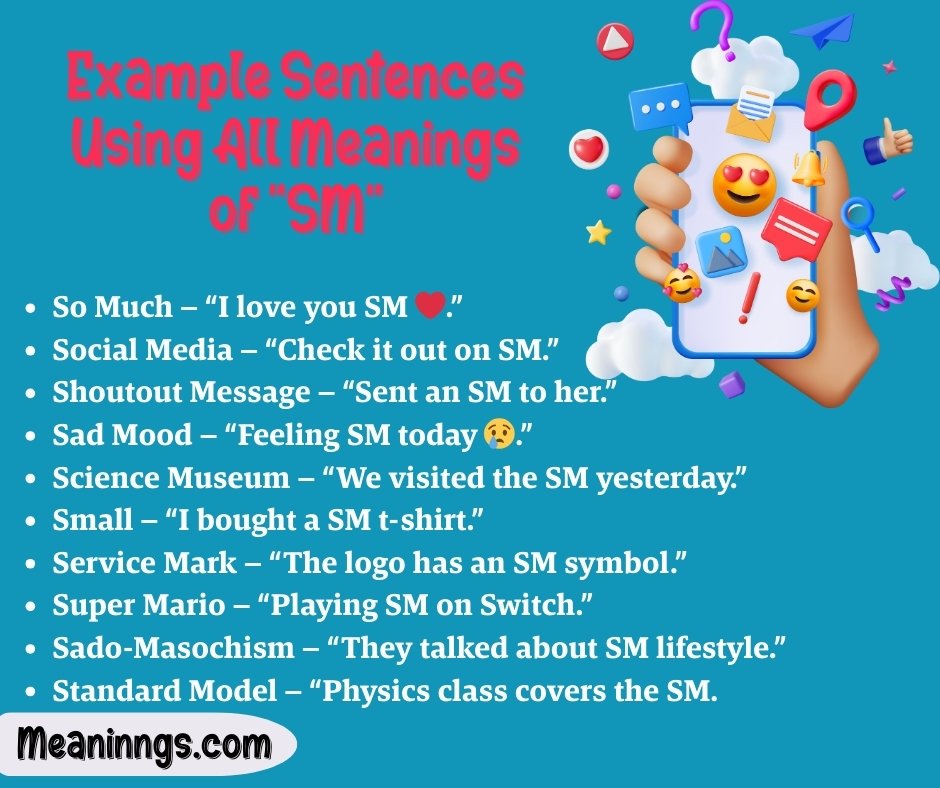
Let’s see SM in action across its various meanings:
Meaning: So Much
- “That concert was amazing sm, I can’t stop thinking about it!”
- “I appreciate you sm for always being there when I need you ❤️”
- “This weather is annoying me sm, I just want summer back”
- “Your support means sm to me, thank you!”
- “I’m sm tired after that workout 😫”
SM Meaning: Social Media
- “Our SM engagement increased by 40% this quarter”
- “Can you post this on SM before 5 PM?”
- “I deleted all my SM apps for a digital detox”
- “Check out our SM pages for daily updates”
- “The SM team needs new content by Monday”
Meaning: Small
- “Do you have this jacket in SM?”
- “I ordered the SM coffee but they gave me large”
- “The SM version fits better in my bag”
Meaning: Sales Manager
- “The SM approved the new budget proposal”
- “Send that report to your SM for review”
- “Our SM is organizing the quarterly meeting”
Meaning: Santa Monica
- “We’re meeting at the pier in SM this Saturday”
- “Traffic to SM is terrible right now”
- “The best tacos are in SM, trust me”
Meaning: Super Mario
- “Been playing SM all weekend, trying to beat this level”
- “The new SM game releases next month!”
- “SM is still the best Nintendo franchise”
FAQ’s
1. What is the most common SM meaning in text?
The most common meaning of SM in text is “so much.” It’s used to express emotional intensity, emphasis, or a significant amount of something. When you see SM in casual conversations, Instagram captions, or text messages between friends, it almost always means “so much.” For example, “I love this sm” translates to “I love this so much.”
2. Is “sm” appropriate for formal conversations?
No, “sm” is not appropriate for formal conversations. It’s strictly casual internet slang designed for informal texting, social media posts, and conversations with friends. In professional settings, academic writing, or formal emails, always write out the complete phrase “so much” or “social media” depending on context. Using abbreviations like SM in formal communication can appear unprofessional or confusing.
3. Does “sm” always mean “so much”?
No, SM doesn’t always mean “so much,” though that’s its primary meaning. Depending on context, SM can also stand for social media, sadomasochism (written as S&M), small, Service Mark, Sales Manager, or even geographic references like Santa Monica. The correct interpretation depends on the conversation topic, platform, and surrounding words. Reading context clues makes the intended meaning clear in almost every situation.
4. Why do people use “sm” instead of “so much”?
People use “sm” instead of “so much” for several reasons: speed (it’s faster to type), character efficiency (especially on platforms with limits), casual aesthetic (it fits the informal tone of modern texting), and cultural fluency (it’s part of Gen Z’s digital dialect). The abbreviation maintains emotional authenticity while matching the quick pace of digital communication. It’s not lazy—it’s efficient expression in a fast-moving online world.
5. Is “SM” used the same way on all platforms?
While SM generally maintains consistent meaning across platforms, subtle differences exist. On Instagram and TikTok, “sm” most commonly means “so much” in captions and comments. In business Slack channels or professional contexts, SM often refers to “social media.” On Snapchat, it’s predominantly “so much” due to the platform’s casual, personal nature. Gaming platforms might use SM for “Super Mario” or other context-specific meanings. The core meanings stay stable, but platform culture influences which interpretation appears most frequently.
Conclusion
Understanding SM in texting isn’t just about decoding two letters—it’s about staying fluent in modern digital communication. Whether you’re expressing love with “miss you sm,” discussing platform strategies with “SM marketing,” or simply trying to understand what your friends mean, context always guides interpretation.
The abbreviation’s popularity isn’t accidental. SM perfectly captures how we communicate in 2026: quickly, emotionally, and authentically. It bridges the gap between formal language and genuine feeling, letting us express “so much” in just two characters.

Muhammad Shoaib is a language-focused content writer and researcher at Meaninngs.com, where he explains the meaning of words, phrases, and text in a clear and reader-friendly way. His work focuses on simplifying language, uncovering context, and helping readers understand text with confidence and clarity.