In today’s fast-paced digital world, texting abbreviations have become second nature. One acronym you’ve probably encountered is “LYK.”
Whether you’re scrolling through Instagram DMs, chatting on WhatsApp, or texting friends, understanding what LYK means helps you stay connected and communicate effectively.
This comprehensive guide breaks down everything about LYK—from its definition and usage to real-life examples and common variations.
What Is the Meaning of LYK in Text?
LYK stands for “Let You Know.” It’s a casual abbreviation used in text messages, social media, and online chats when someone wants to inform you about something later. Instead of typing the full phrase “I’ll let you know,” people simply write “LYK” to save time and keep conversations flowing naturally.
For example, if a friend asks whether you’re free this weekend, you might respond: “Not sure yet, I’ll LYK tomorrow!” This shows you’ll provide an update once you have the information.
The acronym is pronounced letter by letter (L-Y-K), though it’s rarely spoken aloud. Like other internet slang terms such as “BRB” (Be Right Back) or “TTYL” (Talk To You Later), LYK exists primarily in written digital communication.
Why Do People Use LYK? (The Real Purpose Behind It)
Texting shortcuts like LYK have become incredibly popular for several practical reasons. Understanding why people use this abbreviation helps you appreciate its value in modern communication.
1. It Saves Time
Typing “I’ll let you know” takes 14 characters (not counting spaces), while “LYK” requires only 3. In fast-paced conversations where quick responses matter, these shortcuts significantly speed up communication. This efficiency became especially important during the early texting era when character limits and per-message charges were common.
2. It Sounds Casual and Friendly
LYK carries a relaxed, approachable tone that works perfectly for informal chats. Using this abbreviation signals you’re having a casual conversation rather than a formal exchange. It creates a comfortable atmosphere where both parties can communicate freely without overthinking every word.
3. It Fits Modern Texting Style
Today’s digital generation values brevity and efficiency. Abbreviations like LYK align with the natural rhythm of texting culture, where messages are often short and to the point. Using these shortcuts shows you’re comfortable with contemporary communication styles.
4. It Shows You’re Being Helpful
When you say “I’ll LYK,” you’re making a commitment to follow up. It demonstrates consideration for the other person’s question or request. Rather than leaving them hanging, you’re acknowledging their inquiry and promising an update.
5. It Works in Both Casual & Semi-Professional Settings
While LYK thrives in personal conversations, it occasionally appears in relaxed workplace chats on platforms like Slack or Microsoft Teams. Among friendly colleagues who communicate informally, LYK provides a quick way to promise updates without sounding too stiff.
Examples of LYK in Real Conversations
Seeing LYK in action helps you understand how naturally it fits into different contexts. Here are realistic examples showing various usage scenarios.
Casual Conversations
Example 1:
- Friend: “Want to grab dinner tonight?”
- You: “Let me check my schedule. I’ll LYK in an hour!”
Example 2:
- Friend: “Did you finish that Netflix series?”
- You: “Almost done! I’ll LYK what I think when I’m finished.”
Family or Friends
Example 3:
- Mom: “Can you pick up groceries on your way home?”
- You: “Not sure if I’ll have time. I’ll LYK after work.”
Example 4:
- Sibling: “Are you coming to the family reunion?”
- You: “Need to check with my boss first. LYK by Friday!”
Professional or Semi-Formal Use
Example 5:
- Coworker: “Do we have that meeting today?”
- You: “Let me confirm with Sarah. I’ll LYK shortly.”
Example 6:
- Team member: “Can you review my draft?“
- You: “Still wrapping up another project. I’ll LYK when I’m available.”
Flirting or Romantic Tone
Example 7:
- Crush: “Want to see a movie this weekend?”
- You: “That sounds fun! Let me see what’s playing and I’ll LYK 😊”
Example 8:
- Partner: “Should we try that new restaurant?”
- You: “I’ll check if they have reservations and LYK!”
Tone Variations of LYK (What It Really Implies)
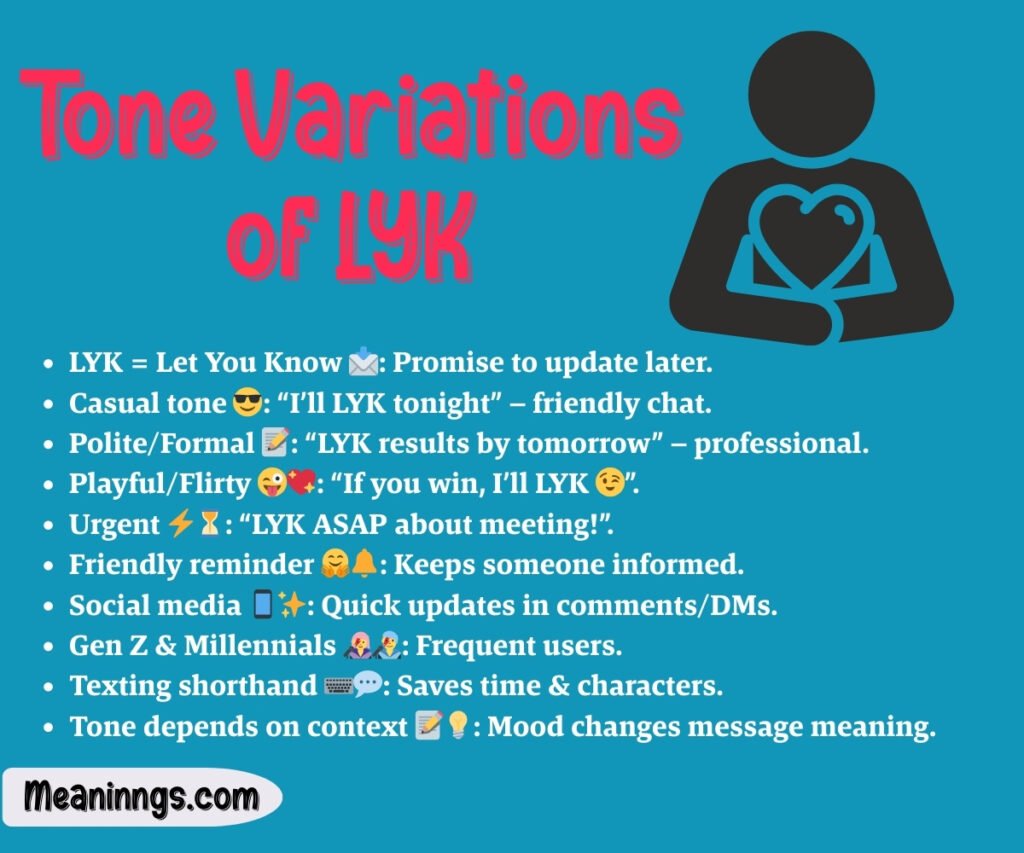
The tone behind LYK depends entirely on context, punctuation, and accompanying words. Understanding these subtle variations helps you interpret messages correctly.
Polite and Helpful: “I’ll LYK as soon as I find out!” (Shows eagerness to help)
Neutral and Informative: “I’ll LYK tomorrow.” (Simple, straightforward update)
Uncertain or Hesitant: “Maybe… I’ll LYK later.” (Indicates doubt or reluctance)
Excited and Enthusiastic: “Definitely! I’ll LYK soon! 🎉” (Shows genuine interest with emoji support)
Professional but Casual: “Still reviewing the documents. Will LYK by EOD.” (Business-appropriate but informal)
The addition of emojis, exclamation points, or extra context significantly influences how LYK comes across. Pay attention to these cues when interpreting or using the abbreviation.
Variations & Similar Slang to LYK
LYK isn’t the only abbreviation in this category. Several related terms serve similar purposes in digital communication:
- LMK (Let Me Know) – Asking someone to provide information
- ILYK (I’ll Let You Know) – More explicit version of LYK
- JSYK (Just So You Know) – Sharing information proactively
- FYI (For Your Information) – Professional way to share updates
- LMYK (Let Me/You Know) – Combined variation of LMK and LYK
- KIT (Keep In Touch) – Promising ongoing communication
- TTYL (Talk To You Later) – Indicating you’ll reconnect soon
- BRB (Be Right Back) – Short-term absence notification
Each abbreviation has its specific use case, so choosing the right one depends on whether you’re asking for information, providing it, or maintaining connection.
Is LYK Considered Formal or Informal?
Understanding when LYK is appropriate ensures you communicate professionally when needed and casually when appropriate.
Informal Use:
LYK works perfectly in:
- Text messages with friends and family
- Social media DMs (Instagram, Snapchat, Facebook)
- Casual group chats
- Gaming communications
- Personal email exchanges with close contacts
Acceptable in Semi-Professional Use When:
- Communicating with friendly coworkers on chat platforms
- You’ve established a casual rapport with the recipient
- The workplace culture encourages informal communication
- You’re using internal messaging tools like Slack or Teams
Avoid LYK When:
- Writing formal business emails or reports
- Communicating with clients or customers
- Sending professional correspondence to superiors
- Preparing academic papers or official documents
- First-time communication with professional contacts
- Applying for jobs or internships
As a general rule, if you’re unsure whether LYK is appropriate, use the full phrase “I’ll let you know” instead. It’s always safer to err on the side of formality in professional settings.
How to Use LYK Naturally in Your Texts (With Examples)
Learning to incorporate LYK seamlessly into your messages makes your texting feel more natural and contemporary.
Beginning of the Sentence
“LYK if you need anything else!” “LYK when you’re free to talk.” “LYK once you’ve decided.”
Middle of the Sentence
“I’ll check with my parents and LYK by tonight.” “Let me ask around and LYK what I find out.” “I need to confirm my schedule first, but I’ll LYK soon.”
End of the Sentence
“Not sure about the time yet, but I’ll LYK.” “Still waiting for confirmation, will LYK.” “Let me think about it and I’ll LYK.”
With Emojis
“I’ll LYK tomorrow! 👍” “Let me check and LYK! 😊” “I’ll LYK as soon as possible! ⏰”
Emojis add emotional context and make your message feel warmer and more personal.
When You Should NOT Use LYK
While LYK is convenient, certain situations call for more formal language:
- Job Applications or Cover Letters – Professional language demonstrates seriousness
- Academic Writing or Research Papers – Scholarly work requires formal language
- Official Business Correspondence – Client emails, proposals, and reports need professionalism
- First Contact with Professionals – Initial emails should establish formality
- Legal or Medical Communications – These fields require precise, formal language
- Cross-Cultural Professional Settings – Not everyone understands internet slang
- When Clarity Is Critical – Important messages shouldn’t rely on abbreviations
Remember, overusing abbreviations in the wrong context can make you appear unprofessional or careless.
Is LYK Used Globally?
LYK primarily originates from English-speaking countries, particularly the United States and United Kingdom. Its global usage varies:
Common in: United States, Canada, United Kingdom, Australia, New Zealand, and other English-speaking regions
Less Common in: Non-English speaking countries where local slang dominates
Social Media Impact: Platforms like Instagram, TikTok, and Snapchat have spread LYK internationally, especially among younger users who consume English-language content
While LYK enjoys widespread recognition in English-speaking digital spaces, people from different linguistic backgrounds might prefer their native abbreviations or may not understand it immediately.
The Psychology Behind Using Abbreviations Like LYK
Understanding why abbreviations resonate with users reveals interesting insights about modern communication psychology.
1. Convenience
Human brains naturally seek efficient communication methods. Abbreviations reduce cognitive load and typing effort, making conversations feel effortless. This efficiency particularly appeals to mobile users typing on small screens.
2. Social Bonding
Using slang like LYK creates in-group identity. When both parties understand these abbreviations, it establishes shared cultural knowledge that strengthens social bonds. It signals you’re part of the same digital generation or social circle.
3. Emotional Distance Control
Abbreviations can create slight emotional distance, making them useful when you want to keep things light and casual. They prevent messages from feeling too heavy or formal, which works well for maintaining comfortable social boundaries.
4. Digital Generation Influence
Millennials and Gen Z grew up with character limits on platforms like Twitter (originally 140 characters) and SMS texting restrictions. These constraints encouraged creative abbreviation usage that has since become habitual.
5. Texting Culture Evolution
As texting evolved from a novel communication method to the primary form of daily interaction, abbreviated language became normalized. Using abbreviations like LYK now signals comfort with digital communication norms.
How LYK Evolved Over Time
The journey of LYK reflects broader changes in digital communication:
1990s-Early 2000s: Early internet chat rooms and SMS texting faced strict character limits and per-message charges. Users created abbreviations to save space and money. LYK emerged during this period alongside LOL, BRB, and other foundational internet slang.
Mid-2000s: Social media platforms like MySpace and early Facebook popularized informal communication styles. Abbreviations spread from dedicated chatters to mainstream users.
2010s: Smartphone adoption exploded, making texting more accessible. While character limits disappeared, abbreviations remained popular for speed and convenience. Twitter’s 140-character limit (later 280) reinforced abbreviation culture.
2020s-Present: LYK thrives across all messaging platforms. While less commonly used than LMK, it maintains steady popularity among teens and young adults. Modern usage often includes emojis and GIFs alongside abbreviations.
Funny and Creative Ways People Use LYK
Creative texters have found amusing ways to play with LYK:
- Dramatic Delays: “I’ll LYK… maybe next year 😂”
- Overpromising: “I’ll LYK in 5 minutes!” (sends update 3 hours later)
- Emphasis Stacking: “I’ll LYK ASAP ASAP ASAP!!!”
- Combo Phrases: “LYK when you know, you know?”
- Self-Aware Jokes: “I’ll LYK but let’s be honest, I’ll probably forget 🤷♀️”
These playful uses show how internet slang evolves beyond literal meanings into tools for humor and personality expression.
A Helpful Table: Different Meanings Based on Context
| Context | Example Message | Implied Meaning |
| Making Plans | “I’ll LYK if I can make it!” | Commitment to confirm attendance |
| Waiting for Info | “Let me ask my boss, I’ll LYK” | Need to gather information first |
| Uncertain Response | “Maybe… I’ll LYK later” | Hesitation or need more time to decide |
| Polite Delay | “Still thinking about it, LYK soon” | Respectful way to ask for patience |
| Professional Setting | “Reviewing your proposal, will LYK by Friday” | Business-appropriate follow-up promise |
| Romantic Interest | “That sounds amazing! I’ll LYK! 😊” | Enthusiastic but need to check schedule |
| Group Coordination | “I’ll LYK who’s coming to the party” | Taking responsibility to gather responses |
Example Sentences Using LYK (For Various Situations)
Daily Use
- “I’ll check the weather and LYK if we should bring jackets.”
- “Let me see what time the movie starts, I’ll LYK!”
- “I’ll LYK when I’m leaving the house.”
- “Still deciding what to order for dinner, will LYK soon.”
College/School
- “I’ll LYK if I can study together tonight.”
- “Let me check my class schedule and LYK about meeting up.”
- “I’ll LYK what the professor said about the deadline.”
- “Still working on my part of the project, I’ll LYK when it’s done.”
Relationships
- “Let me see if my roommate is using the car, I’ll LYK!”
- “I’ll LYK after I talk to my parents about the trip.”
- “Need to check with my girlfriend first, I’ll LYK tomorrow.”
- “I’ll LYK if I’m free for our anniversary dinner.”
Work
- “Let me verify those numbers and LYK by end of day.”
- “I’ll LYK once I get approval from management.”
- “Still waiting on feedback from the client, will LYK soon.”
- “I’ll LYK if the meeting time works for everyone.”
Longer Example Conversations Showing LYK in Action
Scenario 1: Making Plans
Sarah: Hey! Want to go to the beach this Saturday?
Mike: That sounds awesome! Let me check if I have work that day. I’ll LYK by tomorrow morning!
Sarah: Perfect! Just need to know soon so I can plan everything.
Mike: For sure. I’ll definitely LYK before noon tomorrow. 👍
Scenario 2: Waiting for Information
Alex: Did you hear back about the concert tickets?
Jamie: Not yet, still waiting for the website to restock. I’ve been refreshing all day!
Alex: Okay, no pressure. Just LYK when you find out!
Jamie: Will do! I’ll LYK the second I get them. Crossing fingers! 🤞
Scenario 3: Semi-Professional
Colleague 1: Do we need to prepare anything for tomorrow’s team meeting?
Colleague 2: Good question. Let me check with our manager and LYK.
Colleague 1: Thanks! Appreciate it.
Colleague 2: No problem. I’ll LYK within the hour.
Scenario 4: Flirty Chat
Chris: Would you maybe want to grab coffee sometime? ☕
Taylor: I’d love to! Let me check my crazy schedule this week.
Chris: Take your time! No rush at all.
Taylor: Thanks for understanding! I’ll LYK by tonight for sure. 😊
Is LYK the Same as LMK?
This common question deserves clear clarification. LYK and LMK are NOT the same, though they’re closely related:
LYK (Let You Know) = “I will provide information to you”
- Example: “I’ll LYK when I arrive.”
LMK (Let Me Know) = “You provide information to me”
- Example: “LMK when you arrive.”
The key difference lies in who’s giving the update:
- LYK = You’re promising to share information
- LMK = You’re asking someone to share information
Think of them as opposite sides of the same coin. Understanding this distinction prevents confusion in text conversations.
How to Replace LYK (If You Prefer Full Words)
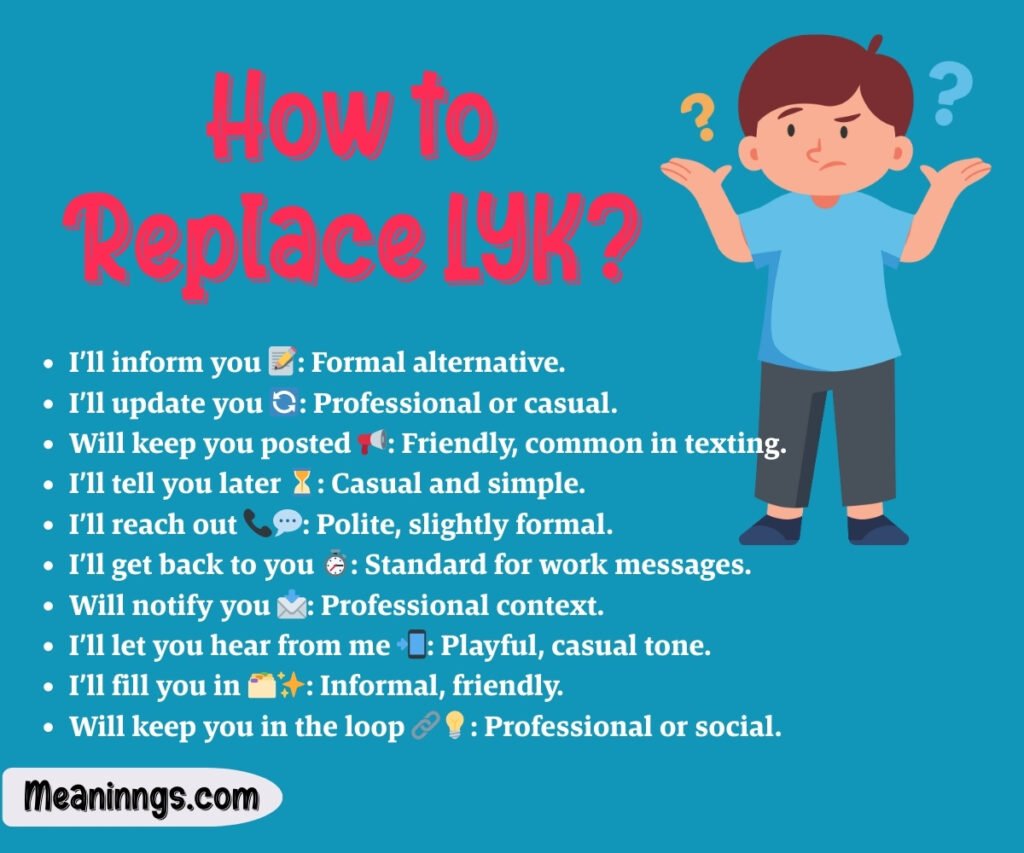
If you’re in situations where abbreviations feel inappropriate, use these alternatives:
- “I’ll let you know”
- “I’ll keep you posted”
- “I’ll update you”
- “I’ll inform you”
- “I’ll get back to you”
- “I’ll circle back”
- “I’ll follow up with you”
- “I’ll send you an update”
These phrases work better in professional emails, formal communications, or when clarity matters more than brevity.
A Short Quote About Communication
“The single biggest problem in communication is the illusion that it has taken place.” – George Bernard Shaw
This timeless quote reminds us that while abbreviations like LYK make communication faster, ensuring mutual understanding remains paramount. Always consider your audience and context.
Frequently Asked Questions
What does LYK mean in texting?
LYK means “Let You Know” – a promise to provide information or updates later.
Is LYK the same as LMK?
No. LYK means you’ll provide info; LMK asks someone to provide info to you.
Can I use LYK in professional emails?
Avoid it in formal business communications; use it only in casual workplace chats with close colleagues.
Is LYK rude or dismissive?
Not at all. LYK is neutral and helpful, showing commitment to follow up with information.
Do people use LYK globally?
It’s common in English-speaking countries but less recognized in non-English regions.
Can LYK mean “like”?
Rarely. While some people informally spell “like” as “lyk,” the standard meaning is “Let You Know.”
Is LYK acceptable in group chats?
Yes! It works perfectly for quick updates in casual group conversations.
When did LYK become popular?
LYK emerged during the early 2000s alongside SMS character limits and internet chat culture.
Should I use LYK with older generations?
Consider your audience; older people might not understand internet slang, so full phrases work better.
Does using LYK make me sound lazy?
Not at all! It’s simply efficient communication that matches modern texting culture.
Conclusion
Understanding LYK meaning in text empowers you to communicate more effectively in today’s digital world. This simple three-letter abbreviation represents the evolution of language in response to technological change, offering speed, efficiency, and casual friendliness.
Whether you’re texting friends about weekend plans, updating family members, or coordinating with colleagues, LYK provides a convenient shortcut that keeps conversations flowing naturally. Just remember to match your language to your audience—while LYK thrives in casual contexts, professional situations still call for complete phrases.

Muhammad Shoaib is a language-focused content writer and researcher at Meaninngs.com, where he explains the meaning of words, phrases, and text in a clear and reader-friendly way. His work focuses on simplifying language, uncovering context, and helping readers understand text with confidence and clarity.