If you’ve spent any time chatting online, gaming with friends, or texting someone, you’ve probably seen “BRB” pop up in your conversations. But what does it actually mean, and why does it still matter in 2026? This guide breaks down everything you need to know about BRB — from its simple definition to real-world usage examples, cultural significance, and modern digital etiquette.
What Does BRB Mean in Text?
BRB stands for “Be Right Back.” It’s a quick, informal way to tell someone you’re stepping away from a conversation temporarily but plan to return shortly. Unlike saying goodbye or ending a chat, BRB signals that you’re taking a brief pause — maybe to grab a snack, answer the door, or handle something urgent — and you’ll be back to continue the conversation.
Think of it as the digital equivalent of holding up a finger and saying “one sec!” in a face-to-face conversation. It keeps communication flowing smoothly without leaving the other person wondering if you’ve disappeared for good.
Why People Use BRB in Text (Real-World Reasons)
People use BRB for practical and courteous reasons:
- Maintains conversation flow — It prevents awkward silences and lets others know you haven’t ghosted them
- Shows respect — Taking a second to type “BRB” demonstrates consideration for the person you’re chatting with
- Sets expectations — It communicates you’ll return soon, so people don’t close the chat or move on
- Prevents misunderstandings — Without BRB, sudden silence might seem rude or confusing
- Saves time — Three letters are faster than typing “I need to step away for a moment but I’ll be back soon”
In fast-paced digital environments like gaming or live chats, BRB has become essential shorthand that keeps everyone on the same page.
Is BRB Still Used in 2025? (Yes — and Here’s Why)
Despite being around since 1989, BRB remains widely used in 2026. While some internet slang fades away, BRB has proven its staying power. Here’s why it’s still relevant:
Gaming communities rely heavily on BRB to coordinate with teammates. When you’re in the middle of a match, typing “BRB” takes seconds and keeps your team informed.
Live streaming platforms like Twitch use BRB screens when content creators take short breaks. It’s become visual vocabulary in streaming culture.
Workplace messaging apps like Slack and Microsoft Teams see casual BRB usage among coworkers who communicate regularly.
Social media platforms continue to see BRB in comments, DMs, and stories. On TikTok and Instagram, hashtags like #BRBmoment trend when people humorously announce breaks or mental health pauses.
The abbreviation adapts to new platforms while maintaining its core meaning — a testament to its usefulness in our constantly connected world.
How to Use BRB in Text (With Real Examples)
Chat Example 1 — Casual
Friend 1: “Did you see the new episode last night?”
Friend 2: “Hold on, someone’s at the door. BRB”
Friend 1: “No worries!”
This shows typical casual usage where BRB maintains the conversation’s momentum without formal language.
Chat Example 2 — Gaming
Player 1: “Ready for the next round?”
Player 2: “BRB, need to grab my charger”
Player 3: “Hurry back, we’re starting in 2 mins”
Gamers use BRB to keep teammates informed during sessions. It’s considered good etiquette to announce brief departures.
Chat Example 3 — Work Chat
Colleague: “Can you review this report when you have time?”
You: “BRB, grabbing coffee, then I’ll take a look”
Colleague: “Sounds good 👍”
In semi-professional settings with regular contacts, BRB works fine. However, save formal alternatives for executives or clients.
Chat Example 4 — Social Media
Comment: “This video made my day! 😂”
Reply: “BRB, sharing this with everyone I know”
On social platforms, BRB often appears playfully or hyperbolically to express enthusiasm or emotional reactions.
Chat Example 5 — Relationship / Friends
Partner: “What do you want for dinner tonight?”
You: “BRB, checking what we have in the fridge”
Partner: “Take your time ❤️”
Between close contacts, BRB feels natural and maintains intimacy in digital conversations.
How Long Is a “BRB” Break?
Originally, BRB indicated breaks of 1-2 minutes in early chatrooms. Today, expectations have relaxed:
- Typical BRB: 2-10 minutes
- Acceptable range: Up to 15-20 minutes
- Beyond 20 minutes: Consider updating the person or using “BBL” (Be Back Later)
Context matters. In active gaming, even 5 minutes feels long. In casual texting, 15 minutes is perfectly reasonable. The key is returning within a timeframe that matches the word “right” — meaning relatively soon, not hours later.
If you know you’ll be gone longer, be specific: “BRB in 30 mins” or switch to alternatives like “GTG” (Got To Go) or “Back after lunch.”
Emotional Tone of BRB
BRB typically carries a neutral to friendly tone. It’s casual without being dismissive, brief without being rude. The emotional temperature can shift slightly based on context:
- Standalone “BRB” — Neutral, straightforward
- “BRB 😊” — Warm, polite
- “brb” (lowercase) — Very casual, relaxed
- “BRB!!!!” — Urgent or excited
- “BRB 🏃♂️💨” — Playful, humorous
Adding emojis, explanations, or punctuation personalizes the message and prevents it from feeling abrupt.
BRB Meaning in Different Contexts
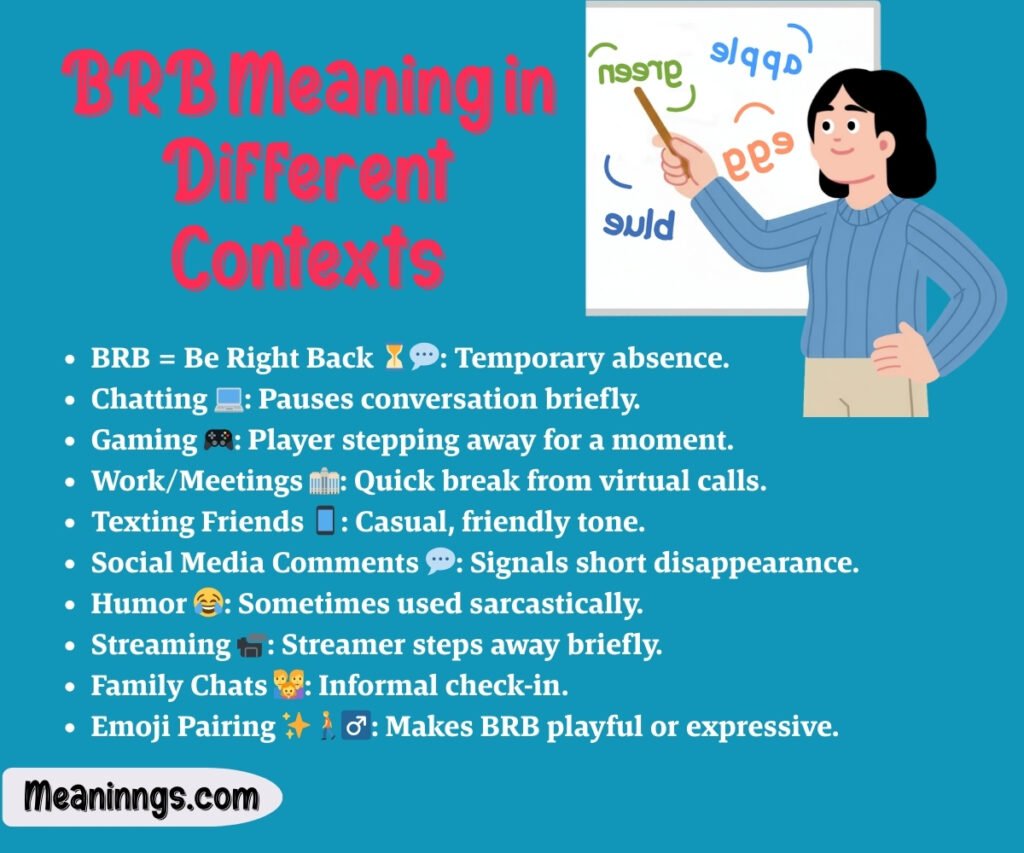
In Texting
In SMS and messaging apps, BRB maintains conversation continuity. It’s perfect for interruptions like phone calls, doorbells, or multitasking moments. Most people write it casually without overthinking.
In Gaming
Gaming gives BRB special importance. Players announce “BRB” to avoid penalties for inactivity, keep teammates informed, and maintain team coordination. Some games even have built-in BRB indicators or away-from-keyboard (AFK) timers.
In Work or Professional Chats
BRB works in informal workplace communication with colleagues you message regularly. However, avoid it in formal business emails, client communications, or professional presentations. Use complete phrases instead: “I’ll return momentarily” or “Back in a few minutes.”
In Video Calls
During virtual meetings, saying “BRB” verbally or in chat lets participants know you’re stepping away briefly. It’s especially useful in casual video hangouts with friends or informal team calls.
In Live Streams
Streamers use BRB extensively. Many creators display custom “BRB screens” with graphics, music, or timers during bathroom breaks or technical adjustments. It’s become standard streaming etiquette.
The Psychology Behind Using BRB
Using BRB reflects deeper aspects of digital communication psychology:
Presence management — BRB helps us manage our online presence and availability status, signaling we’re still engaged but temporarily unavailable.
Social courtesy — It demonstrates respect for others’ time and attention, acknowledging that abrupt silence can feel jarring in real-time conversations.
Anxiety reduction — For both sender and receiver, BRB reduces uncertainty. The sender doesn’t feel guilty about stepping away, and the receiver doesn’t wonder what happened.
Community norms — In gaming and online communities, using BRB shows you understand digital etiquette and respect group dynamics.
Synonyms and Alternative Phrases for BRB
Casual Alternatives
- “One sec”
- “Hold on”
- “Back in a bit”
- “Gimme a minute”
- “Hang tight”
- “Be right there”
Formal Alternatives
- “I’ll return momentarily”
- “Please excuse me for a moment”
- “Back in five minutes”
- “I’ll be with you shortly”
- “Give me a moment, please”
Funny or Playful Alternatives
- “BRB, adulting”
- “BRB, finding snacks”
- “Off to the void, BRB”
- “AFK for life stuff”
- “Stepping into the real world, BRB”
BRB vs. Other Popular Slang Terms
| Term | Meaning | Duration | Intent |
| BRB | Be Right Back | 2-15 minutes | Temporary, returning soon |
| AFK | Away From Keyboard | Variable, often longer | Physical absence from device |
| GTG | Got To Go | Ending conversation | Leaving completely |
| BBL | Be Back Later | 30+ minutes to hours | Extended absence |
| TTYL | Talk To You Later | Hours to days | Ending conversation friendly |
Understanding these differences helps you choose the right abbreviation for each situation.
Variations of BRB (Used Worldwide)
While “BRB” is universally understood in English, different languages and regions have their own adaptations:
- Spanish: “YV” (Ya Vuelvo) — “I’ll be back”
- Portuguese: “JV” (Já Volto) — “Coming back”
- German: Often use “BRB” or “BBG” (Bin Bald Gleich da)
- French: “JR” (Je Reviens) or still “BRB”
- Turkish: “ASD” (Az Sonra Döneceğim) — “I’ll return soon”
However, BRB has become so globally recognized that many non-English speakers use it universally in international gaming and chat contexts.
Is BRB Considered Polite?
Yes, BRB is generally considered polite in informal and semi-formal digital communication. It shows consideration by:
- Acknowledging the other person
- Managing expectations about your availability
- Indicating you value the conversation enough to return
- Preventing awkward silence or confusion
However, politeness depends on context. In formal business settings, complete sentences are more appropriate. With close friends, even skipping BRB might be fine depending on your communication style.
The politest approach combines BRB with brief context: “BRB, doorbell rang” feels more considerate than just “BRB.”
Common Mistakes People Make When Using BRB
Using BRB for long breaks
Saying “BRB” then disappearing for three hours frustrates people. If you’ll be gone longer than 20 minutes, be specific or use BBL instead.
Using BRB during arguments
Dropping “BRB” in the middle of a heated discussion can seem dismissive or like you’re avoiding confrontation. Emotional conversations deserve better communication.
Using BRB in formal meetings
Professional presentations, client calls, or formal business emails aren’t appropriate for abbreviated slang. Use complete, professional language.
Never returning
The classic BRB failure — saying you’ll be right back and never coming back. This erodes trust and makes you seem unreliable.
Overusing BRB
Constantly saying BRB every few minutes disrupts conversation flow. If you’re repeatedly interrupted, consider postponing the chat until you have dedicated time.
BRB in Digital Etiquette (2025 Standards)
Modern digital etiquette around BRB includes these updated guidelines:
Be clear
Add brief context when possible: “BRB, grabbing lunch” works better than standalone “BRB.”
Be respectful
Use BRB in appropriate settings. Skip it for formal professional communication where complete sentences show more respect.
Follow up
Actually return when you say “be right back.” If plans change, update the person: “Sorry, taking longer than expected.”
Be honest
Don’t use BRB to ghost someone. If you need to end the conversation, be direct but kind: “I need to run, talk later!”
The Cultural Influence of BRB
BRB represents more than internet slang — it’s a cultural artifact of digital communication evolution.
Pop culture appearances include the 2004 film “Napoleon Dynamite,” where character Kip uses chat abbreviations, and the 2012 K-pop song “BRB” by Big Bang. Celebrities like Chrissy Teigen have used “BRB, deleting Twitter” dramatically (before returning), creating viral moments.
Meme culture has embraced BRB in phrases like “Going to the moon, BRB” (from 2006 LOLcats) and “BRB, crying” to express emotional reactions.
Internet history marks BRB’s first documented appearance on January 3, 1989, in an Apple II Development Forum. It spread through bulletin board systems (BBS) before exploding with AOL Instant Messenger in the late 1990s.
Today’s social media continues this legacy with trending hashtags, streaming graphics, and casual digital vernacular.
Practical Examples of BRB in Daily Situations
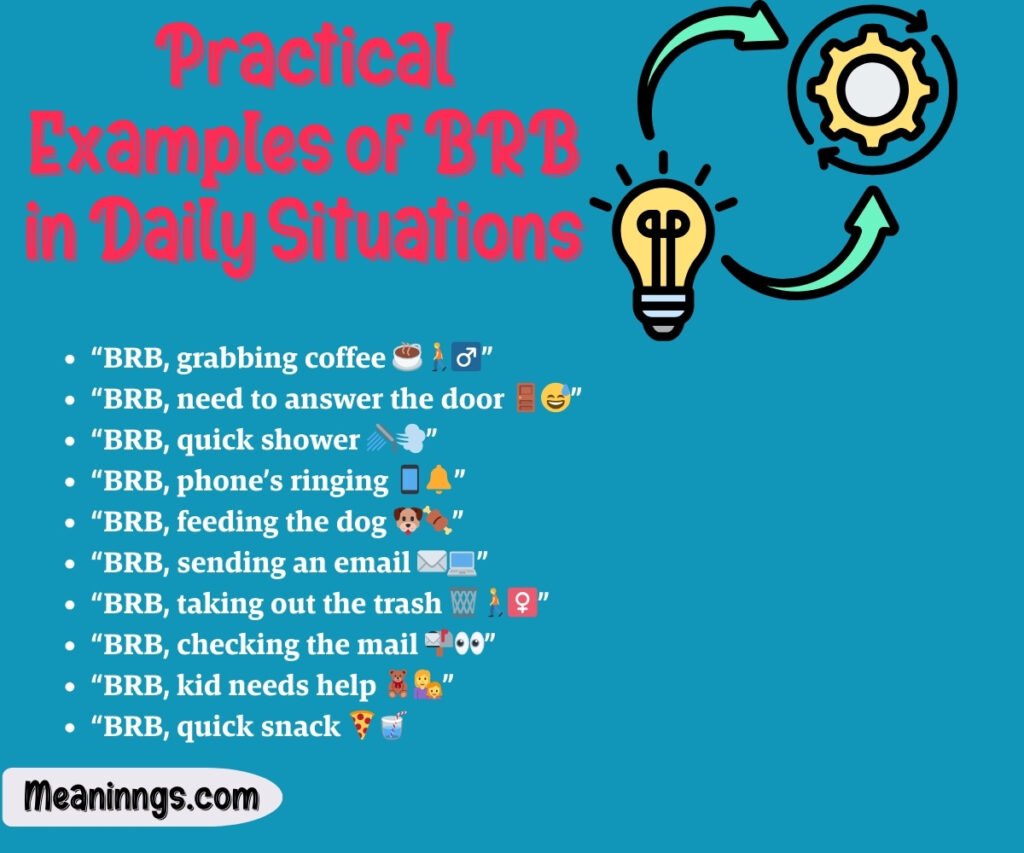
Scenario 1: Cooking and Texting
You’re preparing dinner while texting a friend about weekend plans. The pot starts boiling over.
You: “BRB, kitchen emergency! 🔥”
Friend: “Save the pasta!”
This shows how BRB handles real-life interruptions naturally.
Scenario 2: Work-from-Home
You’re in a casual Slack channel with coworkers when your child needs help with homework.
You: “BRB, parenting duty calls”
Teammate: “Been there! Take your time”
Remote work has normalized BRB for household interruptions.
Scenario 3: Gaming
You’re raiding with your guild when nature calls.
You: “BRB 2 mins, bathroom”
Guild leader: “Make it quick, boss spawns in 5”
Gaming demands clear, quick communication, making BRB essential.
Scenario 4: During a Movie
You’re text-watching a show with friends when the delivery arrives.
You: “BRB, food’s here 🍕”
Friend: “Pause the episode?”
You: “Already did!”
Coordinating shared activities often involves BRB moments.
Scenario 5: Emotional Conversation
Your friend is sharing something important, but you need to step away.
Friend: “…and that’s why I’m really struggling right now”
You: “I hear you. Give me 5 mins to close my office door so I can focus fully. BRB”
Here, BRB shows you’re taking the conversation seriously by eliminating distractions.
How to Reply When Someone Says BRB
Appropriate responses to BRB include:
- “No problem!”
- “Take your time”
- “All good 👍”
- “See you soon”
- “K” or “Kk”
- 👍 emoji
- No reply (also acceptable)
Match your response to the relationship and context. Close friends might get playful responses (“Don’t fall in!”), while professional contexts warrant simple acknowledgment.
Creative Emoji Ways to Use BRB
Modern texters combine BRB with emojis for personality:
- “BRB 🏃♂️💨” — Running away quickly
- “BRB ☕” — Coffee break
- “BRB 🚽” — Bathroom (humorous honesty)
- “BRB 🍔” — Food break
- “BRB 😴” — Quick nap
- “BRB 📞” — Taking a call
- “BRB 🐕” — Walking the dog
Emojis add warmth and context without extra typing.
BRB in Professional Communication (Best Practices)
Appropriate Situations
- Casual team chat channels (Slack, Teams, Discord)
- Quick messages with regular colleagues
- Internal informal communication
- Virtual coffee breaks or team hangouts
Avoid in These Situations
- Client emails or messages
- Formal business presentations
- Job applications or interviews
- Communication with executives
- Professional networking (LinkedIn messages)
- Customer service interactions
Professional alternatives: “I’ll return in a moment,” “Please excuse me briefly,” “Back shortly,” or “I’ll be with you in five minutes.”
The Evolution of BRB: A Brief History
1989: BRB first appears in Apple II Development Forum on January 3rd, marking its earliest documented use in online communication.
Early 1990s: Bulletin board systems (BBS) and early chat rooms adopt BRB as typing speed and character efficiency become valuable.
1996: BRB becomes standardized in online lexicons and internet slang dictionaries.
1997: AOL Instant Messenger launches, bringing BRB into mainstream usage with millions of users.
Late 1990s-2000s: BRB reaches peak cultural relevance alongside other chat acronyms like LOL, TTYL, and AFK.
2006: “Going to the moon, BRB” LOLcat memes popularize humorous BRB usage.
2010s: BRB transitions to mobile texting, gaming platforms, and social media while competing with newer abbreviations.
2020s-Present: BRB remains relevant in streaming culture, gaming, and casual digital communication, proving its enduring utility.
Extended Meanings of BRB in Modern Culture
Beyond its literal meaning, BRB has taken on extended cultural significance:
Mental health breaks — “Taking a BRB from social media” signals stepping back for wellbeing without permanent departure.
Life transitions — People use “BRB” humorously when traveling, changing jobs, or going through major life events.
Streaming culture — Custom BRB screens have become mini art projects, with creators designing elaborate animated loops.
Relationship language — “BRB, processing this” acknowledges needing time to think during important conversations.
Custom Example Sentences Using BRB
- “Hold on, my cat just knocked over my coffee. BRB!”
- “BRB, gotta restart my router — internet’s acting up.”
- “Someone’s calling me on the other line, BRB 📞”
- “BRB in 10, running to grab my mail”
- “Dinner’s ready, BRB! Save my spot in queue”
- “BRB, switching to my laptop for easier typing”
- “My phone’s dying, BRB while I find my charger”
- “BRB, need to let the dog outside real quick”
When You Should NOT Use BRB
During emotional arguments
Using BRB during fights can feel like you’re running away from conflict. If you need space, communicate that clearly: “I need some time to cool down. Can we continue this later?”
During important work conversations
Critical business discussions deserve full attention. Don’t interrupt serious meetings or deadline conversations with casual BRB unless absolutely necessary.
When you’re leaving permanently
BRB implies return. If you’re ending a conversation or leaving a platform, be honest about it instead of creating false expectations.
When deep listening is required
If someone is sharing something vulnerable or important, stepping away sends the wrong message. Focus fully or reschedule when you can give proper attention.
How to Make BRB Sound More Human and Warm
Adding personality prevents BRB from feeling robotic:
- Add context: “BRB, doorbell” vs. just “BRB”
- Include emojis: “BRB 😊” feels friendlier
- Give timeframes: “BRB in 5” sets clear expectations
- Express gratitude: “Thanks for waiting, BRB!”
- Use alternatives: Vary with “One sec,” “Hold on,” “Be right there”
- Acknowledge importance: “This is important — BRB, just need to grab water”
Small touches transform functional abbreviation into genuine human connection.
Is BRB Safe for All Ages?
Yes, BRB is completely safe and appropriate for all age groups. It carries no negative connotations, vulgar meanings, or inappropriate context. Parents can feel comfortable with children using BRB in online chats, gaming, or texting.
In fact, teaching kids to use BRB demonstrates good digital citizenship and online etiquette. It shows respect for others and proper communication practices.
BRB Across Languages (Global Adaptations)
While English-speaking internet culture created BRB, digital communication has become global:
| Language | Abbreviation | Full Phrase | Literal Translation |
| Spanish | YV | Ya Vuelvo | I’ll be back |
| Portuguese | JV | Já Volto | I’m coming back |
| French | JR | Je Reviens | I’m returning |
| German | BBG | Bin Bald Gleich da | Be there soon |
| Turkish | ASD | Az Sonra Döneceğim | I’ll return soon |
| Korean | 잠시만 | Jamshiman | Just a moment |
| Japanese | すぐ戻る | Sugu modoru | Coming back soon |
Despite local variations, “BRB” often transcends language barriers in international gaming and global online communities.
BRB and Modern Texting Etiquette (2026 Update)
Digital etiquette continues evolving. Here’s what’s current in 2026:
Transparency matters — Users appreciate context over mystery. “BRB, taking out trash” beats ambiguous absence.
Async communication — With asynchronous messaging normalized, BRB expectations have relaxed. People understand responses may not be instant.
Platform awareness — Professional platforms (email, LinkedIn) require different standards than casual apps (Discord, Instagram).
Generational differences — Gen Z often uses BRB ironically or with humor, while older generations use it more literally.
Streaming integration — Automated BRB screens, chatbots, and status indicators have professionalized the concept.
Mental health consciousness — “BRB from social media” for wellbeing is widely respected and encouraged.
FAQ’s
What does BRB mean in texting?
BRB means “Be Right Back” — a quick way to say you’re stepping away temporarily but will return shortly.
Is BRB still used in 2025?
Yes, BRB remains widely used across gaming, streaming, texting, and casual workplace communication.
How long should a BRB break be?
Typically 2-10 minutes, though up to 15-20 minutes is acceptable. Anything longer requires an update or different abbreviation.
Can I use BRB in professional emails?
No, avoid BRB in formal business communication. Use complete phrases like “I’ll return momentarily” instead.
What’s the difference between BRB and AFK?
BRB means you’ll be right back (very brief). AFK (Away From Keyboard) typically indicates longer absence from your device.
Is it rude to use BRB?
No, BRB is considered polite as it shows consideration by informing others of your temporary absence.
What should I reply when someone says BRB?
Simple responses like “No problem,” “Take your time,” “K,” or 👍 emoji work well. No reply is also acceptable.
When was BRB first used?
BRB first appeared on January 3, 1989, in an Apple II Development Forum, then spread through BBS and AOL Instant Messenger.
Conclusion
BRB has traveled an impressive journey from 1989 bulletin boards to 2026 streaming screens, proving that truly useful communication tools never really go out of style. This simple three-letter abbreviation continues solving a fundamental problem in digital conversation: how to step away politely without ending the interaction.
Whether you’re gaming with friends across continents, texting your family, or chatting with coworkers, BRB remains a small but mighty piece of internet culture. It represents courtesy, efficiency, and the ongoing evolution of how we connect in digital spaces.

Muhammad Shoaib is a language-focused content writer and researcher at Meaninngs.com, where he explains the meaning of words, phrases, and text in a clear and reader-friendly way. His work focuses on simplifying language, uncovering context, and helping readers understand text with confidence and clarity.