In today’s fast-paced digital world, texting abbreviations like DWBI have become essential tools for quick communication.
Whether you’re scrolling through Instagram, chatting on WhatsApp, or texting friends, understanding what DWBI means can help you navigate modern conversations with confidence.
This comprehensive guide breaks down everything you need to know about DWBI, from its meaning to real-world usage examples.
What Does DWBI Mean in Text?
DWBI stands for “Don’t Worry ‘Bout It” – a casual, shortened version of “Don’t Worry About It.” This popular texting slang is used across social media platforms, instant messaging apps, and everyday text conversations to quickly reassure someone or dismiss minor concerns.
The abbreviation uses “‘Bout” instead of “About,” making it sound more laid-back and conversational. When someone sends you DWBI, they’re essentially telling you to relax, stop stressing, or that something isn’t worth your concern.
Key Characteristics of DWBI:
- Informal tone: Casual and relaxed communication style
- Quick response: Saves time in fast-paced digital conversations
- Reassurance function: Helps calm worries or dismiss minor issues
- Platform versatility: Used on TikTok, Instagram, Snapchat, WhatsApp, and text messages
Why People Use DWBI (Emotional & Social Context)
People choose DWBI over longer phrases for several important reasons that go beyond simple convenience:
Speed and Efficiency: Typing four letters is significantly faster than the full phrase, especially on mobile devices. In our instant-messaging culture, this brevity keeps conversations flowing smoothly.
Social Connection: Using slang like DWBI creates a sense of belonging within peer groups. It signals that you’re current with digital communication trends and understand modern texting language.
Emotional De-escalation: DWBI serves as a linguistic tool to minimize stress in conversations. By keeping things light, it helps maintain positive relationships even when discussing potentially awkward situations.
Tone Setting: The casual nature of DWBI immediately establishes an informal, friendly atmosphere. It’s the digital equivalent of a reassuring pat on the shoulder.
Examples of DWBI in Real Conversations
Understanding how DWBI works in context makes all the difference. Here are authentic examples:
Example 1 – Minor Mishap:
- Friend: “OMG I’m so sorry I spilled coffee on your book!”
- You: “DWBI, it was old anyway. No biggie!”
Example 2 – Running Late:
- Friend: “Traffic is terrible, I’ll be 15 minutes late 😫”
- You: “DWBI! I’ll order appetizers while I wait”
Example 3 – Forgotten Items:
- Roommate: “I forgot to grab milk at the store”
- You: “DWBI, I’ll pick some up tomorrow”
Example 4 – Work Context (Informal):
- Coworker: “Did I mess up the formatting on that doc?”
- You: “DWBI, I fixed it already”
Variations & Similar Slang to DWBI
DWBI isn’t alone in the texting world. Several related abbreviations convey similar meanings:
- DWAI (Don’t Worry About It): Slightly more formal than DWBI
- DW (Don’t Worry): Even shorter, more direct
- NP (No Problem): Acknowledges without dismissing
- NBD (No Big Deal): Emphasizes the unimportance of an issue
- NVM (Never Mind): Drops the subject entirely
- DWBIH (Don’t Worry ‘Bout It, Honey): Adds affectionate tone
Each variation has subtle differences in tone and formality, making context crucial for choosing the right one.
Is DWBI Formal or Informal?
DWBI is strictly informal and should only be used in casual digital communication. Here’s a breakdown:
✅ Appropriate Settings:
- Text messages with friends
- Social media comments and DMs
- Casual group chats
- Informal workplace communication (with close colleagues you know well)
❌ Inappropriate Settings:
- Professional emails
- Client communications
- Academic writing
- Formal business correspondence
- Conversations with supervisors or authority figures
The casual contraction “‘Bout” immediately signals informality. In professional contexts, opt for complete phrases like “No worries,” “It’s not a problem,” or “Please don’t be concerned.”
How to Use DWBI Naturally? (With Examples)
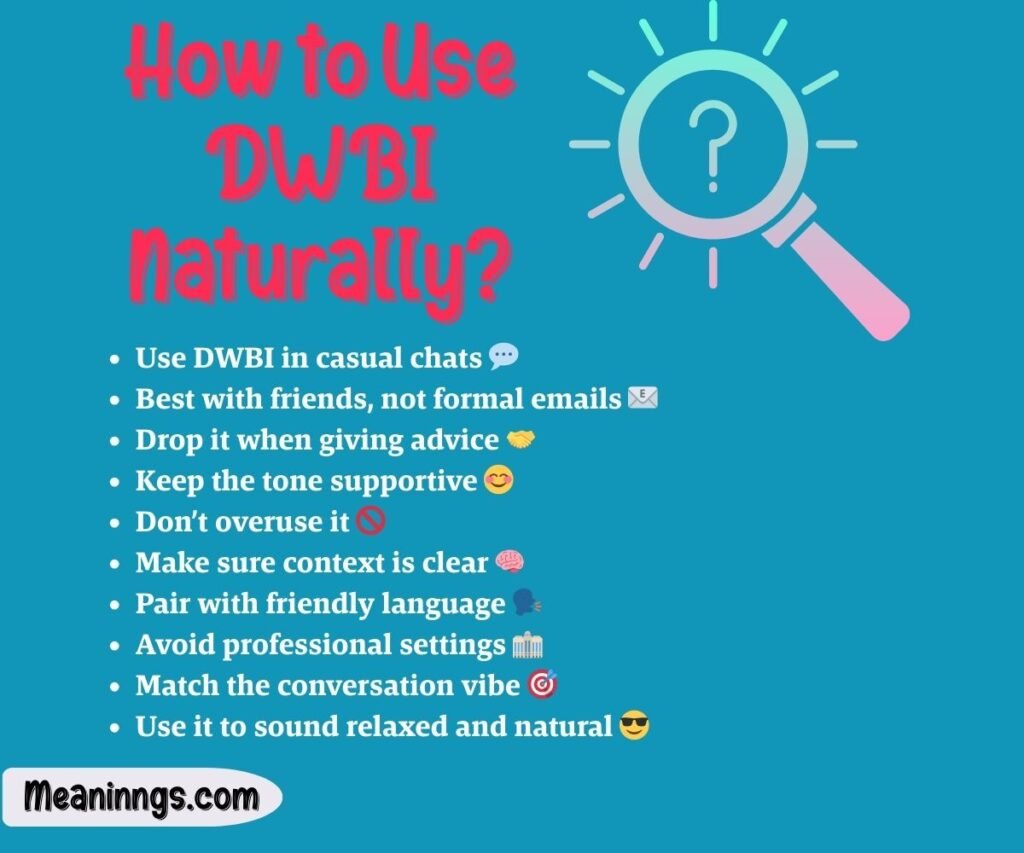
Knowing when and how to use DWBI naturally requires understanding different emotional contexts:
When Someone Apologizes
When friends apologize for minor mistakes, DWBI offers quick reassurance:
- “Sorry I forgot to text back!” → “DWBI, I know you’ve been busy”
- “My bad for being late” → “DWBI, the movie hasn’t started yet”
When Someone Feels Guilty
Help ease unnecessary guilt with a casual dismissal:
- “I feel bad about canceling” → “DWBI, we’ll reschedule soon!”
- “I shouldn’t have bothered you” → “DWBI, I’m always happy to help”
When Someone Is Overthinking
Cut through anxiety loops with simple reassurance:
- “Did I say something wrong earlier?” → “DWBI, everything’s cool”
- “Are you sure you’re not mad?” → “DWBI, seriously, all good!”
When Something Minor Goes Wrong
Minimize the impact of small problems:
- “The food order got messed up” → “DWBI, I’ll eat whatever”
- “I scratched your DVD case” → “DWBI, I never use it anyway”
Tone & Meaning Behind DWBI (Emotional Breakdown)
While DWBI typically conveys reassurance, its tone can shift based on context:
Reassuring & Caring: “DWBI, everyone makes mistakes” (warm, supportive)
Dismissive & Casual: “DWBI” (brief, potentially indifferent)
Nonchalant & Cool: “Eh, DWBI” (relaxed, unbothered)
Context matters enormously. The same abbreviation can feel comforting from a close friend but cold from someone you don’t know well. Pay attention to your relationship with the recipient before using DWBI.
DWBI Usage Table (Do’s & Don’ts)
| Situation | Do | Don’t |
| Friend apologizes for minor issue | Use DWBI to reassure quickly | Overuse it repeatedly |
| Professional email | Use “No problem” or “Not to worry” | Use DWBI (too casual) |
| Someone is genuinely upset | Show empathy with fuller responses | Dismiss feelings with just DWBI |
| Fast-paced group chat | Use DWBI for efficiency | Use without understanding tone |
| Cross-cultural communication | Consider formality preferences | Assume everyone knows slang |
| Close friend relationship | Use freely in casual contexts | Use if it might seem dismissive |
How DWBI Differs From DW (Don’t Worry)
While both abbreviations share similar meanings, key differences exist:
DWBI (Don’t Worry ‘Bout It):
- More casual and laid-back
- Can sound slightly dismissive
- Specifically addresses a particular issue or concern
- Often used to end discussion on a topic
- More popular among younger users
DW (Don’t Worry):
- Broader, more general reassurance
- Slightly more formal (though still casual)
- Can stand alone more easily
- More universally recognized
- Less potentially dismissive
Think of DW as a gentle reassurance, while DWBI adds a layer of “and let’s move on from this.”
Why DWBI Is Becoming Popular in 2025
Several cultural and technological trends have boosted DWBI’s popularity:
Social Media Amplification: Platforms like TikTok and Instagram have accelerated slang adoption. According to recent data, approximately 40% of Gen Z users incorporate DWBI into regular texting habits.
Speed Culture: Our increasingly fast-paced digital lives demand quicker communication methods. DWBI fits perfectly into rapid-fire text exchanges.
Emotional Intelligence in Digital Spaces: There’s growing awareness of managing anxiety and stress through language. DWBI serves as an emotional de-escalation tool.
Influencer Impact: Content creators and influencers frequently use DWBI, exposing millions of followers to the term and normalizing its usage.
Cultural & Linguistic Perspective on DWBI
From a linguistic standpoint, DWBI represents the ongoing evolution of English in digital spaces. Language researchers note that texting abbreviations serve important social functions beyond mere convenience.
In Western English-speaking Countries: Casual abbreviations like DWBI are widely accepted among peers and younger demographics. The informal tone fits well with cultural preferences for directness and efficiency.
In Asian and Middle Eastern Cultures: More formal or indirect communication styles may be preferred. What seems friendly in one culture might appear dismissive in another. When communicating across cultures, consider your audience’s communication norms.
Generational Differences: Younger users (Gen Z and Millennials) embrace DWBI naturally, while older generations may find it too casual or unclear. This generational gap highlights how digital language evolves differently across age groups.
Example Sentences Using DWBI (Custom-Written)
Here are additional natural examples showing DWBI in various contexts:
- “I accidentally deleted your voicemail.” → “DWBI, it wasn’t important anyway.”
- “Should I pick up extra snacks?” → “DWBI, we have plenty already.”
- “I hope I didn’t wake you with that text!” → “DWBI, I was already up scrolling.”
- “Thanks for lending me your charger yesterday!” → “DWBI, anytime you need it!”
- “I’m stressing about tomorrow’s presentation.” → “You’ll crush it, DWBI!”
- “Sorry for the double text!” → “DWBI, I do it all the time lol”
Misunderstandings or Confusions Around DWBI
Despite its simplicity, DWBI can cause confusion:
Seeming Dismissive When Comforting Is Needed: If someone shares a genuine concern, responding with only “DWBI” might feel cold or uncaring. In serious situations, take time for fuller, more empathetic responses.
Cultural Misinterpretation: Non-native English speakers or those unfamiliar with texting slang might misunderstand the abbreviation entirely or perceive it as rude.
Tone Ambiguity: Without vocal cues, DWBI’s tone depends entirely on context. The same text can seem friendly or annoyed depending on the relationship and situation.
Confusion With Other Acronyms: Some people mistake DWBI for technical terms (like Data Warehousing & Business Intelligence in IT contexts) or confuse it with similar abbreviations like DBI.
How to Respond When Someone Says DWBI
Knowing how to respond appropriately maintains conversation flow and shows emotional awareness:
Friendly Response
- “Haha thanks, you’re the best!”
- “Appreciate you 🙌”
- “Cool, let’s hang soon then!”
Grateful Response
- “Thanks for understanding!”
- “You’re awesome, seriously”
- “I appreciate that, means a lot”
Neutral Response
- “Okay cool”
- “Sounds good 👍”
- “Alright!”
Playful Response
- “If you insist! 😄”
- “Phew, was stressing lol”
- “You always know what to say!”
Supportive Response
- “Same goes for you btw”
- “Thanks, I’ll remember that”
- “Right back at you!”
Longer Examples in Realistic Conversations
Scenario 1: Forgotten Birthday
Sarah: “OMG I just realized I missed your birthday last week! I’m the worst friend ever 😭” Alex: “DWBI! We can celebrate whenever. Plus you sent me that hilarious meme yesterday, that counts!” Sarah: “Okay but I’m definitely taking you out for dinner” Alex: “Only if you stop feeling guilty about it 😊”
Scenario 2: Project Delay
Mike: “Hey, I know the design was due today but I’m still working on it” Jamie: “DWBI, take your time to make it good” Mike: “Should be done by tomorrow afternoon?” Jamie: “Perfect, no rush on my end”
Scenario 3: Cancelled Plans
Taylor: “I have to cancel tonight, my car broke down 🚗💔” Jordan: “DWBI! Is everything okay? Need a ride?” Taylor: “I’m good, waiting for roadside assistance” Jordan: “Let me know when you’re free to reschedule”
Is DWBI Used Worldwide?
DWBI is primarily used in English-speaking countries and communities, particularly in:
- United States: Very common among younger demographics
- United Kingdom: Growing usage, especially on social media
- Canada: Popular in informal texting
- Australia: Increasingly used among Gen Z
However, its usage spreads beyond these regions through social media’s global reach. International users on platforms like Instagram, TikTok, and WhatsApp encounter and adopt DWBI through exposure to English-language content.
Language Learning Communities: English learners actively study texting slang to better understand native speakers and communicate more naturally in digital spaces.
Is DWBI Tone Always Positive?
Not necessarily. While DWBI typically aims to reassure, it can occasionally carry negative undertones:
Positive Tone: “I spilled your drink, I’m so sorry!” → “DWBI, I’ll get another one!”
Neutral Tone: “Should I bring extra chairs?” → “DWBI, we have enough”
Potentially Negative/Dismissive Tone: “I was hoping we could talk about this” → “DWBI” (can feel like shutting down conversation)
The key factors affecting tone include:
- Relationship closeness
- Context of the conversation
- Additional words or emojis included
- Previous interaction history
Comparing DWBI With Other Reassuring Slang

| Abbreviation | Full Meaning | Tone | Best Used When |
| DWBI | Don’t Worry ‘Bout It | Casual, possibly dismissive | Quick reassurance for minor issues |
| DWAI | Don’t Worry About It | Slightly more formal | Showing genuine concern |
| DW | Don’t Worry | General reassurance | Broad situations |
| NP | No Problem | Neutral acknowledgment | Responding to thanks |
| NBD | No Big Deal | Emphasis on insignificance | Minimizing problems |
| NVM | Never Mind | Topic dismissal | Dropping a subject |
Why Understanding DWBI Helps You Communicate Better
Mastering modern texting slang like DWBI offers several communication advantages:
Faster Responses: Quick, efficient replies keep conversations flowing naturally without typing delays.
Social Fluency: Understanding current slang helps you connect with peers and participate confidently in digital conversations.
Tone Control: Knowing when DWBI is appropriate versus when longer responses are needed demonstrates emotional intelligence.
Cultural Awareness: Recognizing informal language patterns helps you navigate different communication contexts appropriately.
Relationship Building: Using shared language strengthens bonds and creates a sense of community with friends and peers.
FAQs
What does DWBI mean in text?
DWBI means “Don’t Worry ‘Bout It” – a casual way to reassure someone not to stress about something minor in text messages and social media.
Is DWBI rude or disrespectful?
DWBI isn’t inherently rude, but context matters. It can seem dismissive in serious situations or with people you don’t know well. Use it primarily with friends in casual conversations.
Should I use DWBI in professional messages?
No. DWBI is too informal for professional settings. Use complete phrases like “No problem,” “Don’t worry,” or “It’s perfectly fine” in work emails and business communication.
Does DWBI have a technical meaning?
In texting, DWBI means “Don’t Worry ‘Bout It.” However, in IT and business contexts, DWBI can stand for “Data Warehousing & Business Intelligence” – a completely different technical term.
What’s the shorter version of DWBI?
The shorter version is DW, meaning “Don’t Worry.” It’s more widely recognized and slightly less casual than DWBI.
Conclusion
DWBI has become a staple of modern digital communication, offering a quick, casual way to reassure friends and dismiss minor concerns. While its informal tone makes it perfect for text messages, social media, and casual chats, understanding when and where to use it appropriately is crucial for effective communication.
Remember that DWBI works best with friends in low-stakes situations. For more serious conversations, professional contexts, or when someone genuinely needs support, take the time to craft fuller, more thoughtful responses. Language is powerful – use DWBI to keep things light, but don’t let brevity replace genuine care and connection.

Muhammad Shoaib is a language-focused content writer and researcher at Meaninngs.com, where he explains the meaning of words, phrases, and text in a clear and reader-friendly way. His work focuses on simplifying language, uncovering context, and helping readers understand text with confidence and clarity.