Ever received a text that simply says “WSG?” and found yourself staring at your screen, wondering what it means? You’re not alone. In today’s fast-paced digital world, acronyms like WSG have become the new language of connection, especially among younger generations. Whether you’re scrolling through Snapchat, replying to Instagram DMs, or just trying to keep up with modern texting culture, understanding WSG is essential for staying fluent in online conversations.
In this comprehensive guide, we’ll decode everything about WSG—from its basic meaning and cultural origins to smart reply strategies and real-world usage scenarios. By the end, you’ll know exactly when and how to use WSG like a pro.
What Is “wsg”? — Definition and Basic Meaning
WSG stands for “What’s Good?”—a casual, informal greeting that’s become a staple in digital communication. Think of it as the modern equivalent of “What’s up?” or “How are you?” but with a more laid-back, friendly vibe.
When someone sends you “WSG,” they’re essentially:
- Saying hello and checking in
- Asking how you’re doing
- Starting a conversation in a relaxed way
- Showing interest in what’s happening in your life
The beauty of WSG lies in its simplicity. It’s three letters that pack a friendly punch, perfect for the fast-paced nature of texting and social media where brevity rules.
Origin and Evolution of “wsg”
The phrase “What’s good?” has deep roots in African American Vernacular English (AAVE) and hip-hop culture, where it’s been used as a casual greeting for decades. The transition from spoken phrase to text acronym happened gradually:
| Time Period | Development |
| Early 2000s | “What’s good?” used verbally in hip-hop communities and youth culture |
| Mid-2010s | Social media expansion makes shorthand communication standard |
| 2019-2020 | “WSG” surfaces frequently in texts, hashtags, and chat platforms |
| 2020s-Present | Becomes globally recognized across Snapchat, TikTok, Instagram, and messaging apps |
The acronym gained massive popularity alongside the rise of platforms like Snapchat (launched 2011) and TikTok, where character limits and quick communication are the norm. Today, WSG is understood by millions of users worldwide, transcending its original cultural boundaries while maintaining respect for its AAVE origins.
Different Shades of Meaning: How Context Influences “wsg”
While WSG primarily means “What’s good?”, its implied meaning shifts based on context:
1. General Greeting Simply equivalent to “Hello, how are you?” Used when casually reaching out to friends or acquaintances.
2. Expressing Interest Shows genuine curiosity about what someone is doing or what’s happening in their life. Example: “WSG? Haven’t heard from you in a minute.”
3. Flirtatious Context Often used as an opening line when flirting, typically accompanied by emojis like 😏, 😉, or 🔥.
4. Checking Availability Can signal interest in making plans or seeing if someone is free to talk or hang out.
5. Boastful or Challenging Tone Occasionally used rhetorically as a challenge, like “WSG? Think you can beat me at this game?”
Understanding these nuances helps you interpret the sender’s intention and respond appropriately.
Who Uses “wsg” — Generational & Cultural Perspectives
Gen Z (Born 1997-2012)
WSG is everyday vocabulary for Gen Z. They use it naturally across all platforms—DMs, game chats, social media comments, and text messages. It fits their preference for efficient, casual communication.
Millennials (Born 1981-1996)
Millennials understand and occasionally use WSG, though they might default to “What’s up” or “Hey there” more frequently. They’re familiar with the term but use it less consistently.
Older Generations
Baby Boomers and Gen X typically don’t use WSG. They prefer traditional greetings like “Hello” or “How are you?” If they encounter WSG, they may need explanation.
Cultural Perspective
WSG originated in the Black community and hip-hop culture. Using it means participating in language that has cultural significance. While it’s now mainstream, acknowledging its roots shows cultural awareness and respect.
How to Respond to “wsg” — Smart & Natural Replies
Responding to WSG depends on your relationship with the sender and the conversation context. Here are proven response strategies:
Friendly Replies
Perfect for casual conversations with friends:
- “Not much, just chilling. You?”
- “All good here! What’s up with you?”
- “Just finished work, finally relaxing. Wbu?”
- “Same old, same old. What about you?”
- “Living the dream! How about you?”
Flirty or Playful Replies
Use these when there’s romantic interest or playful banter:
- “Better now that you texted 😊”
- “WSG? Hopefully us, if you’re free tonight 👀”
- “Just thinking about you, actually. What’s good with you?”
- “Nothing much, but I’d rather be hanging with you”
- “Trying to figure out how to steal your heart. Any tips?”
Casual or Group Chat Replies
Keep it light and conversational:
- “Chillin. You?”
- “Nm (nothing much), wbu?”
- “Just vibing. What’s up?”
- “Not much! What’s going on?”
- “The usual. You good?”
Business / Collaboration Context
While rare, if WSG appears in a relaxed professional setting:
- “Hey! Things are good, just wrapping up some projects. How can I help?”
- “Doing well, thanks for checking. What’s on your mind?”
Pro Tip: Match the sender’s energy. If they send “WSG?” with emojis and enthusiasm, respond with similar warmth. If it’s a simple check-in, keep your reply equally casual.
Alternatives and Similar Slang to “wsg”
WSG exists alongside other popular texting acronyms. Here’s how they compare:
| Acronym | Meaning | Usage Context |
| WYD | What You Doing | Asks specifically about current activity |
| WYA | Where You At | Asks about location, often for meetup planning |
| SUP | What’s Up | General greeting, slightly less trendy |
| WSP | What’s Up | Nearly identical to WSG, interchangeable |
| HYD | How You Doing | More focused on emotional state |
| WBU | What About You | Follow-up question after sharing your status |
Key Difference: WSG is about overall state and vibe, while WYD focuses on specific activities. WSG feels more contemporary and Gen Z-friendly.
When to Use “wsg” — Appropriate Contexts
✅ Use WSG When:
- Texting friends your age or younger
- Chatting on Snapchat, Instagram, or TikTok
- Starting casual conversations in group chats
- Reconnecting with someone after time apart
- Gaming chat or online communities
- Social media comments on friends’ posts
- Keeping Snapchat streaks alive
- Setting a relaxed, friendly tone
❌ Avoid WSG When:
- Professional or work-related communication
- Formal emails or business correspondence
- Talking with older relatives unfamiliar with slang
- Serious or sensitive conversations
- Academic settings or with professors
- First-time communication with authority figures
- Job applications or networking
The rule of thumb: if you’d normally use proper grammar and formal language, don’t use WSG.
Risks and Misinterpretations: What Can Go Wrong
While WSG is generally harmless, misunderstandings can happen:
1. Tone Misreading Without vocal cues, WSG can sound rude or dismissive if mistimed. A simple “WSG” might seem cold if the recipient expects warmth.
2. Generational Gap Older recipients might find WSG confusing or unprofessional, potentially creating awkwardness.
3. Cultural Appropriation Concerns Using AAVE-derived slang without understanding its cultural context can be perceived as appropriation, especially by those from the originating community.
4. Over-Casualness Using WSG in situations requiring professionalism can damage your credibility or seem disrespectful.
5. Leaving Someone on “WSG” Sending just “WSG” without follow-up can feel like low-effort communication, leaving the recipient unsure how to respond.
Safety Tip: Always consider your audience. When in doubt, err on the side of being slightly more formal than too casual.
Examples of “wsg” in Real Conversations
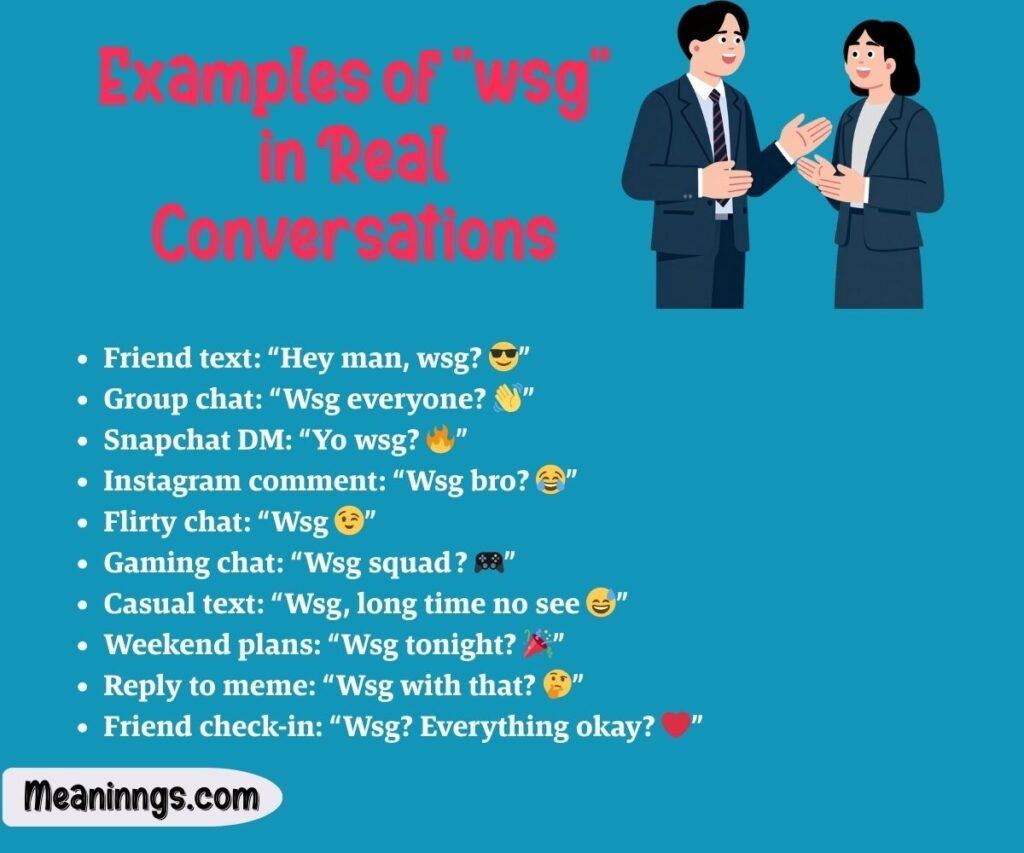
Example 1: Casual Check-In
Person“WSG? Haven’t talked in forever”
Person B: “Facts! Been crazy busy. How you been?”
Example 2: Making Plans
Person“WSG tonight?”
Person B: “Nothing planned yet. What’s up?”
Person“Wanna catch a movie?”
Example 3: Flirty Exchange
Person“WSG cutie? 😏”
Person B: “Better now that you texted 😊 What about you?”
Example 4: Group Chat
Person“WSG everyone?”
Person B: “Just finished the assignment!”
Person C: “Chillin, about to game”
Example 5: Snapchat Story Reply
Person(Posts gym selfie)
Person B: “WSG with you posting gym pics every day? 💪”
Person“Just getting that fitness in! You should join”
Expert Insight: Why “wsg” and Slang Matter in Modern Communication
According to digital communication researchers, acronyms like WSG serve several important functions:
Efficiency: In an age of information overload, short greetings save time while maintaining connection.
Social Bonding: Using current slang signals group membership and cultural awareness. It says “I understand your world.”
Tone Setting: WSG immediately establishes a casual, friendly atmosphere, lowering formality barriers.
Linguistic Evolution: Slang reflects how language naturally evolves with technology and cultural shifts. Understanding it keeps you relevant in digital spaces.
Dr. Sarah Thornton, linguist specializing in digital communication, notes: “Acronyms like WSG aren’t just abbreviations—they’re social tools that help people navigate relationship dynamics and establish rapport quickly in text-based environments.”
Tips for Using “wsg” Well — Best Practices
1. Know Your Audience Before using WSG, ask yourself: Would this person understand and appreciate casual slang?
2. Follow Up Meaningfully Don’t just drop “WSG” and disappear. Be ready to engage in conversation.
3. Match the Energy Mirror the formality level of previous messages. If someone uses proper grammar, maybe stick to “Hey” instead.
4. Use Appropriate Emojis Emojis clarify tone. A simple “WSG? 😊” feels friendlier than a standalone “WSG”
5. Don’t Overuse It Variety keeps conversations fresh. Mix up your greetings—sometimes use “Hey,” “What’s up,” or other casual openers.
6. Read the Room If someone seems confused or doesn’t reciprocate slang usage, adjust your communication style.
7. Respect Cultural Origins Acknowledge that WSG comes from AAVE and use it respectfully, not mockingly.
When Not to Use “wsg”: Common Pitfalls
Pitfall #1: Professional Settings Never use WSG in job applications, emails to supervisors, or formal business communication.
Pitfall #2: First Impressions When meeting someone’s parents, professors, or professional contacts, avoid slang entirely.
Pitfall #3: Serious Conversations If discussing sensitive topics, grief, or conflict, WSG feels inappropriately casual.
Pitfall #4: With Unfamiliar Recipients Don’t assume everyone knows internet slang. If uncertain, use standard greetings.
Pitfall #5: Excessive Abbreviation Mixing too many acronyms (“WSG? WYD later? HMU”) can feel exhausting or juvenile.
Why People Use “wsg” — Motivations & Social Functions
People choose WSG over traditional greetings for several reasons:
Speed: Three characters beat typing “What’s good?” or “How are you?”
Coolness Factor: WSG sounds modern and trendy, appealing to younger users.
Low Pressure: It’s less formal than “How are you?” and doesn’t demand a detailed response.
Versatility: Works as greeting, question, or conversation starter.
Social Currency: Using current slang demonstrates cultural fluency and connection to youth culture.
Identity Signaling: It shows you’re part of the in-group that understands digital communication norms.
How “wsg” Relates to Other Texting Trends
WSG fits into broader texting trends:
Abbreviation Culture: Like LOL, BRB, and TBH, WSG represents the ongoing compression of language in digital spaces.
Visual Communication: WSG often pairs with emojis, GIFs, or Bitmojis, creating multimodal messages.
Ephemeral Messaging: On platforms like Snapchat where messages disappear, WSG suits the quick, casual vibe.
Meme Integration: WSG frequently appears in memes and viral content, reinforcing its cultural relevance.
Platform-Specific Adaptation: While the core meaning stays consistent, WSG usage varies slightly between TikTok captions, Snapchat DMs, and Instagram comments.
Variations and Mistakes to Watch For
Common Variations:
- wsg (lowercase, most common)
- WSG (all caps, adds emphasis)
- Wsg (capitalized first letter)
- WSG? (with question mark, slightly more formal)
- WSGGGG (extended letters, showing enthusiasm)
Spelling Mistakes to Avoid:
- WSC (incorrect)
- WGS (wrong order)
- WSH (different meaning entirely)
Alternative Meanings (Context-Dependent):
- With Special Guest: In event promotions (e.g., “Live concert WSG Drake”)
- Water, Sewer, Gas: In real estate listings
- World Surfing Games: Sports context
- Work Safe Guide: Professional/technical context
In texting and social media, WSG almost always means “What’s Good?” but stay alert to context clues.
The Impact of “wsg” on Communication
WSG has influenced digital communication in several ways:
Positive Impacts:
- Makes online conversations feel more personal and less robotic
- Breaks down formality barriers in appropriate contexts
- Facilitates quick check-ins that maintain relationships
- Creates shared language among peer groups
Potential Concerns:
- May contribute to declining formal writing skills
- Can create communication gaps between generations
- Risks oversimplifying complex greetings into one-size-fits-all phrases
- Might perpetuate cultural appropriation if used without awareness
Balance is Key: WSG works best when used consciously as one tool in a diverse communication toolkit, not as a replacement for all other greetings.
Real-World Scenarios: When “wsg” Comes Up
ScenarioCatching Up with Friends
Context: You haven’t talked to your high school friend in months.
Message: “WSG? Miss seeing you around!”
Why It Works: Shows casual warmth and reopens communication without pressure.
Scenario B: Reconnecting After Time Apart
Context: Someone you met at a party follows up a week later.
Message: “Hey! WSG? Really enjoyed talking to you last weekend”
Why It Works: Balances casual and interested, opening space for conversation.
Scenario C: Game Chat
Context: You join your gaming squad online.
Message: “WSG squad? Ready to run some matches?”
Why It Works: Sets a relaxed, team-oriented tone perfect for gaming culture.
Scenario D: Social Media DM
Context: Someone comments on your Instagram story.
Message: “WSG? That food looks amazing! Where’d you get it?”
Why It Works: Casual opening that seamlessly transitions into specific interest.
Building Trust and Authenticity with “wsg”
For brands and content creators, using WSG can build relatability:
Do:
- Use WSG if your target audience is Gen Z or younger millennials
- Maintain consistency with your overall brand voice
- Pair with authentic, non-forced content
- Understand the cultural context before using
Don’t:
- Force slang that doesn’t fit your brand personality
- Use WSG in formal product announcements
- Overuse it to the point of seeming desperate for youth appeal
- Appropriate AAVE language without acknowledging its origins
Example Brand Use: “WSG fam? 👀 New drop coming tomorrow. Who’s ready?”
This works for streetwear or youth-focused brands but would feel out of place for luxury goods or corporate services.
Cultural and Linguistic Insight on “wsg”
From a Natural Language Processing (NLP) perspective, WSG presents interesting challenges:
Entity Recognition: AI systems must distinguish WSG (What’s Good) from other potential meanings based on context.
Sentiment Analysis: Understanding whether WSG carries neutral, positive, or flirty sentiment requires analyzing surrounding words and emojis.
Register Classification: WSG clearly signals informal register, helping AI systems adjust tone in automated responses.
Cross-Cultural Translation: WSG’s AAVE origins mean direct translation to other languages often loses cultural nuance.
Linguistic Perspective: WSG demonstrates how marginalized language varieties influence mainstream communication, a process called “linguistic democratization.”
How “wsg” Fits into Professional and Creative Branding
While WSG is primarily casual, some professional contexts embrace it:
Creative Industries: Marketing agencies, design studios, and content creation companies often use WSG to maintain approachable brand voices.
Tech Startups: Youth-focused tech companies incorporate WSG in internal communications and casual customer service.
Social Media Management: Brands targeting Gen Z deliberately use WSG in captions and comment responses to build rapport.
Influencer Marketing: Content creators use WSG to maintain authentic connections with followers.
Caution: B2B companies, financial institutions, healthcare providers, and legal firms should avoid WSG entirely to maintain professional credibility.
Better Communication: Blending Slang & Clarity
The key to effective communication is code-switching—knowing when to use WSG and when to use formal language:
Code-Switching Examples:
With Friends (Casual): “WSG? Wanna grab food later?”
With Colleagues (Professional): “Hi everyone, hope you’re doing well. Would anyone like to join for lunch?”
With Family Elders (Respectful): “Hi Grandma! How are you doing today?”
Mastering this flexibility makes you a more effective communicator across all contexts.
The Future of “wsg” and Texting Slang
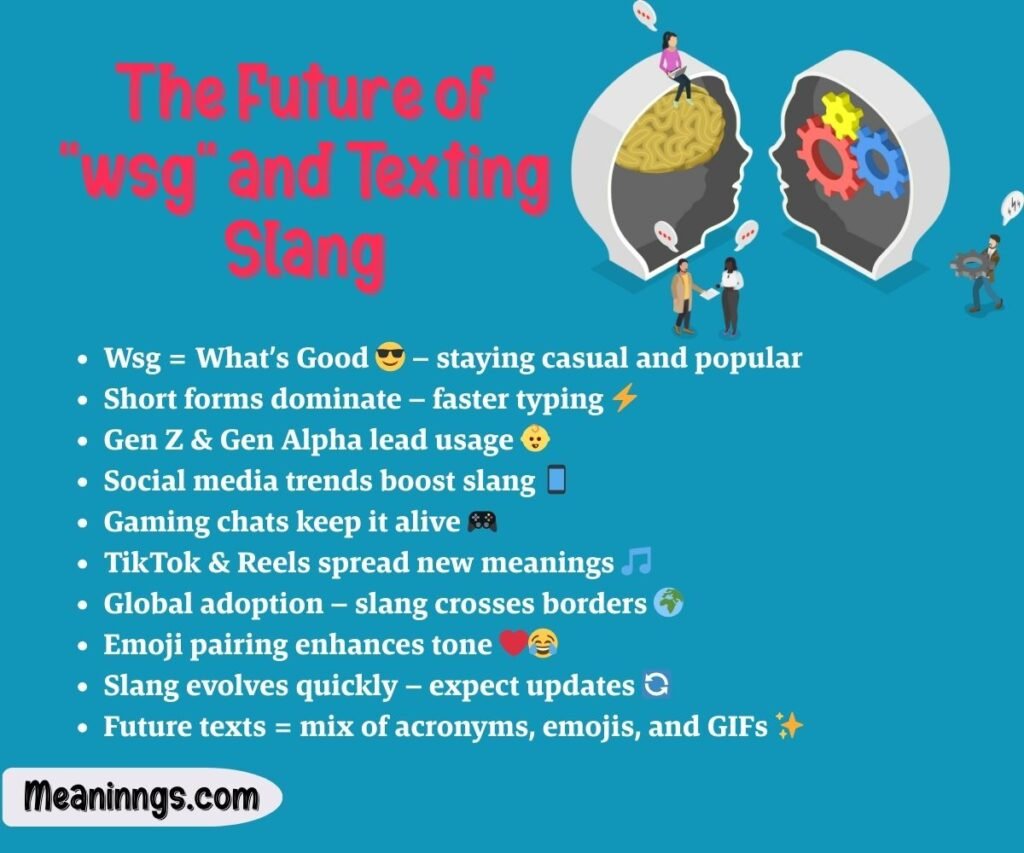
Like all slang, WSG’s popularity may eventually wane, but current trends suggest:
Short-Term (2026-2028): WSG will likely remain popular, especially on visual platforms like TikTok and Snapchat.
Medium-Term (2028-2030): New acronyms may emerge, but WSG will probably maintain recognition, similar to how “LOL” endures despite being decades old.
Long-Term (2030+): WSG might become legacy slang—understood but less actively used by emerging generations who create their own linguistic markers.
What’s Next? As virtual reality and voice messaging become more prevalent, we may see a shift back toward spoken phrases rather than typed acronyms, or entirely new forms of abbreviated communication.
Summary Breakdown: Why “wsg” Matters
Key Takeaways:
- WSG = “What’s Good?” — a casual greeting popular in digital communication
- Origins: Rooted in AAVE and hip-hop culture, emerged as acronym around 2019-2020
- Usage: Perfect for friends, peers, and casual social media interactions
- Responses: Keep it light, match the sender’s energy, and follow up meaningfully
- Avoid: Professional settings, formal contexts, and with unfamiliar audiences
- Cultural Awareness: Respect WSG’s origins and use it authentically, not mockingly
Understanding WSG helps you navigate modern communication with confidence, build genuine connections, and stay current in digital conversations.
Related Topics / Internal Linking Ideas
- WYD Meaning in Text: Complete Usage Guide
- TikTok Slang Dictionary 2026
- How to Text Like Gen Z: A Complete Guide
- Understanding AAVE and Its Impact on Modern Slang
- Snapchat Etiquette: Do’s and Don’ts
- Professional vs. Casual Communication: When to Code-Switch
Quote on Language & Texting
“Language is always changing. The velocity of changes is impacted by technology and the rate of information exchange. Digital communication accelerates linguistic evolution, creating new forms of expression that reflect how we actually connect with each other.” — Dr. Naomi Baron, Professor of Linguistics
Frequently Asked Questions
What does WSG mean in text?
WSG stands for “What’s Good?” — a casual greeting similar to “What’s up?” or “How are you?”
How do you respond to WSG?
Respond casually like “Not much, you?” or “All good! What’s up?” Match the sender’s energy.
Is WSG the same as WYD?
No. WYD asks “What You Doing” (specific activity), while WSG means “What’s Good” (general greeting/state).
Can I use WSG in professional emails?
No. WSG is too casual for professional settings. Use “Hello” or “How are you?” instead.
Where did WSG originate?
WSG comes from “What’s good?” in African American Vernacular English (AAVE) and hip-hop culture, becoming mainstream through social media.
Is WSG flirty?
It can be, depending on context and emojis used, but it’s primarily just a friendly greeting.
What does WSG mean on Snapchat?
Same as texting — “What’s Good?” Often used to start conversations or keep streaks alive.
When should I avoid using WSG?
Avoid WSG in professional contexts, with older adults unfamiliar with slang, or during serious conversations.
What are alternatives to WSG?
Try WYD, SUP, WSP, or simply “What’s up?” for similar casual vibes.
How popular is WSG in 2026?
Very popular among Gen Z and younger millennials, especially on TikTok, Snapchat, and Instagram.
Final Thoughts
In the ever-evolving landscape of digital communication, understanding acronyms like WSG isn’t just about knowing what letters stand for—it’s about cultural fluency, social connection, and effective communication across different contexts.
WSG represents more than a shorthand greeting; it’s a linguistic bridge that connects people in our fast-paced digital world. Whether you’re a parent trying to understand your teenager’s texts, a marketer targeting younger audiences, or simply someone who wants to stay current with modern communication, knowing WSG helps you navigate online conversations with confidence and authenticity.

Muhammad Shoaib is a language-focused content writer and researcher at Meaninngs.com, where he explains the meaning of words, phrases, and text in a clear and reader-friendly way. His work focuses on simplifying language, uncovering context, and helping readers understand text with confidence and clarity.