If you’ve spent any time texting, scrolling through social media, or chatting online, you’ve probably seen “BTW” pop up in conversations. Maybe you’ve even used it yourself without thinking twice. But do you really know what BTW means, where it came from, and when you should (or shouldn’t) use it?
Understanding digital abbreviations like BTW isn’t just about keeping up with trends. It’s about communicating clearly, avoiding misunderstandings, and knowing how to adapt your language to different situations. In this guide, we’ll break down everything you need to know about BTW in 2026, from its meaning and origin to practical usage tips and common mistakes.
What Does “BTW” Mean in Text?
BTW stands for “By The Way.” It’s one of the most popular internet abbreviations used to introduce additional information, change topics smoothly, or add a side note to an ongoing conversation.
When you see BTW in a message, it signals that what follows is related but not central to the main point. Think of it as a conversational pivot that keeps dialogue flowing naturally without abrupt interruptions.
Here’s a simple example: “I finished the report. BTW, the meeting got moved to 3 PM.”
In this case, BTW introduces new but relevant information without disrupting the original message about the report.
Key Characteristics of BTW:
- Informal tone: Best suited for casual conversations
- Transition phrase: Helps shift between topics
- Time-saver: Reduces typing effort in fast-paced chats
- Universally recognized: Used across age groups and cultures
The Origin of “BTW”
The phrase “by the way” has existed in English for centuries, dating back to Shakespeare’s time. In A Midsummer Night’s Dream (1590), Shakespeare wrote: “Let’s follow him, and by the way let us recount our dreams.”
However, the abbreviation BTW emerged much later with the rise of digital communication. According to linguistic records, BTW first appeared in online usage around 1989. During the early days of internet chat rooms and bulletin board systems in the 1990s, people needed shortcuts to communicate quickly.
When typing on old-fashioned keyboards and early mobile phones with number pads, brevity became essential. Internet users began creating initialisms like LOL, BRB, and BTW to speed up conversations. These abbreviations helped save time and effort while maintaining conversational flow.
BTW gained widespread popularity throughout the 2000s as texting and social media platforms like Facebook, Twitter, and Instagram became mainstream. Today, it’s recognized globally as standard digital language, transcending linguistic and cultural boundaries.
When and How to Use “BTW”
Using BTW effectively depends on understanding context, tone, and audience. Here are the primary ways people use this abbreviation:
Adding Extra Information
BTW works perfectly when you want to share details that complement your main message:
- “The party starts at 7. BTW, parking is free behind the building.”
- “I loved your presentation. BTW, the data on slide 5 was really impressive.”
Changing Topics Smoothly
When you need to shift conversation direction without being abrupt:
- “That movie was amazing. BTW, have you seen the new series everyone’s talking about?”
- “Thanks for the update. BTW, did you get my email from yesterday?”
Giving Reminders
BTW softens reminders, making them feel less demanding:
- “BTW, don’t forget about the deadline tomorrow.”
- “Great discussion today. BTW, we still need your feedback on the proposal.”
Introducing Side Notes
For adding observations or comments that aren’t crucial but worth mentioning:
- “I’m heading to the store. BTW, your package arrived earlier.”
- “The event was well-organized. BTW, I ran into Sarah there.”
Common Situations for Using BTW
| Situation | Example | Why It Works |
| Casual texting with friends | “Can’t wait for dinner! BTW, I’m bringing dessert.” | Keeps tone light and friendly |
| Social media comments | “Great post! BTW, your photography skills are amazing.” | Adds personal touch without overshadowing main comment |
| Internal work chats | “The report is ready. BTW, I updated the format.” | Informal but professional for team communication |
| Quick updates | “BTW, the store closes at 9 today.” | Delivers important info efficiently |
| Topic transitions | “That reminds me, BTW, how did your interview go?” | Smoothly bridges different subjects |
Tone and Context Matter
While BTW is neutral by itself, the surrounding context dramatically affects how it’s perceived. Understanding this helps you avoid miscommunication.
When BTW Sounds Friendly:
- “Your playlist is incredible! BTW, what’s that song at the beginning?”
- “Thanks for helping! BTW, I really appreciate it.”
When BTW Might Seem Dismissive:
- “I disagree with your point. BTW, you spelled the author’s name wrong.”
- “I can’t make it tonight. BTW, I told you last week.”
The difference lies in what comes after BTW and the overall message tone. Pairing it with criticism or corrections can make it sound passive-aggressive, even if that wasn’t your intention.
Platform-Specific Tone Variations:
Text Messages: Most natural home for BTW. Feels conversational and genuine.
WhatsApp/Messenger: Perfect for casual updates and quick transitions.
Instagram/Twitter: Works well in comments and captions for side notes.
Email: Use sparingly. In professional emails, consider writing out “by the way” or using alternatives like “additionally” or “on a related note.”
LinkedIn: Generally too informal. Opt for professional alternatives instead.
Variations and Alternatives of BTW
BTW isn’t the only way to introduce side information. Here are common variations and alternatives:
BTW Variations:
- btw (lowercase): Most common in casual texting
- Btw (capitalized first letter): Slightly more formal
- B-T-W (spelled out): Used when saying it aloud
- BT Dubs: Slang pronunciation popular among teens
Professional Alternatives:
- Additionally
- Furthermore
- On a related note
- Just to let you know
- For your information (FYI)
- I wanted to mention
- Speaking of which
- As a side note
- Incidentally
- In case you missed it (ICYMI)
Casual Alternatives:
- Oh, and
- Also
- Plus
- By the way (spelled out)
- Quick note
- Side note
- Fun fact
BTW in Different Platforms
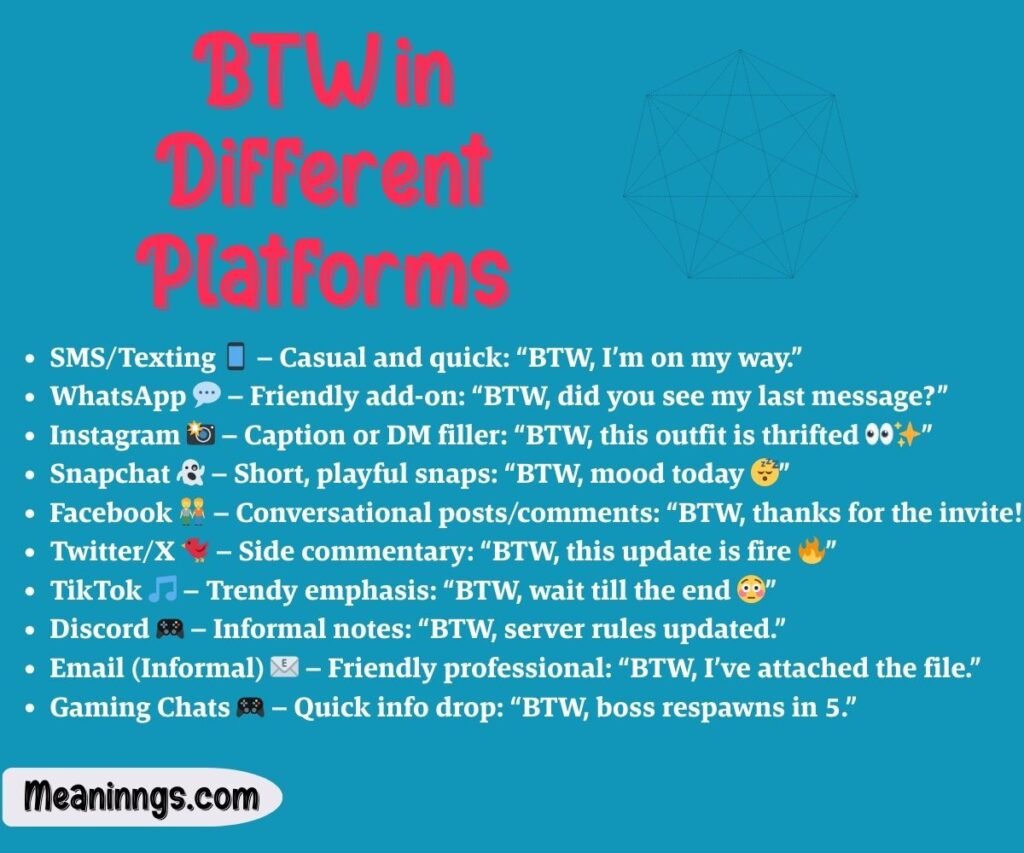
Each digital platform has its own communication style, affecting how BTW is received:
Text Messaging (SMS/iMessage)
Usage: Very common and natural Tone: Friendly, conversational Best for: Quick updates, casual conversations, reminders
Social Media (Instagram, Twitter, Facebook)
Usage: Frequent in comments and captions Tone: Casual, engaging Best for: Adding context, sharing extra thoughts, connecting with followers
Messaging Apps (WhatsApp, Messenger, Telegram)
Usage: Extremely popular Tone: Informal, efficient Best for: Group chats, daily conversations, topic transitions
Professional Communication (Email, Slack)
Usage: Use cautiously Tone: Can seem too casual Best for: Internal team chats only (avoid in formal emails)
Gaming and Forums
Usage: Standard communication Tone: Very casual Best for: Quick side comments, sharing tips, changing subjects
Common Mistakes When Using “BTW”
Even though BTW is simple, people make these errors that can affect communication quality:
1. Overusing It
Using BTW multiple times in one conversation dilutes its impact: ❌ “BTW, I’m free tomorrow. BTW, did you see my message? BTW, what time works for you?” ✅ “I’m free tomorrow. Did you see my message about meeting times?”
2. Using It in Formal Settings
BTW is too casual for formal correspondence: ❌ “Dear Professor Smith, Thank you for your feedback. BTW, when is the assignment due?” ✅ “Dear Professor Smith, Thank you for your feedback. Additionally, could you clarify the assignment deadline?”
3. Placing It Awkwardly
BTW works best at the beginning of a new thought: ❌ “I was thinking, and BTW about this, that we should meet.” ✅ “I was thinking we should meet. BTW, what’s your schedule like?”
4. Misreading Tone
Not considering how BTW might sound in sensitive situations: ❌ “I heard about your job loss. BTW, are you looking for new opportunities?” ✅ “I heard about your job loss. I’m here if you need anything. When you’re ready, I’m happy to help with your job search.”
5. Confusing It With Other Abbreviations
Sometimes people mistakenly think BTW means “between”: ❌ “Let’s meet BTW 3 and 4.” ✅ “Let’s meet between 3 and 4.” (Write it out)
The Psychology Behind “BTW”
Digital communication lacks the nonverbal cues we rely on in face-to-face conversations—no facial expressions, body language, or vocal tone. Abbreviations like BTW serve as linguistic tools to manage conversation flow and emotional context.
Conversational Signaling
Professor Deborah Tannen from Georgetown University explains that transitions like “by the way” function as social cues in digital communication. They signal whether the conversation is continuing smoothly or experiencing a subtle shift.
BTW acts as a bridge, softening the introduction of new information and maintaining social bonds. Linguists call this “phatic communication“—language used to maintain relationships rather than just convey information.
Emotional Weight
Research from the University of Amsterdam (2023) found that tone ambiguity is among the top three causes of miscommunication in digital messaging. Abbreviations carry emotional weight because they shape perceived tone.
Consider these scenarios:
Friendly context: “BTW, your new haircut looks amazing!” Neutral context: “The meeting’s at 2 PM. BTW, bring your laptop.” Potentially negative: “BTW, I already told you that yesterday.”
The same abbreviation takes on different emotional colors depending on context, making awareness crucial for effective communication.
Cognitive Efficiency
Using BTW reduces cognitive load for both sender and receiver. It provides a mental “marker” that helps organize information into primary and secondary categories, making messages easier to process and remember.
Is BTW Formal or Informal?
BTW is decidedly informal. While it’s widely accepted in casual digital communication, it’s generally inappropriate for formal situations.
When BTW Is Appropriate:
- Text messages with friends and family
- Social media posts and comments
- Casual emails with colleagues you know well
- Internal team chats (Slack, Teams)
- Gaming and online forums
- Direct messages on social platforms
When to Avoid BTW:
- Formal business correspondence
- Academic papers or professional reports
- Cover letters and resumes
- Communication with clients or stakeholders
- First-time emails to strangers
- Legal or official documents
- Professional presentations
Pro Tip: When in doubt, write out “by the way” or choose a more formal alternative. Better safe than sorry when professionalism matters.
BTW and Other Common Internet Abbreviations
Understanding BTW is easier when you see it in context with related abbreviations. Here’s a comparison:
| Abbreviation | Meaning | Usage | Formality Level |
| BTW | By the way | Add side information | Informal |
| FYI | For your information | Share important details | Semi-formal |
| TBH | To be honest | Express honest opinion | Very informal |
| IMO | In my opinion | Share personal view | Informal |
| LMK | Let me know | Request response | Informal |
| ICYMI | In case you missed it | Highlight information | Informal |
| FWIW | For what it’s worth | Add perspective | Informal |
| NVM | Never mind | Dismiss or cancel | Very informal |
| BRB | Be right back | Signal temporary absence | Informal |
| SMH | Shaking my head | Express disapproval | Very informal |
These abbreviations form the foundation of modern digital shorthand. Mastering them improves communication efficiency across platforms.
How “BTW” Reflects Modern Digital Culture
BTW represents broader shifts in how we communicate in the digital age. Its evolution tells the story of internet culture itself.
Speed and Efficiency
Digital communication prioritizes speed. We’ve adapted language to match the pace of instant messaging, creating shortcuts that convey meaning quickly without sacrificing clarity.
Global Language
Despite being an English abbreviation, BTW has achieved global recognition. Non-native English speakers use it regularly, demonstrating how internet culture transcends linguistic boundaries.
Generational Adoption
Originally popular among tech-savvy users and younger generations, BTW has now spread across all age groups. Grandparents texting grandchildren use it as naturally as teenagers chatting with friends.
Platform Evolution
BTW has successfully transitioned across every major communication platform—from IRC chat rooms in the 1990s to modern platforms like Discord, TikTok, and WhatsApp. This adaptability shows its fundamental utility.
Communication Democratization
Abbreviations like BTW have democratized digital language. They create common ground regardless of education level, geographic location, or social status, making online spaces more accessible.
BTW in Pop Culture and Media
BTW has become so ubiquitous that it frequently appears in movies, TV shows, music, and other media:
Entertainment References
- TV shows use BTW in texting scenes to reflect authentic youth communication
- Song lyrics incorporate BTW to create conversational, relatable tone
- Comedians reference BTW in jokes about digital miscommunication
Marketing and Advertising
Brands use BTW in social media marketing to create friendly, approachable voices:
- “Loving our new collection? BTW, we just restocked your favorite colors.”
- “Summer sale starts tomorrow! BTW, loyalty members get early access.”
News and Journalism
Even traditional media has adapted, using BTW in more casual online articles and social media posts to engage younger audiences.
This mainstream adoption confirms BTW’s status as permanent digital vocabulary rather than temporary slang.
Expert Linguistic Insight
Linguists and communication experts have extensively studied internet abbreviations like BTW:
Dr. David Crystal, renowned linguist, notes that internet language represents natural language evolution. Abbreviations like BTW aren’t “corrupting” language but rather adapting it to new mediums.
Research findings from communication studies show that:
- People who use internet abbreviations appropriately demonstrate strong digital literacy
- Context awareness when using abbreviations correlates with higher emotional intelligence
- Abbreviations don’t negatively impact formal writing skills when used appropriately
Language evolution experts observe that BTW and similar terms follow patterns seen throughout history when new communication technologies emerge—from telegraph codes to text-speak.
The consensus: BTW represents healthy, natural language adaptation to modern communication needs.
When NOT to Use “BTW”
Knowing when to avoid BTW is just as important as knowing when to use it:
1. First Professional Interactions
Never use BTW in initial emails to potential employers, clients, or business contacts. Establish professionalism first.
2. Sensitive Conversations
Avoid BTW when discussing serious topics like illness, loss, or major life challenges. It can seem dismissive of important matters.
3. Formal Academic Writing
Never use BTW in essays, research papers, or academic correspondence. Maintain academic tone throughout.
4. Legal or Financial Communication
Keep all legal documents, contracts, and financial correspondence completely formal.
5. When Precision Matters
In situations requiring absolute clarity—like instructions, warnings, or critical information—write everything out completely.
6. Cross-Cultural Professional Settings
If you’re unsure about cultural norms, err on the side of formality until you understand the communication expectations.
Creative Ways to Use “BTW” in Text
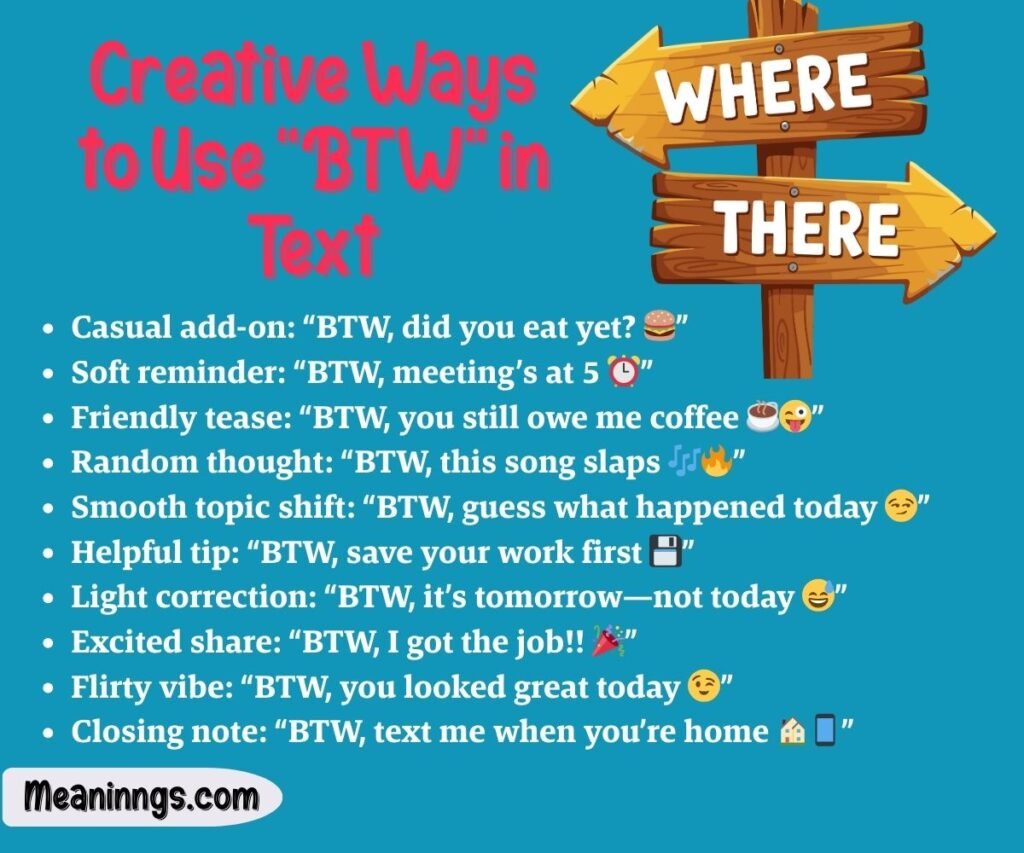
While BTW has standard uses, creative applications can make your messages more engaging:
1. Build Anticipation
“I have news to share. BTW, it’s good news!”
2. Add Humor
“Just finished cleaning the entire house. BTW, by ‘entire house’ I mean I picked up three things.”
3. Share Compliments
“BTW, that idea you mentioned yesterday? Brilliant. I can’t stop thinking about it.”
4. Create Callbacks
“BTW, remember that restaurant we discussed last month? Let’s finally go!”
5. Express Gratitude
“BTW, I never properly thanked you for helping me last week. You’re amazing.”
6. Share Discoveries
“BTW, I just found the perfect solution to that problem we’ve been discussing.”
FAQ’s
What does BTW stand for?
BTW stands for “By The Way”—used to introduce additional information or smoothly transition between topics in digital conversations.
Is BTW appropriate for professional emails?
No, BTW is too informal for most professional emails. Use alternatives like “additionally,” “furthermore,” or “on a related note” instead.
Can BTW be used on social media?
Yes, BTW is perfectly appropriate for social media posts, comments, and direct messages across all platforms.
What’s the difference between BTW and FYI?
BTW introduces side information or topic changes, while FYI (For Your Information) shares important details someone should know about.
Is it rude to use BTW?
BTW isn’t inherently rude, but context matters. It can sound dismissive if paired with criticism or used in sensitive situations.
How do you pronounce BTW out loud?
Say each letter individually (B-T-W) or use the slang “BT Dubs.” Most people just say “by the way” in spoken conversation.
When did BTW become popular?
BTW emerged in internet chat rooms around 1989 and became mainstream through 1990s-2000s texting and social media adoption.
Are there alternatives to BTW?
Yes, alternatives include: “additionally,” “also,” “on another note,” “speaking of which,” “incidentally,” and “just to let you know.”
Conclusion
BTW has evolved from a simple typing shortcut into an essential part of modern digital communication. Understanding what BTW means, where it came from, and how to use it properly empowers you to communicate more effectively across all digital platforms.
Remember these key takeaways:
- BTW means “By The Way” and introduces additional information
- It’s informal and best suited for casual digital conversations
- Context and tone dramatically affect how BTW is perceived
- Professional situations require more formal alternatives
- Knowing when NOT to use BTW is as important as knowing when to use it
As digital communication continues evolving, abbreviations like BTW will remain valuable tools for efficient, natural conversation. Master them, understand their nuances, and you’ll navigate the digital world with confidence and clarity.

Muhammad Shoaib is a language-focused content writer and researcher at Meaninngs.com, where he explains the meaning of words, phrases, and text in a clear and reader-friendly way. His work focuses on simplifying language, uncovering context, and helping readers understand text with confidence and clarity.
Pingback: Su Meaning in Text: Simple Definition, Usage, and Replies
Pingback: WSG Meaning in Text: What It Really Means & How to Use It 2026