
If you’ve ever received a text saying “STG I didn’t do it” or seen someone comment “STG this is crazy” on social media, you might be wondering what this popular acronym actually means. In today’s digital world, understanding slang terms like STG is essential for effective online communication. This comprehensive guide breaks down everything you need to know about STG, from its primary meaning to context-specific interpretations.
What Does STG Mean in Text? (The Core Meaning)
STG stands for “Swear To God” – the most common and widely used interpretation across all digital platforms. This abbreviation serves as a modern, condensed way to emphasize truthfulness, sincerity, or intense emotion in casual conversations.
When someone uses STG in a message, they’re essentially saying “I promise” or “I’m being completely honest.” The phrase has evolved from its traditional religious context into everyday slang that adds emotional weight to statements. Think of it as a digital oath that reinforces the seriousness of what someone is saying.
The abbreviation functions as an interjection in sentences, expressing sentiments like surprise, frustration, excitement, or authenticity. While the phrase originally carried religious significance, modern usage treats it more casually – as a way to stress sincerity rather than invoke literal divine witness.
Why People Use “STG” in Texting
The popularity of STG in digital communication stems from several practical reasons:
Speed and Efficiency: Typing three letters takes significantly less time than spelling out the full phrase “swear to God,” making conversations faster and more efficient.
Emotional Emphasis: STG adds dramatic weight to statements, helping convey strong feelings that might get lost in plain text without vocal tone or facial expressions.
Cultural Relevance: Using current slang like STG helps people stay connected with modern communication trends, particularly among younger generations who value authenticity and relatability.
Versatility: The term works in multiple contexts – from pleading innocence to expressing frustration, gratitude, or disbelief.
People gravitate toward STG because it captures the essence of sincerity and intensity in just three letters, perfectly suited for the fast-paced nature of texting and social media.
Examples of “STG” in Real Conversations
Understanding how STG works in practice helps clarify its usage. Here are authentic examples across different emotional contexts:
Defending Innocence:
- “STG I didn’t tell anyone your secret 😭”
- “You’re accusing the wrong person, stg I wasn’t even there”
Expressing Frustration:
- “This is the longest wait I’ve ever experienced, I stg”
- “STG if this app crashes one more time 😤”
Showing Gratitude:
- “This is the kindest thing anyone’s ever done for me stg”
- “You saved my life with that advice, STG thank you 🙏”
Making Promises:
- “STG I’ll never be late again”
- “I promise I’ll finish this tonight, stg”
Dramatic Exaggeration:
- “STG I will cry if they cancel this show 😭”
- “This is the best pizza I’ve ever had, stg”
Notice how the tone shifts based on context and accompanying emojis, demonstrating the flexibility of this acronym.
Different Meanings of STG (Less Common but Real)
While “Swear To God” dominates usage, STG has several alternative meanings depending on the context:
1. “Set The Ground”
In project management or planning discussions, STG occasionally refers to establishing foundational rules or parameters. This usage appears primarily in professional or organizational contexts.
2. “Shoot The Gun”
Within gaming communities, particularly in shooting game discussions, STG can reference the action of firing weapons. However, it’s more commonly used to describe the “Shoot ‘Em Up” genre of action video games. Classic STG games include Space Invaders, Asteroids, and Galaxian, while modern examples include Call of Duty, Battlefield, and Halo.
3. “Something To Go”
This interpretation rarely appears but might surface in casual conversation when discussing food orders or quick tasks that need completion.
4. “Special Task Group”
In military, law enforcement, or corporate settings, STG can denote specialized teams assigned to specific missions or projects. Another law enforcement usage is “Security Threat Group,” referring to organized groups within prisons that pose safety risks.
5. “Saint George”
In religious or historical contexts, STG serves as an abbreviation for Saint George, though this usage is uncommon in casual texting.
Additional Professional Meanings:
- Sterling (Currency): In financial contexts, STG represents the British pound sterling (£), typically written in lowercase as “stg.”
- Standard Gauge: In railway terminology, STG refers to track width specifications
- Science and Technology Group: Used in research or academic environments
How to Identify the Correct Meaning Through Context
Determining which STG interpretation applies requires careful attention to conversational context:
Check the Emotional Tone: If the message feels emotional, dramatic, serious, or defensive, it almost certainly means “Swear To God.” Casual chats among friends default to this meaning.
Analyze the Subject Matter: Discussions about gaming, finances, or technical topics may signal alternative meanings. Gaming contexts suggest shooting games, while financial discussions indicate sterling currency.
Consider the Platform: Social media platforms like TikTok, Snapchat, Instagram, and Twitter predominantly use STG as “Swear To God.” Professional emails or technical documents suggest specialized meanings.
Look at Surrounding Words: Phrases like “STG I didn’t” or “STG this is” clearly indicate the primary meaning, while “STG games” or “STG currency” point to alternatives.
Assess the Relationship: Messages between friends typically use slang interpretations, while professional communications lean toward technical definitions.
Is STG Considered Rude or Offensive?
Generally, STG is not considered a curse word or inherently offensive. However, several factors influence its appropriateness:
Religious Sensitivity: Since STG expands to “Swear To God,” some individuals with strong religious beliefs may find casual usage disrespectful or irreverent. The phrase invokes God’s name, which certain faiths discourage in everyday speech.
Professional Settings: Using STG in workplace emails, client communications, or formal documents appears unprofessional and immature. It immediately undermines credibility and sounds too casual for business contexts.
Cultural Differences: International audiences or older generations may not understand the acronym, leading to confusion or misinterpretation.
Tone Perception: Depending on context, STG can sound aggressive, flippant, or defensive. In heated arguments, it may escalate tension rather than diffuse it.
The key is matching your language to your audience. Among friends who understand and use similar slang, STG fits perfectly. In formal, professional, or mixed-audience situations, choose more appropriate alternatives.
Who Commonly Uses “STG”?
Primary Demographics:
Gen Z and Millennials: These generations dominate STG usage, having grown up with texting culture and internet slang. They use it naturally in daily digital communication.
Teenagers and Young Adults: The 13-30 age range represents the core user base, particularly active on platforms where slang thrives.
Social Media Enthusiasts: People who spend significant time on TikTok, Snapchat, Instagram, and Twitter incorporate STG into their vocabulary more frequently.
Gaming Communities: Gamers use STG both as slang emphasis and to reference shooting game genres, making them dual-purpose users.
Casual Texters: Anyone engaging in informal conversations with friends and family may adopt STG for convenience and emotional expression.
While older adults can certainly use STG, it’s less common among those unfamiliar with modern texting conventions. The term represents youth culture’s influence on digital language evolution.
STG Meaning in Social Media Platforms
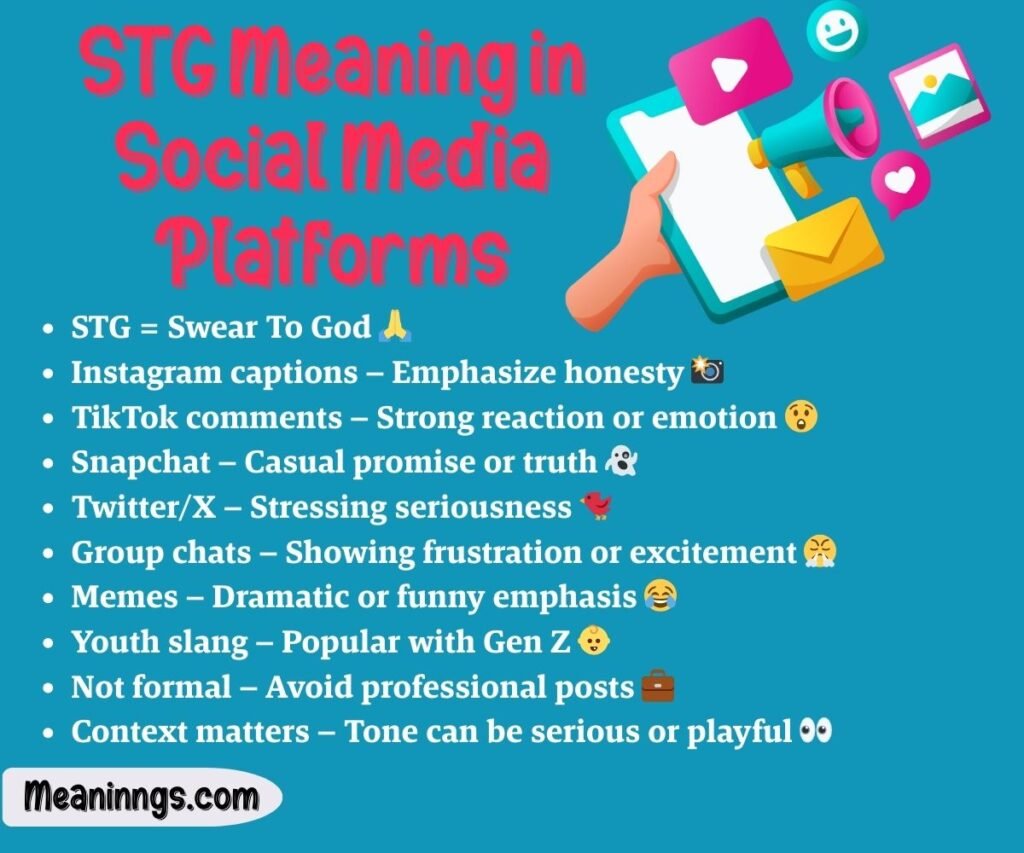
Each social platform brings unique context to STG usage:
STG on TikTok
On TikTok, STG appears frequently in video captions and comments to emphasize reactions, truth claims, or dramatic statements. Creators use it to express genuine excitement or frustration:
- “STG this trend is wild fr 😭”
- “If this doesn’t go viral, stg I’m quitting 😤”
The platform’s emotional, fast-paced nature makes STG perfect for capturing intense moments in short videos.
STG on Snapchat
Snapchat users incorporate STG in snaps, streaks, and direct messages. Common uses include:
- “STG I didn’t screenshot your story”
- “This filter makes me look insane stg 😂”
The temporary nature of Snapchat content encourages casual, authentic expression where STG fits naturally.
STG on Instagram
Instagram sees STG in comments, DMs, and occasionally captions. Influencers and regular users employ it to add authenticity and conviction:
- “Just six months of commitment, stg look at these results! 💪”
- “This makeup look took hours but worth it stg”
Beauty, fitness, and comedy influencers use STG frequently to emphasize sincerity and build trust with followers.
STG on Twitter/X
Twitter users deploy STG in tweets and replies to express strong opinions, frustrations, or humorous observations:
- “STG people be too dramatic 💀”
- “This show just ended on a cliffhanger, stg I can’t wait a week 😭”
The platform’s conversational, opinionated culture makes STG a natural fit for emphasizing viewpoints.
Tone Variations of STG (How the Emotion Changes)
STG’s meaning shifts dramatically based on emotional delivery:
Sincere/Honest: “STG I would never lie to you” – genuine promise-making
Defensive: “STG I didn’t say that!” – protecting reputation when accused
Frustrated: “STG this traffic is unbearable” – expressing annoyance
Excited: “STG this is the best day ever! 🎉” – celebrating happiness
Dramatic/Exaggerated: “STG I will die if you don’t come” – playful hyperbole
Grateful: “You’re a lifesaver, stg thank you” – sincere appreciation
The surrounding context, punctuation, and emojis help readers interpret which emotional tone the sender intends.
STG vs Similar Slang Terms
Understanding related acronyms helps distinguish STG’s unique role:
| Term | Full Meaning | Key Difference |
| ISTG | I Swear To God | Adds “I” at the beginning, making it more personal and first-person specific |
| ISTFG | I Swear To F***ing God | Includes explicit language for stronger emphasis, more aggressive tone |
| OMG | Oh My God | Expresses surprise or shock rather than truthfulness or sincerity |
| NGL | Not Gonna Lie | Prefaces honest opinions but less emphatic than STG |
| FR | For Real | Confirms truth or agreement, similar but less intense than STG |
| No Cap | No Lie | Urban slang equivalent meaning complete honesty |
| On God | On God | AAVE phrase with identical meaning to STG |
While these terms overlap in expressing honesty or emotion, STG specifically emphasizes oath-taking sincerity.
Should You Use STG in Professional Messages?
The short answer: No. STG belongs strictly in casual, informal communication.
Why STG Fails Professionally:
Appears Immature: Professional environments value clear, formal language. Slang suggests lack of seriousness or polish.
Confuses Recipients: Not everyone knows current texting acronyms. Older colleagues or international clients may not understand STG.
Undermines Credibility: Saying “STG I’ll send the report soon” sounds unprofessional compared to “I assure you the report will be delivered on schedule.”
Cultural Insensitivity: Religious colleagues may find casual invocation of God inappropriate in business contexts.
Professional Alternatives:
- “I assure you…”
- “You have my word…”
- “I promise…”
- “With complete sincerity…”
- “Truthfully…”
- “Honestly…”
These phrases convey the same emphasis on honesty while maintaining professional standards. Save STG for texts with friends, family, and peers in casual settings.
Cultural Notes on “Swear To God”
The phrase “Swear to God” has deep cultural and religious roots predating internet slang:
Historical Context: Oath-taking has existed for millennia across cultures, with invoking deity names adding sacred weight to promises. In many religions, such oaths carry serious spiritual consequences for dishonesty.
Religious Significance: Christianity, Islam, and Judaism all have teachings about taking God’s name in vain or making false oaths. Some believers avoid the phrase entirely, viewing casual usage as disrespectful.
Cultural Evolution: What once represented a solemn, legally-binding oath has transformed into casual internet slang. This shift reflects broader changes in how younger generations use language – prioritizing expressiveness and efficiency over traditional formality.
Global Variations: Different cultures have equivalent expressions:
- British slang: “I swear down”
- AAVE: “On God” or “On everything”
- General alternatives: “Cross my heart,” “Hand to heart”
Understanding this cultural background helps explain both STG’s power and why some find it problematic.
Custom Example Sentences Using STG
Here are diverse examples showing STG’s versatility across situations:
- “STG I studied all night for this exam 📚”
- “If he cancels plans again, stg I’m done 😤”
- “This burger is amazing, stg best I’ve ever had 🍔”
- “STG I heard strange noises last night 👀”
- “You won’t believe what happened, stg it was insane”
- “STG time moves slower on Mondays than any other day”
- “I can’t deal with this drama, stg I’m staying out of it”
- “STG my cat just knocked over my coffee AGAIN 😭”
- “This movie deserves an Oscar, stg it’s incredible”
- “STG I finished that entire series in one night 🎬”
When You Should NOT Use STG
Certain situations absolutely require avoiding STG:
Formal Academic Writing: Essays, research papers, thesis documents, and academic reports demand formal language without slang abbreviations.
Professional Emails: Communication with bosses, clients, colleagues, or potential employers should maintain professional tone.
Official Documents: Legal forms, contracts, resumes, cover letters, and business proposals require standard English.
Religious Settings: Out of respect for those with strong faith, avoid casual religious references in spiritual contexts.
First Impressions: When meeting someone new professionally or socially, err toward formal communication until you gauge their communication style.
Cross-Cultural Communication: International audiences or non-native English speakers may not understand internet slang.
Serious Conversations: Discussions about grief, illness, or sensitive topics deserve sincere, unabbreviated language showing proper respect.
Public Speaking: Presentations, speeches, or recorded videos to broad audiences should avoid casual slang that may confuse or offend.
Long Explanation: The Psychology Behind Slang Like STG
Internet slang like STG reveals fascinating insights into human communication psychology:
Need for Efficiency: Digital communication favors brevity. Humans naturally seek faster ways to express complex emotions, making abbreviations psychologically satisfying.
Tribal Identity: Using specific slang creates in-group belonging. When people share language codes, they signal membership in communities (Gen Z, gamers, social media users).
Emotional Amplification: Plain text lacks vocal tone and body language. Slang terms like STG compensate by adding emotional intensity that might otherwise be lost.
Authenticity Seeking: Modern communication values realness over formality. STG and similar terms signal genuine, unfiltered expression rather than polished corporate-speak.
Cognitive Ease: Familiar abbreviations require less mental processing. Once learned, STG becomes automatic, speeding up both writing and reading.
Social Bonding: Shared slang creates connection. Understanding and using the same terms signals cultural awareness and builds rapport between communicators.
This psychological foundation explains why slang evolves constantly and why terms like STG spread rapidly across platforms and demographics.
The Linguistic Structure of STG
From a linguistic perspective, STG demonstrates several interesting properties:
Classification: STG functions as an initialism – each letter is pronounced individually (“ess-tee-gee”) rather than as a word. This distinguishes it from acronyms like “NASA” that form pronounceable words.
Part of Speech: When meaning “Swear To God,” STG operates as an interjection – a word or phrase expressing emotion inserted into sentences without grammatical connection.
Syntactic Flexibility: STG can appear at the beginning (“STG I didn’t do it”), middle (“I didn’t, stg, say anything”), or end (“I didn’t do it stg”) of sentences without changing core meaning.
Semantic Evolution: The term underwent semantic bleaching – losing its original religious intensity to become a general emphatic marker. This linguistic process occurs when words/phrases lose specific meaning through overuse.
Code-Switching: Users toggle between “STG” in casual contexts and full “swear to God” or formal alternatives in professional settings, demonstrating linguistic register awareness.
Does STG Mean the Same in All Countries?
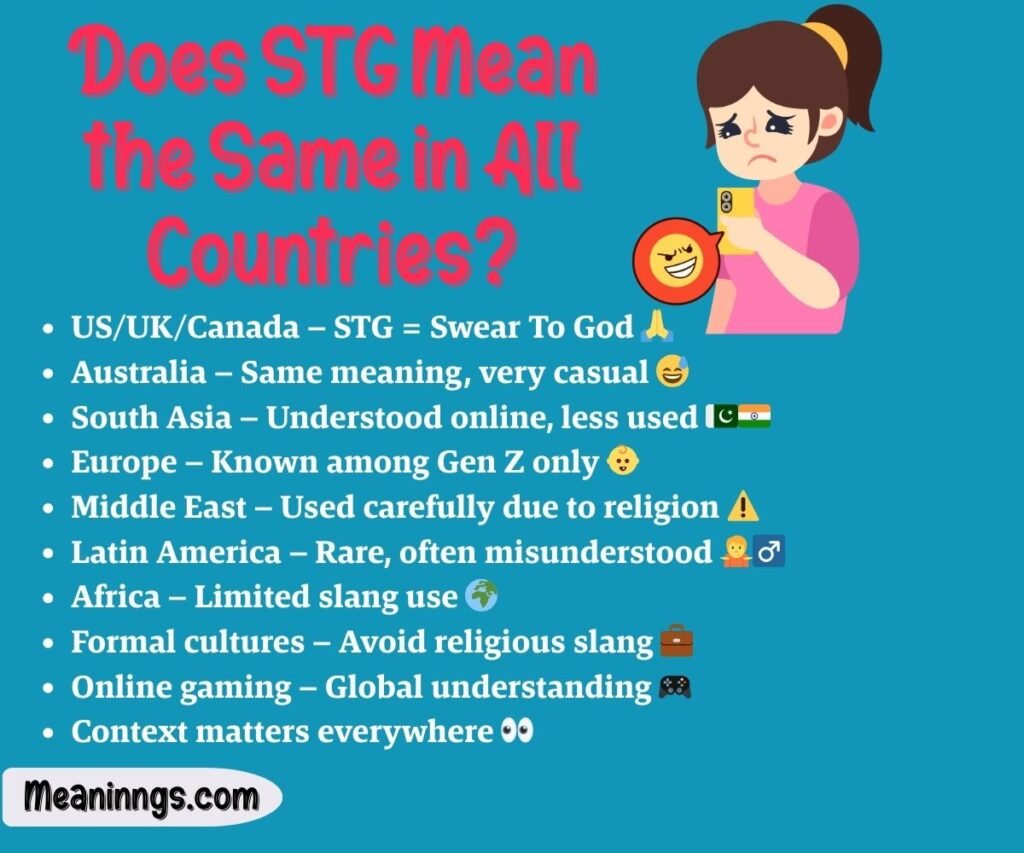
While STG originated in English-speaking internet culture, its usage varies globally:
United States: STG enjoys widespread usage among younger demographics across all social platforms.
United Kingdom: British users understand STG but also use “I swear down” as a cultural equivalent.
Australia/New Zealand: English-speaking countries adopt STG similarly to American usage.
Non-English Speaking Countries: In regions where English isn’t primary, STG appears mainly among younger, internet-savvy users familiar with English slang. However, many people won’t recognize it.
Translation Challenges: STG doesn’t translate directly to other languages. Each culture has its own oath-taking expressions that serve similar functions but use different linguistic structures.
Cultural Sensitivity: In conservative or religiously strict regions, even the English STG might be viewed more seriously than in Western secular contexts.
Global digital communication means STG spreads internationally, but understanding remains strongest in English-speaking countries and among bilingual internet users.
Full Summary Table of STG Meanings
| Meaning | Context | Example Usage | Frequency |
| Swear To God | Casual texting, social media | “STG I didn’t do it” | Very Common |
| Shoot ‘Em Up (Gaming) | Video game discussions | “Classic STG games are underrated” | Moderate |
| Sterling (Currency) | Financial documents | “Price: 500 STG” | Moderate |
| Security Threat Group | Law enforcement | “Monitor STG activities” | Rare |
| Standard Gauge | Railway/Engineering | “Track uses STG specifications” | Rare |
| Set The Ground | Project planning | “Let’s STG for this initiative” | Very Rare |
| Saint George | Religious/Historical | “Feast of STG” | Very Rare |
| Special Task Group | Military/Corporate | “STG deployment authorized” | Rare |
How to Use STG Safely and Correctly?
Follow these guidelines for appropriate STG usage:
Know Your Audience: Only use STG with people who understand internet slang. Friends, peers, and fellow social media users work; bosses, clients, and strangers don’t.
Match the Platform: STG fits naturally on Snapchat, TikTok, Instagram, and Twitter. It sounds out of place in LinkedIn messages or professional emails.
Consider Cultural Context: Be mindful that some people find casual religious references offensive. When in doubt, choose neutral alternatives.
Don’t Overuse: Excessive STG usage dilutes its impact. Reserve it for moments requiring genuine emphasis.
Pair with Context Clues: Emojis, punctuation, and surrounding words help convey intended tone, reducing misinterpretation risk.
Respect Professional Boundaries: Keep STG completely separate from work communications, academic submissions, and formal settings.
Be Authentic: Use STG when you genuinely mean to emphasize something, not as filler text. Authenticity maintains the term’s emotional power.
FAQ’s
What does STG mean in text?
STG means “Swear To God” – a phrase emphasizing truthfulness, sincerity, or strong emotion in casual digital communication.
Is STG rude?
Not inherently, but context matters. STG is casual slang inappropriate for professional settings, and some religious individuals may find it disrespectful.
What is the difference between STG and ISTG?
ISTG means “I Swear To God,” adding the pronoun “I” at the beginning. Both convey the same meaning with ISTG being slightly more personal and first-person specific.
Should I use STG in professional messages?
No. STG belongs strictly in casual communication. Professional environments require formal language like “I assure you” or “you have my word.”
Is STG a Gen Z slang term?
Yes, STG is particularly popular among Gen Z and Millennials, though it emerged from broader internet culture and texting evolution over the past two decades.
Conclusion
STG has evolved from a serious religious oath into versatile internet slang that dominates casual digital communication. While “Swear To God” remains its primary meaning, context determines whether STG refers to shooting games, currency, or other specialized terms.
Understanding when and how to use STG enhances your digital communication skills. The acronym works perfectly for emphasizing honesty, expressing emotions, and connecting with peers in informal settings. However, professional environments, formal writing, and cross-cultural communication require more appropriate alternatives.

Muhammad Shoaib is a language-focused content writer and researcher at Meaninngs.com, where he explains the meaning of words, phrases, and text in a clear and reader-friendly way. His work focuses on simplifying language, uncovering context, and helping readers understand text with confidence and clarity.