In today’s digital world, abbreviations have revolutionized how we communicate. Among the most popular is “TYSM,” a term you’ve likely encountered across social media, texts, and online chats. This guide explains everything you need to know about TYSM and how to use it effectively.
What Does “TYSM” Mean in Text?
TYSM stands for “Thank You So Much.” It’s a casual, friendly abbreviation expressing gratitude in digital conversations. Unlike a simple “thanks,” TYSM adds extra appreciation and warmth.
The acronym uses the first letter of each word: Thank You So Much.
This text abbreviation emerged in the early 2000s when SMS messaging had character limits, pushing users to create shorter expressions.
Why People Use “TYSM” (And Not Just “Thanks”)
People choose TYSM over standard phrases for several reasons:
- Speed: Four letters beat typing the full phrase
- Character limits: Saves space on platforms like Twitter
- Casual tone: Creates a friendly, approachable vibe
- Emotional emphasis: Shows stronger gratitude than simple “thanks”
- Digital culture: Demonstrates familiarity with modern communication
Emotional Meaning Behind TYSM
TYSM carries significant emotional weight despite being just an abbreviation. It conveys genuine appreciation, enthusiasm, personal connection, and positive energy. However, context matters—paired with the wrong emoji, it can accidentally sound sarcastic.
How to Use TYSM in Real Conversations (With Examples)
TYSM works best in casual, friendly exchanges:
- Friend helping: “Can you send me the notes?” → “Sure!” → “TYSM! You’re a lifesaver 🙏”
- Social media: “Loved your post!” → “TYSM!! That means so much 💕”
- Quick acknowledgment: “Forwarded the file” → “Got it, TYSM!”
- Expressing support: “Hope you feel better” → “TYSM for checking in 🥺”
Variations of TYSM You May See Online
The internet has spawned several variations of TYSM, each with subtle differences in tone and intensity:
| Acronym | Full Form | Tone | When to Use |
| TY | Thank You | Neutral, casual | Quick, simple thanks |
| THX | Thanks | Very casual | Gaming, quick replies |
| TYSM | Thank You So Much | Warm, emphatic | Genuine appreciation |
| TYVM | Thank You Very Much | Polite, slightly formal | More refined gratitude |
| TYSVM | Thank You So Very Much | Extra enthusiastic | Deep gratitude |
| TYT | Take Your Time | Informative | Giving someone space |
Is TYSM Formal or Informal?
TYSM is decidedly informal. Use it for:
✅ Personal texts, social media, casual workplace chats (Slack/Teams), gaming communities ❌ Formal business emails, professional correspondence, academic papers, first-time professional interactions
Golden rule: When in doubt, spell out “Thank you so much.”
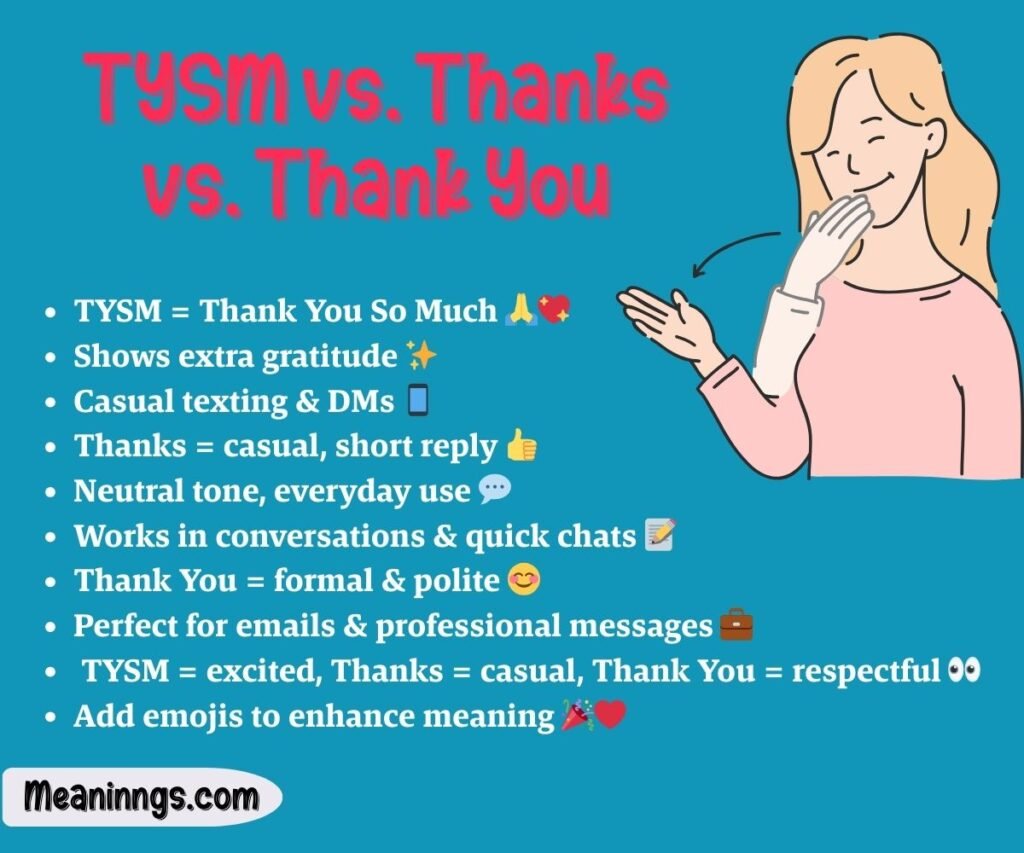
TYSM vs. Thanks vs. Thank You — What’s the Difference?
| Expression | Formality | Best For |
| Thank you | Most formal | All contexts, professional settings |
| Thanks | Moderately casual | Everyday situations, semi-professional |
| TYSM | Very casual | Close friends, informal digital chats |
When to Use TYSM (Situational Examples)
1. When Someone Helps You
“Made it through security! TYSM for the ride this morning 🙏”
2. When Someone Sends You Useful Info
“Downloaded the study guide. TYSM! Exactly what I needed 📚”
3. When You’re Really Grateful
“Your advice helped so much. TYSM for listening ❤️”
4. When You Want to Sound Friendly
“TYSM! I was nervous about posting that 😊”
5. When You’re Appreciating Kindness
“The soup was delicious! TYSM for thinking of me 🥰”
When NOT to Use TYSM
Avoid TYSM in:
- Job applications or professional interviews
- Formal business emails and correspondence
- With people unfamiliar with internet slang
- Serious or somber situations
- Academic submissions
- First professional impressions
What TYSM Does Not Mean
TYSM almost always means “Thank You So Much.” It’s not a username, gaming tag, or different acronym—the meaning is consistent across platforms globally.
Alternative Phrases Similar to TYSM
Casual alternatives:
- “Thanks so much!”
- “Appreciate it!”
- “You’re the best!”
More formal:
- “Thank you so much”
- “I really appreciate it”
- “Thanks a million”
Deeper gratitude:
- “I can’t thank you enough”
- “I’m so grateful”
- “This means the world”
Cultural & Social Usage of TYSM
TYSM has achieved global recognition, transcending cultural boundaries. While originating in English-speaking communities, it’s now understood worldwide. The US and UK use it frequently, and young people globally incorporate it into multilingual conversations, creating a shared digital dialect.
Why Does TYSM Feel More Heartfelt?
Despite being four letters, TYSM often feels genuine because:
- It balances efficiency with emotion in digital spaces
- Uses peer language that creates connection
- Maintains enthusiasm without sounding stiff
- Represents modern sincerity through casual expression
TYSM in Social Media Context
Comments, DMs, story replies, and captions thanking followers
TikTok
Creator responses to fans, video captions, and collaboration acknowledgments
Snapchat
Quick snap replies and casual chat messages
Twitter/X
Thanking for retweets, mentions, and shoutouts
YouTube Comments
Thanking creators for tutorials or responding to helpful replies
How Teens Commonly Use TYSM?
Teens use TYSM multiple times daily with distinct patterns:
- Almost always paired with emojis (🙏, 💕, 😊, 🥺)
- Often emphasized as “tysmmmm” or “TYSM!!!”
- Mixed with other slang naturally
- Frequency varies by platform (higher on Instagram/TikTok)
Examples of TYSM in Context (With Scenarios)
Scenario 1: Asking for a Favour
Alex: “Can you cover my shift tomorrow?” Jordan: “Yeah, no worries!” Alex: “TYSM! I owe you 🙏”
Scenario 2: Receiving a Compliment
Sarah: “Your presentation was incredible!” Maya: “TYSM!! I was so nervous 🥺💕”
Scenario 3: After Getting Help
User: “It’s still not working 😭” Helper: “Try restarting your router” User: “IT WORKED!! TYSM you’re a legend 🎉”
Scenario 4: Supportive Conversation
Emma: “If you need to talk, I’m here ❤️” Liam: “TYSM, means a lot 🙏”
Misinterpretations People Often Make
- Overuse: Using TYSM constantly dilutes its meaning
- Tone issues: Without emojis, can seem sarcastic
- Formality confusion: It’s not professional despite being an acronym
- Cultural gaps: Not everyone understands internet abbreviations
- Platform mistakes: Inappropriate on LinkedIn or professional networks
Is TYSM Used Globally?
Yes! TYSM enjoys international recognition. It’s widely used in English-speaking countries and understood by younger, internet-savvy individuals worldwide, even in multilingual conversations.
Linguistic Angle: How Slang Like TYSM Evolves
TYSM’s evolution illustrates language development patterns:
- Technology-driven: Character limits forced innovation
- Youth-led: Teens coined and popularized it
- Practical to cultural: Started as necessity, became identity
- Digital democratization: Spreads instantly without gatekeepers
Example Sentences Using TYSM
- “TYSM for the birthday wishes! 🎂”
- “Got the package! TYSM for sending it quickly! 📦”
- “Your notes saved my grade. TYSM! 🙏”
- “TYSM for believing in me 💪”
- “The recipe was amazing! TYSM for the tip! 👨🍳”
Common Emojis Used With TYSM
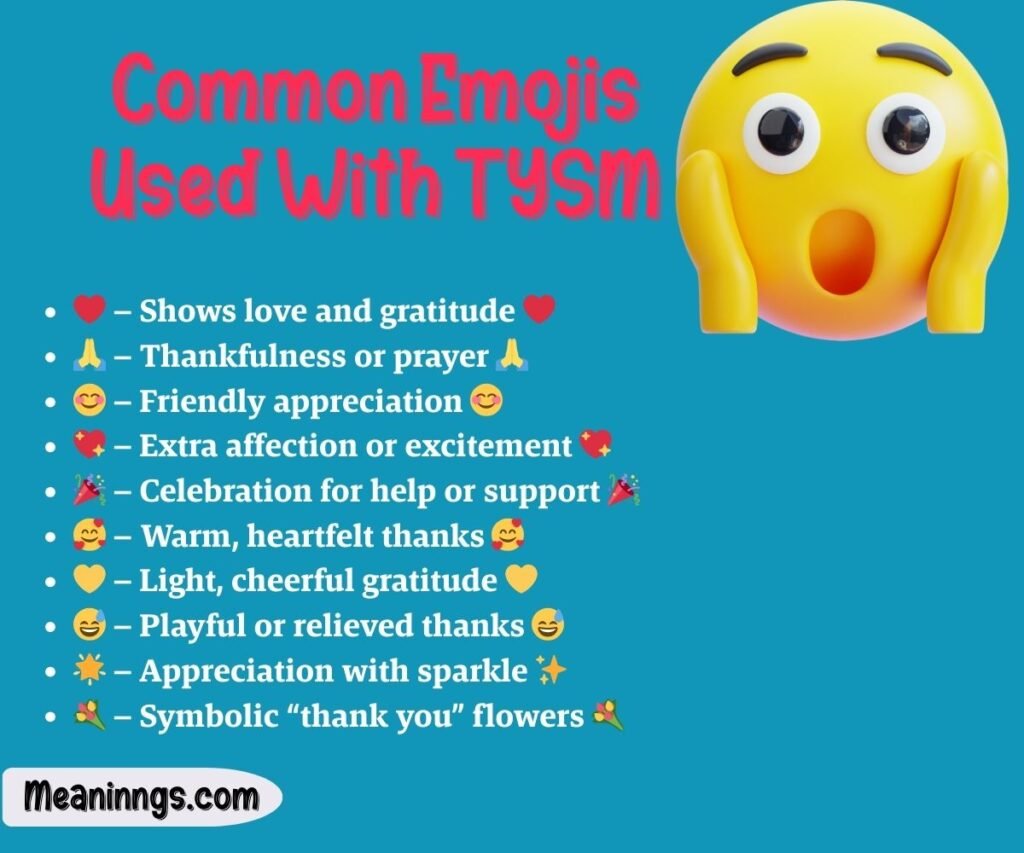
Popular pairings that add emotional context:
- 🙏 Prayer hands (sincere thanks)
- 💕 Two hearts (warm gratitude)
- 😊 Smiling face (friendly)
- 🥺 Pleading face (touched/emotional)
- ❤️ Red heart (deep appreciation)
- 🥰 Smiling with hearts (loving gratitude)
- 🙌 Raised hands (celebratory)
- ✨ Sparkles (extra positivity)
FAQ‘s
What does TYSM mean in text?
TYSM means “Thank You So Much” — a casual way to express gratitude in digital conversations.
Is TYSM rude or polite?
TYSM is polite and friendly but informal. It’s perfect for casual conversations but too casual for formal professional settings.
Can I use TYSM in professional messages?
Only in very casual internal workplace chats with colleagues you know well. For external communication or formal emails, use “Thank you so much” spelled out.
Is TYSM used worldwide?
Yes, TYSM is recognized globally, especially among younger, internet-savvy users across different countries and cultures.
What is the difference between TYSM and TY?
TY means “Thank You” (neutral and simple), while TYSM means “Thank You So Much” (warmer and more emphatic). TYSM shows stronger appreciation.
Conclusion
TYSM has become essential in modern digital communication, offering a quick, friendly way to express genuine gratitude. Remember: keep TYSM for casual conversations with friends and close colleagues, pair it with appropriate emojis, and save complete phrases for formal situations.
As digital communication evolves, abbreviations like TYSM remain valuable tools for efficient, authentic expression. By understanding when and how to use it, you’re participating in a global digital culture valuing both speed and sincerity. Next time someone helps you online, don’t hesitate—send a genuine “TYSM!” and keep digital communities connected and kind.

Muhammad Shoaib is a language-focused content writer and researcher at Meaninngs.com, where he explains the meaning of words, phrases, and text in a clear and reader-friendly way. His work focuses on simplifying language, uncovering context, and helping readers understand text with confidence and clarity.