Ever received a text with “mb” and paused to think—what does that even mean? You’re not alone. In the fast-paced world of digital communication, abbreviations like “mb” have become essential shortcuts that save time and keep conversations flowing naturally. Whether you’re texting with friends, commenting on social media, or chatting in online games, understanding “mb” can prevent awkward misunderstandings and help you communicate more effectively.
This comprehensive guide breaks down everything you need to know about “mb meaning in text”—from its most common interpretations to context clues that reveal which meaning applies. By the end, you’ll confidently navigate modern chat slang like a digital native.
The Many Meanings of “mb” in Texting
The abbreviation “mb” is surprisingly versatile, carrying multiple meanings depending on context, capitalization, and conversation topic. Let’s explore each interpretation to help you decode this popular acronym correctly.
Common Interpretations
Understanding the various meanings of “mb” is crucial for accurate digital communication. Here are the primary ways people use this two-letter abbreviation:
1. My Bad (Most Common) This represents the overwhelming majority of “mb” usage in casual texting. When someone types “mb,” they’re typically acknowledging a mistake or offering a lighthearted apology.
2. Maybe Less common but still prevalent, “mb” can stand for “maybe” when someone is uncertain or doesn’t want to commit to plans.
3. Megabyte In technical contexts, “MB” (usually capitalized) refers to a unit of digital storage measuring approximately 1,048,576 bytes.
4. Message Board/Mailbox Occasionally used in online communities to reference message boards or mailboxes, though this usage is becoming increasingly rare.
5. Motherboard Among tech enthusiasts and gamers, “mb” might refer to a computer’s motherboard, the main circuit board connecting all components.
Maybe: The “mb” of Uncertainty
When “mb” means “maybe,” it typically appears in planning conversations where someone wants to leave their response open-ended. This interpretation shows up frequently when:
- Making tentative plans
- Expressing uncertainty about availability
- Avoiding commitment while remaining polite
Example conversation:
- Friend: “Want to grab coffee tomorrow at 3?”
- You: “mb, I’ll let you know after I check my schedule”
This usage allows speakers to acknowledge a question without providing a definitive answer, maintaining conversational flow while buying time to decide.
My Bad: The Apology Version
“My bad” emerged from American basketball culture in the 1970s and 1980s, where players used it to quickly acknowledge mistakes during gameplay. By the 1990s, the phrase entered mainstream vocabulary, and with the rise of texting in the early 2000s, it naturally shortened to “mb.”
Today, “mb” as “my bad” serves as a casual, informal apology for minor mistakes or misunderstandings. It’s perfect for:
- Acknowledging small errors
- Taking responsibility without being overly formal
- Maintaining a lighthearted tone in conversations
Real-world examples:
- “Sent that to the wrong group chat, mb!”
- “Oh mb, I thought you meant Tuesday, not Thursday”
- “mb for the late response, been super busy”
Megabyte: The Technical Use
When “MB” appears capitalized in technical discussions, it almost certainly refers to megabytes—a measurement of digital storage capacity. This interpretation dominates in contexts involving:
- File sizes and downloads
- Data storage specifications
- Internet data usage
- Computer memory discussions
Technical context examples:
- “This video file is 250 MB”
- “You have 5 GB (5,000 MB) of cloud storage remaining”
- “The app requires 100 MB of free space”
MessageBoard / Mailbox: The Community Use
Though less common in 2026, some online communities still use “mb” to reference message boards or mailboxes. This usage appears primarily in:
- Forum discussions
- Email-related conversations
- Community platform references
Example: “Check the mb for the latest updates from the admin team”
Motherboard: For Tech Geeks
Within gaming and tech communities, “mb” might refer to a computer’s motherboard. This interpretation appears when discussing:
- PC building and hardware upgrades
- Troubleshooting computer issues
- Gaming rig specifications
Example: “Need to upgrade my mb before installing the new processor”
How to Determine Which Meaning Applies?
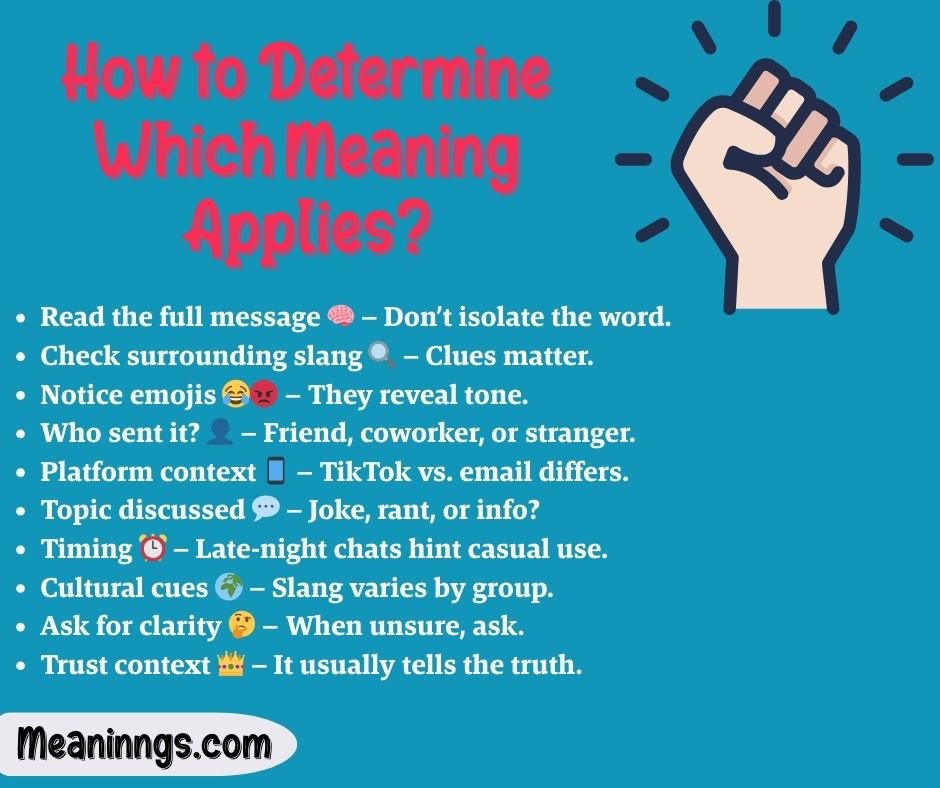
Context is everything when interpreting “mb.” Here are five reliable strategies to decode which meaning the sender intends:
1. Look at Capitalization
| Format | Likely Meaning | Context |
| mb | My bad or maybe | Casual texting, social media |
| MB | Megabyte | Technical discussions, file sizes |
| Mb | Megabit | Internet speed measurements |
Capitalization provides immediate clues. Lowercase “mb” typically signals conversational slang, while uppercase “MB” suggests technical terminology.
2. Consider the Conversation Topic
The subject matter dramatically influences meaning:
- Personal conversations: “My bad” or “maybe”
- Tech discussions: “Megabyte” or “motherboard”
- Planning messages: “Maybe”
- After mistakes: “My bad”
3. Position in the Sentence
Where “mb” appears in a message offers valuable context:
Beginning of sentence:
- “mb, thought the meeting was at 2” (my bad)
- “mb we can meet later?” (maybe)
Standalone:
- “mb” (usually my bad)
After numbers:
- “500 MB” (megabyte)
4. Tone and Emojis
Emojis and punctuation reveal emotional context:
- “mb 😅” → Apologetic (my bad)
- “mb 🤔” → Uncertain (maybe)
- “mb!” → Casual apology (my bad)
- “50 MB” → No emojis (technical)
5. Ask for Clarification
When genuinely confused, simply ask! Digital communication thrives on clarity, and most people appreciate when you seek to understand their message correctly.
Real-Life Examples and Conversations
Let’s examine authentic scenarios where “mb” appears naturally:
Scenario 1: Gaming Chat
- Player A: “Why didn’t you cover point B?”
- Player B: “mb, didn’t see the enemy flanking”
- Player A: “No worries, happens to everyone”
Scenario 2: Planning with Friends
- Alex: “Beach day Saturday?”
- Jordan: “mb, depends on weather”
- Alex: “Cool, let’s decide Friday”
Scenario 3: Tech Discussion
- User 1: “How big is the update?”
- User 2: “Around 2.5 GB, about 2,500 MB”
- User 1: “Okay, got enough storage”
Scenario 4: Social Media Comments
- Original Post: “Can’t believe you forgot my birthday!”
- Reply: “mb! 😭 I’ve been so swamped, making it up to you this weekend!”
Why “mb” Has Multiple Meanings
The evolution of digital language reflects our need for efficiency and speed in communication. Several factors contribute to “mb” having multiple meanings:
1. Natural Language Evolution Language constantly adapts to meet communication needs. As texting became prevalent, common phrases abbreviated naturally, with different communities developing their own interpretations.
2. Context-Dependent Communication Digital conversations rely heavily on context. The same abbreviation can serve multiple purposes because surrounding words, topics, and platforms provide disambiguation.
3. Cross-Cultural Adoption As internet slang spreads globally, abbreviations acquire new meanings across different communities, platforms, and generations.
4. Technical vs. Casual Divide The formal/informal split in digital communication creates parallel abbreviation systems—technical terms like “megabyte” coexist with casual slang like “my bad.”
Tips for Using “mb” Appropriately
Master these guidelines to use “mb” effectively across different contexts:
Do:
- Use lowercase “mb” for casual apologies
- Capitalize “MB” when discussing file sizes
- Include emojis to clarify tone (😅, 😊, 🤔)
- Consider your audience before using slang
- Keep it to informal conversations with friends
Don’t:
- Use “mb” in professional emails or formal communication
- Assume everyone understands the abbreviation
- Over-apologize by using “mb” for serious mistakes
- Use “mb” when a sincere apology is warranted
- Mix technical and casual uses in the same context
Platform-Specific Tips:
Snapchat/Instagram:
- “mb” works great in DMs and comments
- Pair with relevant emojis for clarity
- Perfect for acknowledging typos or late responses
WhatsApp/Text Messages:
- Ideal for quick apologies with friends and family
- Less appropriate for work-related group chats
- Works well in personal one-on-one conversations
Gaming Platforms:
- Essential for fast-paced team communication
- Use “mb” to acknowledge gameplay mistakes quickly
- Keeps chat efficient during intense matches
Professional Settings:
- Avoid “mb” in emails to colleagues or supervisors
- Use full phrases like “my apologies” or “I’m sorry”
- Reserve slang for very casual work channels only
Potential Misunderstandings or Pitfalls
Even common abbreviations can cause confusion. Watch out for these scenarios:
1. Cross-Generational Communication Older generations unfamiliar with texting slang might misinterpret “mb” or find it unprofessional. When communicating across age groups, consider spelling out phrases fully.
2. International Confusion Non-native English speakers might struggle with abbreviated slang. Be prepared to clarify when chatting with international friends.
3. Tone Misreading Text lacks vocal inflection, making tone difficult to gauge. “mb” might seem dismissive if not paired with appropriate emojis or follow-up messages.
4. Technical Confusion Mixing technical and conversational contexts can create confusion. Clearly distinguish between “MB” (megabyte) and “mb” (my bad) through capitalization.
5. Over-Casualness in Wrong Settings Using “mb” in formal or professional contexts appears unprofessional and can damage credibility.
The Linguistic Perspective: Why Short Forms Matter
From a linguistic standpoint, abbreviations like “mb” represent fascinating developments in language evolution. Understanding why these forms matter helps appreciate their role in modern communication:
Communication Efficiency Digital platforms often impose character limits (Twitter’s original 140 characters, SMS message lengths). Abbreviations maximize information density, allowing richer communication within constraints.
Social Identity Markers Using current slang signals group membership and cultural awareness. “mb” marks speakers as digitally fluent, particularly among younger generations.
Speed and Convenience In fast-paced digital conversations—particularly gaming or group chats—typing speed matters. Two-letter abbreviations facilitate quick responses without sacrificing meaning.
Emotional Economy Short forms like “mb” feel less heavy than formal apologies. They acknowledge mistakes while maintaining conversational lightness, preserving relationship dynamics.
Cognitive Processing Frequent abbreviations become automatically processed by regular users, requiring no conscious translation. This cognitive efficiency makes digital conversations feel more natural.
Comparing “mb” with Other Common Abbreviations
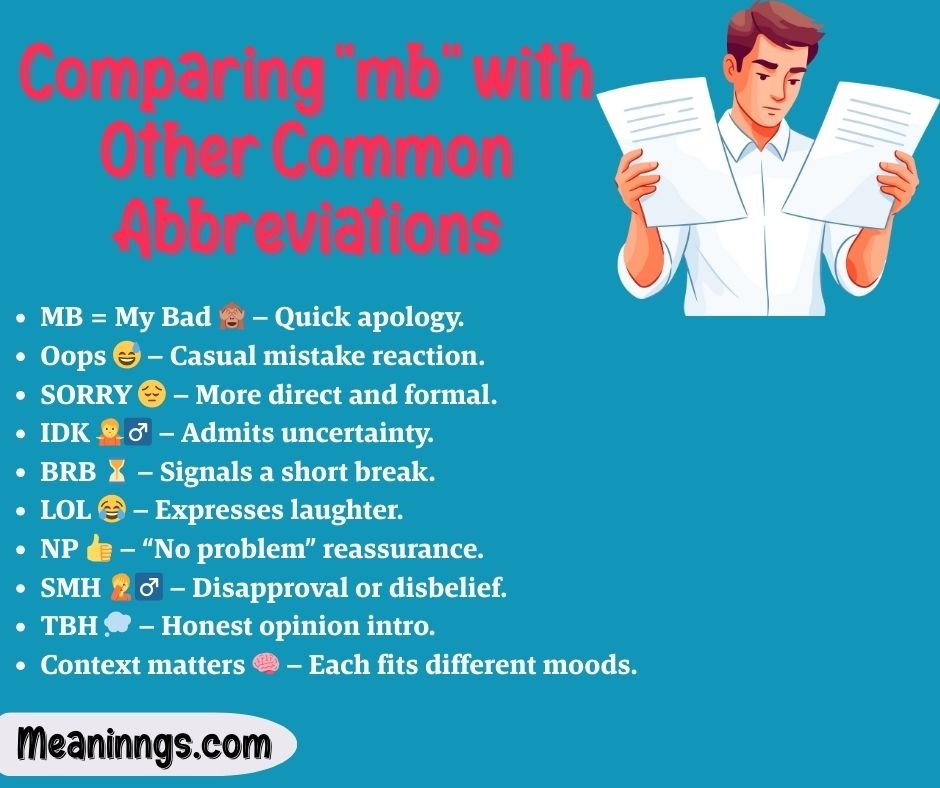
Understanding “mb” becomes clearer when compared to similar texting abbreviations:
| Abbreviation | Full Form | Primary Use | Formality Level |
| mb | My bad | Casual apology | Very informal |
| sry/sorry | Sorry | General apology | Informal |
| np | No problem | Accepting apology | Very informal |
| lol | Laugh out loud | Expressing humor | Very informal |
| brb | Be right back | Leaving temporarily | Very informal |
| btw | By the way | Introducing topic | Informal |
| tbh | To be honest | Being candid | Informal |
| idk | I don’t know | Expressing uncertainty | Very informal |
| nvm | Never mind | Retracting statement | Very informal |
Key Differences:
- “mb” specifically acknowledges fault, while “sry” is more general
- “mb” feels more casual than “sorry,” making it perfect for minor mistakes
- Unlike “idk” (uncertainty about facts), “mb” (as maybe) expresses uncertainty about plans
When “mb” Is Less Likely to Mean What You Think
Certain contexts make specific interpretations unlikely:
“mb” Probably ISN’T “my bad” when:
- Discussing computer hardware or specifications
- Talking about file sizes or data storage
- Following a number (e.g., “500 mb”)
- Appearing in all caps as “MB”
- Discussing internet speeds
“mb” Probably ISN’T “maybe” when:
- Following an apology or acknowledgment of error
- Responding to someone pointing out a mistake
- Paired with apologetic emojis (😅, 😬, 🙈)
- In gaming contexts after a team mistake
“mb” Probably ISN’T “megabyte” when:
- Written in lowercase during casual conversation
- Paired with casual language or emojis
- Appearing at the start of a sentence
- Not preceded by numbers
Real-World Advice for Everyday Use
Practical tips for incorporating “mb” into your digital vocabulary naturally:
For Beginners: Start using “mb” in casual texts with close friends who use similar slang. Observe how others use it before expanding to wider groups.
For Parents and Educators: Understanding teen slang helps monitor digital safety without seeming out of touch. “mb” typically indicates normal, harmless conversation.
For Non-Native Speakers: Master common abbreviations like “mb” to sound more natural in English digital conversations. Context clues matter more than memorizing every possible meaning.
For Professionals: Keep slang and professional communication separate. Save “mb” for personal chats; use proper language in work contexts.
For Gamers: Embrace “mb” as essential team communication. Quick acknowledgments keep gameplay smooth and maintain team morale.
Why Understanding “mb meaning in text” Is Useful?
Grasping digital abbreviations offers several practical benefits:
1. Prevents Miscommunication Correctly interpreting “mb” avoids confusion and keeps conversations flowing smoothly.
2. Enhances Digital Fluency Understanding common slang helps you navigate online spaces confidently and connect with diverse communities.
3. Improves Social Connections Using appropriate abbreviations signals you’re culturally aware and makes digital interactions feel more natural.
4. Saves Time Once familiar with common abbreviations, you can communicate faster without sacrificing clarity.
5. Bridges Generational Gaps Parents and educators who understand teen slang can better connect with younger generations and monitor digital safety effectively.
A Deeper Look: Psychology of Text Abbreviations
Why do abbreviations like “mb” resonate so strongly in digital communication? Psychology offers insights:
Cognitive Load Reduction Abbreviations reduce typing effort and reading time, making conversations feel effortless and maintaining engagement.
Informal Intimacy Casual language creates psychological closeness. Using “mb” instead of formal apologies signals comfortable, friendly relationships.
Emotional Buffer Short forms like “mb” provide emotional distance, making acknowledgment of mistakes feel less heavy or awkward.
Group Identity Shared slang reinforces community belonging. Using “mb” correctly signals membership in digital-native communities.
Efficiency Bias Our brains prefer efficient communication. Abbreviations satisfy this preference, making interactions feel more rewarding.
Example Sentences Using “mb”
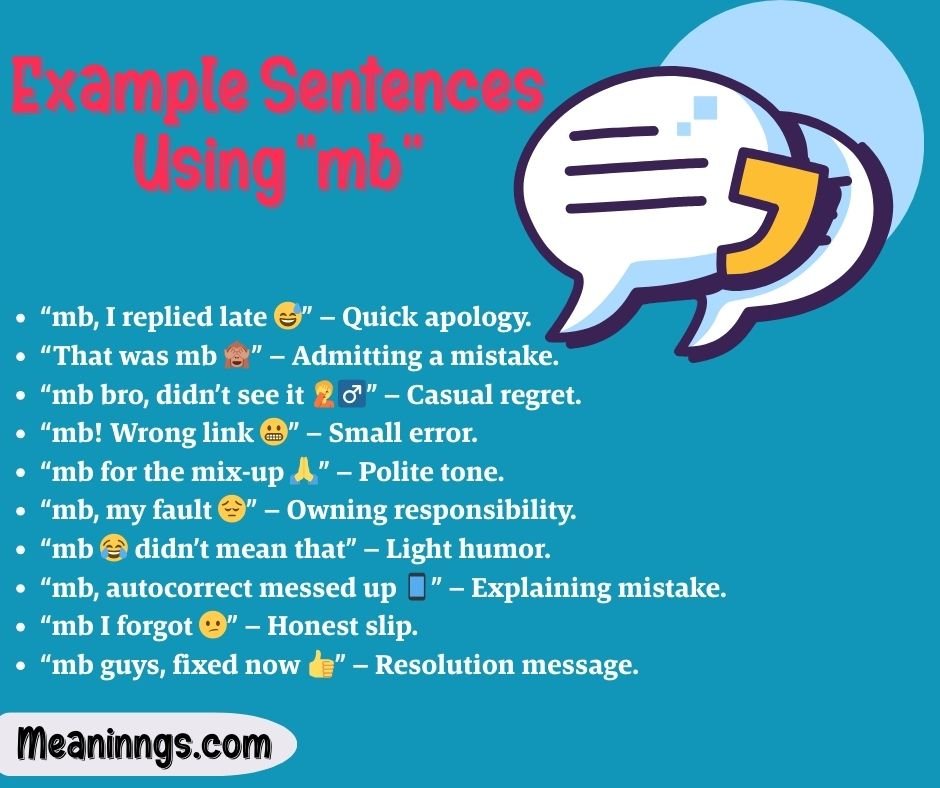
Practice recognizing “mb” in various contexts:
As “My Bad”:
- “mb, completely forgot we had plans today 😅”
- “That was my fault, mb for the confusion”
- “mb! Wrong person, meant to send that to Jake”
- “Didn’t save your number, mb for not texting back”
- “mb if that sounded harsh, didn’t mean it that way”
As “Maybe”:
- “mb we could try that new restaurant?”
- “Can you come to the party?” “mb, depends on work”
- “mb next weekend works better for everyone?”
As “Megabyte”:
- “The photo is 5 MB, too large to email”
- “Free up at least 500 MB before updating”
- “This song is only 3 MB, downloads fast”
When to Avoid Using “mb”
Recognize situations where “mb” isn’t appropriate:
Definitely Avoid:
- Job applications or cover letters
- Professional emails to supervisors or clients
- Formal business communications
- Academic papers or essays
- Serious apologies for significant mistakes
- Communications with people unfamiliar with texting slang
- First impressions with new professional contacts
Use Cautiously:
- Casual work chats (gauge workplace culture first)
- Communications with older relatives
- International conversations (translation issues possible)
- Situations requiring sincere, heartfelt apologies
Safe to Use:
- Personal texts with friends and family
- Social media comments and DMs
- Gaming chats and community forums
- Casual group chats
- Conversations with peers who use similar slang
Summary of Key Insights
Let’s recap the essential points about “mb meaning in text”:
Core Meanings:
- Primary: “My bad” (casual apology for small mistakes)
- Secondary: “Maybe” (expressing uncertainty in plans)
- Technical: “Megabyte” (data storage measurement)
- Niche: “Motherboard,” “message board,” or “mailbox”
Interpretation Tips:
- Capitalization matters: lowercase = slang, uppercase = technical
- Context determines meaning: conversation topic, position, emojis
- When uncertain, ask for clarification
Best Practices:
- Keep “mb” to informal, casual conversations
- Match your communication style to your audience
- Pair with emojis to clarify tone
- Avoid in professional or formal settings
Why It Matters: Understanding “mb” prevents miscommunication, enhances digital fluency, and helps you connect naturally in modern online spaces.
Related Terms to Explore
Expand your digital vocabulary with these related abbreviations:
Similar Apology Terms:
- sry/sorry – More formal than “mb”
- my fault – Accepts responsibility directly
- oops – Acknowledges small mistakes playfully
Uncertainty Expressions:
- idk – “I don’t know”
- nvm – “Never mind”
- idc – “I don’t care”
Common Texting Slang:
- lol – “Laugh out loud”
- brb – “Be right back”
- btw – “By the way”
- tbh – “To be honest”
- imo/imho – “In my opinion/In my humble opinion”
Technical Terms:
- GB – Gigabyte (1,024 MB)
- KB – Kilobyte (1,024 bytes)
- Mbps – Megabits per second (internet speed)
FAQ’s
What does MB mean when a girl texts it?
Usually “my bad” (acknowledging a mistake) or “maybe” (expressing uncertainty), depending on context.
Is MB rude in text messages?
Not typically rude—”mb” is casual and friendly. However, it might seem dismissive if used for serious mistakes requiring sincere apologies.
Can I use MB in professional emails?
Avoid “mb” in professional settings. Use full phrases like “my apologies” or “I apologize” for workplace communication.
What’s the difference between mb and MB?
Lowercase “mb” typically means “my bad” or “maybe” in casual texts. Uppercase “MB” usually refers to megabytes in technical contexts.
How do you respond when someone says mb?
Casually accept with responses like “np” (no problem), “all good,” “no worries,” or simply acknowledge and move forward.
Does mb always mean my bad?
No—context determines meaning. “mb” can mean “maybe,” “megabyte,” or other interpretations depending on capitalization and conversation topic.
When did mb become popular in texting?
The abbreviation gained traction in the early 2000s with the rise of text messaging and became widespread through online gaming communities.
Is mb used on all social media platforms?
Yes—”mb” appears across Snapchat, Instagram, TikTok, Twitter, gaming platforms, and messaging apps like WhatsApp and Discord.
Final Thoughts
Mastering “mb meaning in text” opens doors to more confident, natural digital communication. Whether you’re apologizing with “mb” after a small mistake, expressing uncertainty about plans, or discussing file sizes, understanding context ensures you interpret and use this versatile abbreviation correctly.
Digital language continues evolving rapidly, with new slang emerging constantly. Staying informed about common abbreviations like “mb” helps you remain culturally aware, communicate effectively across platforms, and connect authentically with diverse online communities.

Muhammad Shoaib is a language-focused content writer and researcher at Meaninngs.com, where he explains the meaning of words, phrases, and text in a clear and reader-friendly way. His work focuses on simplifying language, uncovering context, and helping readers understand text with confidence and clarity.